Stay informed with our newsletter.
.webp)


EN





Two groundbreaking developments are redefining technology and scientific exploration. Europe's ASML and ZEISS are developing Hyper NA lithography, a next-generation semiconductor manufacturing system capable of producing smaller, more efficient circuitry. Meanwhile, NASA's James Webb Space Telescope has identified the host galaxy of the most distant fast radio burst ever observed, dating to approximately three billion years after the Big Bang. Together, these advances demonstrate humanity's expanding ability to investigate microscopic structures and distant cosmic mysteries.
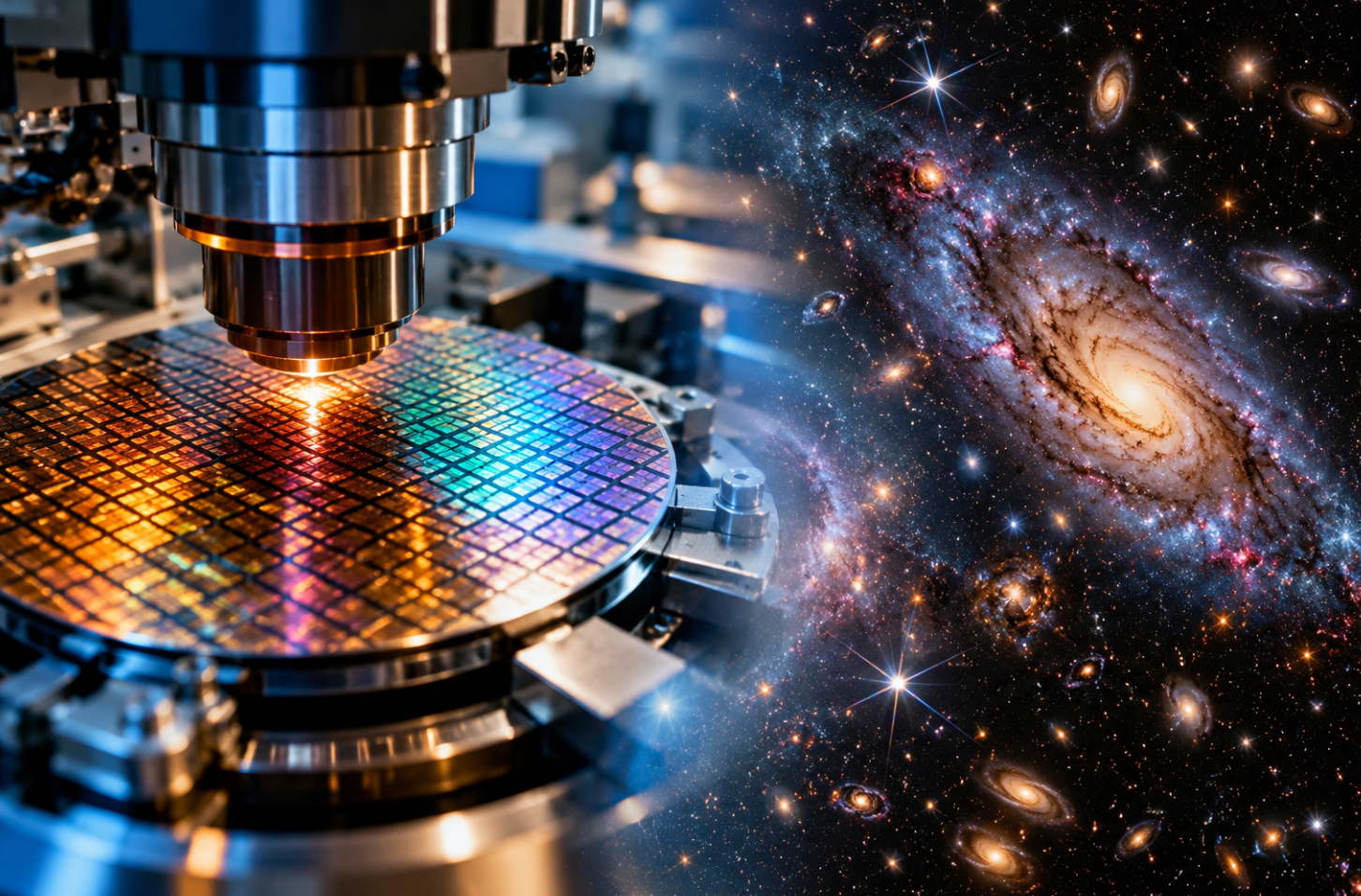
The boundaries of modern technology and scientific exploration are being pushed further than ever. Two remarkable developments announced in October 2026 highlight humanity’s determination to explore the smallest structures of matter and the most distant reaches of the universe.
In Europe, semiconductor equipment manufacturer ASML and optical technology specialist ZEISS are developing a revolutionary chipmaking technology that could reshape the future of electronics. Meanwhile, astronomers using the James Webb Space Telescope have identified the host galaxy of the most distant fast radio burst ever recorded, revealing new clues about mysterious cosmic phenomena.
Although these breakthroughs belong to different scientific disciplines, they share a common ambition: overcoming technological limitations to unlock discoveries once considered impossible.
The semiconductor industry is approaching another technological milestone as Dutch manufacturer ASML, working alongside Germany's Carl Zeiss, explores a next-generation lithography system known as Hyper NA.
According to research reported by Reuters on October 8, 2026, the technology could become operational within approximately 10 years, potentially enabling manufacturers to produce semiconductor circuitry significantly smaller than current advanced systems allow.
The development represents an important step in the evolution of extreme ultraviolet (EUV) lithography, a manufacturing process essential to producing sophisticated microprocessors.
Modern semiconductor chips contain billions of microscopic transistors responsible for processing information. As electronic devices become more powerful, manufacturers must continue increasing transistor density while controlling energy consumption and heat generation.
Hyper NA aims to address these challenges by improving the precision with which microscopic circuit patterns are transferred onto silicon wafers.
Researchers believe the system could print features measuring approximately 5 nanometers, more than one-third smaller than the capabilities of ASML's existing High NA technology.
Such precision could help manufacturers develop faster, more energy-efficient processors for smartphones, computers, automobiles, telecommunications infrastructure, and advanced industrial equipment.
Lithography is one of the most technically demanding stages of semiconductor production.
The process involves projecting intricate circuit patterns onto silicon wafers using specialized light and extraordinarily precise optical components.
ASML's existing EUV machines already represent some of the most sophisticated manufacturing equipment ever developed.
Its advanced systems are enormous, with some comparable in size to a double-decker bus.
Hyper NA would build upon this engineering foundation rather than requiring manufacturers to develop an entirely new production architecture.
According to the research, ZEISS can already manufacture mirrors with the precision required for Hyper NA, while ASML's existing EUV light-source technology could largely be reused.
This approach could reduce certain development challenges while extending the capabilities of semiconductor manufacturing.
However, the technology remains in development, and ASML has not committed to commercial production.
The distinction is important: Hyper NA represents a promising technological pathway rather than an immediately available manufacturing breakthrough.
The implications extend far beyond Europe.
Semiconductors have become essential components of modern economies, powering everything from electric vehicles and medical devices to satellite communications and industrial automation.
Manufacturers worldwide are investing heavily in advanced production capabilities to improve computing performance and manufacturing competitiveness.
Intel has already introduced High NA technology into production, while Samsung and SK Hynix have indicated plans to adopt it in 2028.
Taiwanese semiconductor manufacturer TSMC is targeting adoption around 2030, illustrating how advanced lithography is becoming increasingly important to the industry's long-term development.
For governments and businesses, access to sophisticated semiconductor manufacturing technologies has become a matter of economic competitiveness, technological independence, and supply-chain resilience.
Hyper NA could eventually strengthen Europe's position within this strategically important industry.
Yet the road ahead remains challenging. Developing commercially viable manufacturing systems requires overcoming enormous engineering, cost, and production-efficiency barriers.
The next decade could determine whether Hyper NA becomes another defining milestone in semiconductor history.
While semiconductor engineers are investigating structures measured in billionths of a meter, astronomers are exploring signals that have traveled across the universe for billions of years.
On October 8, 2026, scientists announced that the James Webb Space Telescope (JWST) had identified the host galaxy of the most distant fast radio burst ever observed.
The signal, designated FRB 20240304B, originated when the universe was approximately 3 billion years old.
According to NASA, the discovery provides extraordinary insights into the early universe and the mysterious astrophysical processes responsible for generating powerful radio emissions.
Fast radio bursts, commonly called FRBs, are extremely brief flashes of radio waves that typically last only a few milliseconds.
Despite their short duration, these events can release enormous amounts of energy.
Since their discovery in 2007, astronomers have struggled to determine exactly what produces them.
Some bursts repeat, while others appear only once, making their origins particularly difficult to investigate.
The extraordinary discovery began on March 4, 2024, when South Africa's MeerKAT radio telescope array detected the mysterious burst.
Initial measurements suggested that the signal originated from an exceptionally distant location.
However, determining its precise distance required identifying the galaxy responsible for producing it.
Even powerful ground-based telescopes could not detect a galaxy at the burst's location.
Researchers therefore turned to the James Webb Space Telescope.
Using its advanced Near-Infrared Camera (NIRCam), Webb identified a faint galaxy associated with the radio signal.
Its Near-Infrared Spectrograph (NIRSpec) subsequently measured the galaxy's redshift at 2.148, confirming that astronomers were observing it as it existed approximately 10.6 billion years ago.
The observation established FRB 20240304B as the most distant known fast radio burst.
More importantly, it demonstrated how combining radio astronomy with space-based infrared observations can reveal cosmic structures that would otherwise remain invisible.
Perhaps the most surprising aspect of the discovery was the nature of the burst's host galaxy.
Astronomers initially expected a relatively large, mature galaxy containing substantial populations of stars.
Instead, Webb revealed a small, actively star-forming dwarf galaxy.
Researchers estimated that the galaxy was approximately 1,000 times less massive than anticipated.
Its stellar population also appeared remarkably young, with evidence suggesting that much of its star formation occurred within approximately 30 million years.
This finding could help scientists investigate the origins of fast radio bursts.
One hypothesis links these powerful emissions to collisions between neutron stars, extremely dense remnants of massive stellar explosions.
However, neutron-star mergers can require billions of years to occur.
Another explanation involves magnetars, highly magnetized neutron stars capable of producing extraordinary bursts of electromagnetic energy.
Because magnetars can form relatively soon after massive stars explode, the discovery of an FRB within a young galaxy strengthens the case for this explanation.
Nevertheless, the precise mechanism responsible for fast radio bursts remains unresolved.
The scientific importance of fast radio bursts extends beyond understanding their origins.
As radio waves travel through space, they interact with particles and structures encountered along their journey.
These interactions leave measurable signatures that astronomers can analyze.
Scientists can therefore use FRBs as natural probes to investigate the cosmic web, the vast network of matter connecting galaxies across the universe.
In this case, researchers identified signatures associated with two intervening cosmic structures, including the nearby Virgo Cluster and a previously unknown galaxy cluster.
Such observations could eventually improve scientists' understanding of how matter is distributed throughout the cosmos.
Future radio telescopes, working alongside Webb, may detect even more distant bursts and provide valuable information about the universe's earliest stages.
Although Hyper NA semiconductor technology and the James Webb discovery operate at dramatically different scales, both demonstrate the importance of precision engineering, advanced instrumentation, and international scientific collaboration.
One development seeks to manufacture increasingly sophisticated structures measured in nanometers.
The other uses highly sensitive astronomical instruments to investigate events that occurred more than 10 billion years ago.
Together, they illustrate how technological innovation enables scientific discovery, while scientific research creates opportunities for future technological progress.
For the semiconductor industry, the coming decade could bring major advances in manufacturing precision and energy efficiency.
For astronomy, increasingly powerful observatories could uncover new evidence about stellar evolution, mysterious radio emissions, and the structure of the early universe.
From the smallest circuits on Earth to the most distant galaxies in space, humanity continues to push beyond the limits of what can be measured, manufactured, and understood.
For questions or comments write to contactus@bostonbrandmedia.com



-v3.jpg)


-v3-02.jpg)