Stay informed with our newsletter.
.webp)


EN





Nine UK universities have launched a remote postgraduate education initiative for students from Afghanistan, Cameroon, Myanmar and Sudan who are affected by the UK’s “visa brake.” Working with Mosaik Education, the universities have secured 19 funded places and aim to support around 50 learners. The programme offers online and transnational study routes, helping talented students continue their education despite immigration restrictions, conflict and barriers to international mobility, while preserving access to respected UK qualifications abroad.
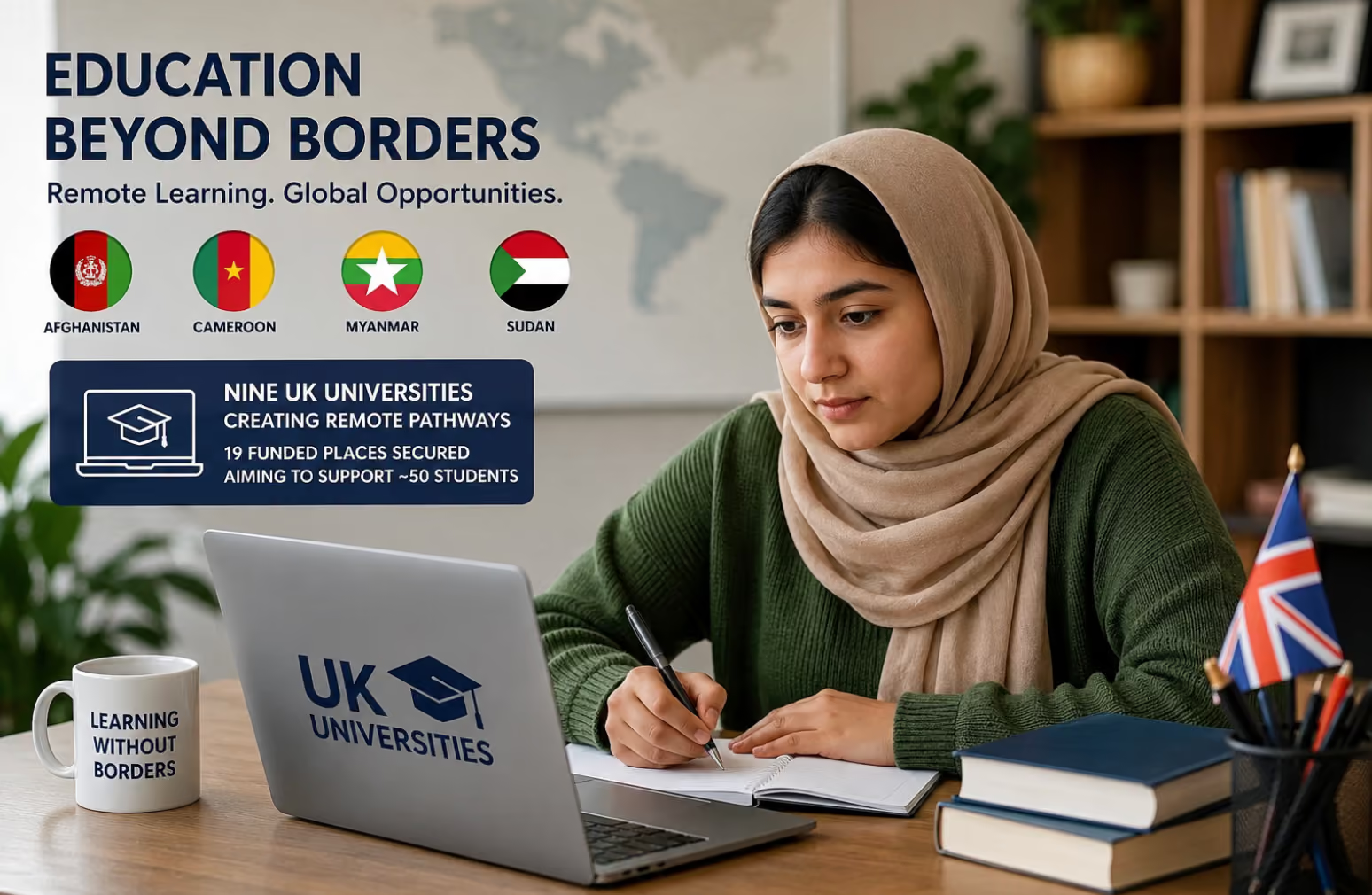
A new collaboration between nine British universities is creating a remote route into postgraduate education for students whose plans were disrupted by the United Kingdom’s “visa brake.” Working with Mosaik Education, the institutions have so far committed 19 funded places for learners from Afghanistan, Cameroon, Myanmar and Sudan. The initiative ultimately aims to support approximately 50 students, offering access to UK qualifications through online learning and transnational education rather than requiring students to travel to Britain.
The participating institutions are King’s College London, the University of London, the University of Leicester, the University of Northampton, the University of St Andrews, Cardiff University, Birkbeck, University of London, the University of Salford and Aberystwyth University. They are working with Higher Ed Partners UK, while Mosaik Education is coordinating the effort through its Global Response Platform. The platform connects universities with humanitarian and education organisations that can identify candidates, support selection and help students continue learning in difficult environments.
The programme was developed in response to an immigration measure introduced by the UK government in March 2026. The Home Office announced that sponsored study visas would be stopped for nationals of Afghanistan, Cameroon, Myanmar and Sudan, while skilled-worker visas would also be halted for Afghan nationals. The rules change came into force on 26 March 2026. The government said the decision followed a sharp increase in asylum applications from people who had originally entered through legal migration routes.
According to official figures, asylum applications by students from the four affected countries in the year ending September 2025 had increased to more than 470% of their 2021 level. The government also reported that asylum claims from people arriving through legal routes had more than tripled since 2021 and represented 39% of approximately 100,000 applications in 2025. These figures formed the government’s justification for applying what it described as an unprecedented emergency restriction.
However, the policy also removed access to established campus-based scholarship routes for students who may have no connection to visa misuse. Before the restriction, around 50 students a year from the four countries reportedly accessed postgraduate education through scholarships such as the UK government’s Chevening programme. Because new applicants can no longer obtain the required study visa, even fully funded students may be unable to take up places at British campuses.
The new Mosaik Scholarship seeks to close part of this gap. Courses offered through the programme will be delivered remotely or through transnational education, which can include UK degrees taught online, through overseas partners or at approved international locations. These formats are currently among the few practical ways for new students affected by the suspension to earn a British qualification without entering the UK.
The scale of Britain’s international teaching network makes such a response possible. UK universities already educate more than 650,000 students outside the country through transnational programmes. Much of the academic infrastructure—digital platforms, remote teaching systems, international partnerships and assessment processes—therefore already exists. The significance of the initiative lies in directing that capacity towards students affected by conflict, displacement and restrictions on mobility.
Mosaik’s platform is also working with regional organisations, including UNHCR India, Prospect Burma and Open Dreams in Cameroon. These partnerships matter because a tuition waiver alone may not be enough. Students in crisis-affected settings can face unstable internet access, power interruptions, missing academic documents, financial insecurity, trauma and family responsibilities. Effective remote education therefore requires flexible admissions, suitable technology, mentoring and sustained student support—not simply access to recorded lectures.
Experience from Myanmar shows that carefully designed online scholarships can produce strong results. A Mosaik briefing reported that Prospect Burma had awarded online scholarships to 86 students and achieved an average annual retention rate of 96%. Its support model includes help with laptops and data costs, counselling, contingency funding and mentoring by people familiar with the students’ circumstances.
The briefing also noted that online scholarships can cost less than half as much as studying in Thailand and only a fraction of the cost of studying physically in the UK. Lower costs could allow universities and scholarship providers to support a larger number of students with the same level of funding. Remote programmes can also enable students to remain close to their families and communities when international travel is unsafe, unaffordable or legally impossible.
These advantages do not mean remote learning is an equal substitute for campus education. Students studying from conflict-affected regions may miss laboratory access, professional networks, campus communities and the personal security that relocation can sometimes provide. Certain postgraduate programmes also cannot be delivered fully online. The initiative should therefore be understood as an alternative pathway, not a complete replacement for safe and equitable student mobility.
Universities must also ensure that remote learners are not treated as secondary participants. Students will need regular academic guidance, reliable access to faculty members, digital library resources, career support and opportunities to connect with classmates. Where internet access is inconsistent, universities may need to provide downloadable materials, flexible deadlines and asynchronous learning options.
Nevertheless, the scheme represents an important shift in how universities respond when migration policy interrupts educational access. Instead of treating immigration restrictions as the end of the admissions process, participating institutions are redesigning delivery so that learning can cross borders even when students cannot.
This suggests a broader role for digital higher education as a form of humanitarian and academic continuity. Universities already use online learning to reach working professionals and international students. The same infrastructure can now help protect the educational futures of people affected by conflict, forced displacement and sudden policy changes.
The collaboration may also influence the wider UK higher-education sector. Mosaik Education is calling on additional universities with online or transnational programmes to contribute funded places, and further commitments are expected later in 2026. Reaching the target of around 50 students would restore approximately the number of annual postgraduate opportunities previously available to students from the four countries through major scholarship routes.
For the students selected, the value extends beyond receiving a degree. Postgraduate education can strengthen professional expertise, preserve academic careers interrupted by crisis and help learners contribute to public services, businesses, civil society and the future reconstruction of their communities.
The programme’s real test will be whether students receive the financial, technological, academic and personal support needed to enrol, remain engaged and graduate successfully. It will also be important to ensure that qualifications delivered remotely carry the same academic standing and recognition as equivalent campus-based degrees.
The response from the nine universities demonstrates that international education does not have to depend entirely on physical mobility. Borders and visa rules can limit travel, but universities can still use global teaching networks to protect access to learning.
With 19 funded places already secured and a goal of approximately 50, the initiative is modest in scale, yet significant in principle: students should not automatically lose their educational futures because conflict and immigration restrictions have closed the conventional route to a classroom.
For questions or comments write to contactus@bostonbrandmedia.com



-v3.jpg)


-v3-02.jpg)