Stay informed with our newsletter.
.webp)


EN





Global aviation is entering a transformative phase shaped by safety challenges, artificial intelligence and rising aircraft demand. A major cargo accident in Miami has renewed attention on airport and runway safety, while Cathay Pacific and Google are testing AI-powered contrail avoidance to reduce aviation’s climate impact. At the same time, Airbus is increasing deliveries as airlines expand and modernize fleets, highlighting an industry balancing growth, sustainability, technology and operational resilience.
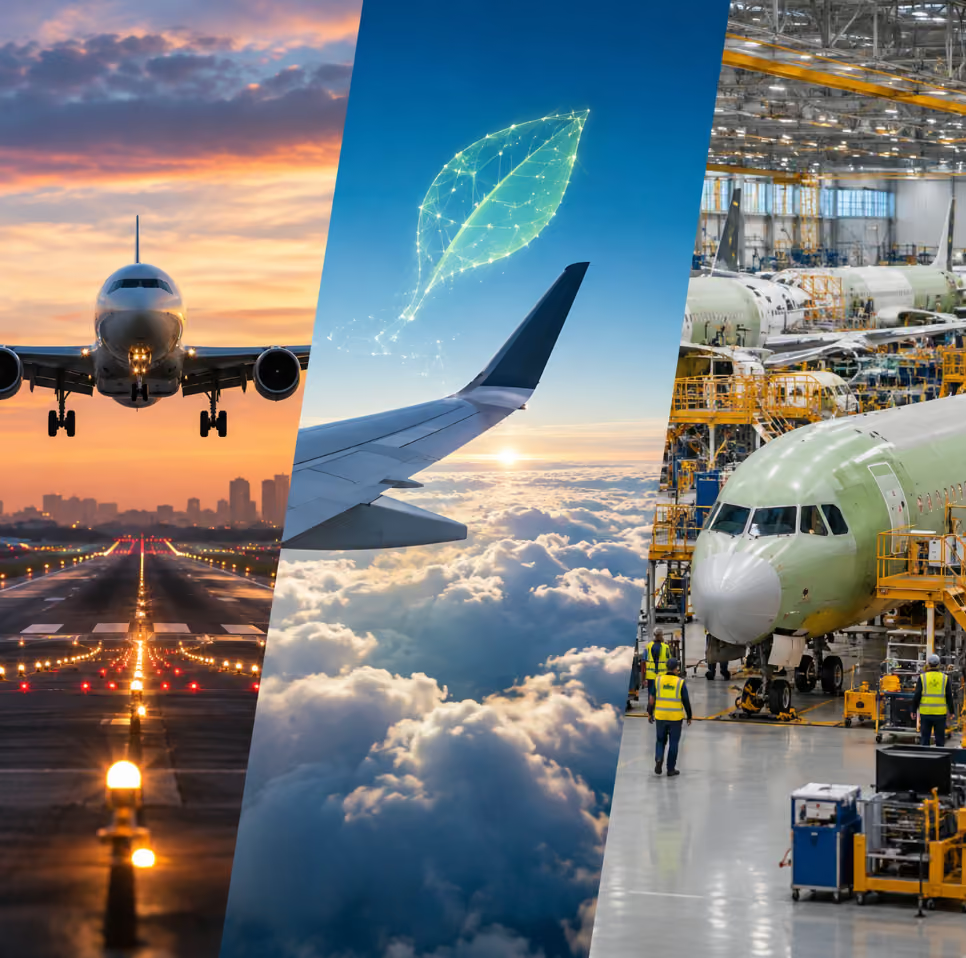
The global aviation industry is entering a period where rapid growth, technological transformation and safety pressures are converging at the same time.
Three major developments in September 2026 illustrate just how dramatically the sector is changing. A deadly Amazon Prime Air cargo aircraft accident in Miami has renewed questions about runway safety and airport infrastructure. In Asia, Cathay Pacific and Google are using artificial intelligence to reduce climate-warming aircraft contrails, reporting encouraging early results. Meanwhile, Airbus aircraft deliveries have risen 9%, demonstrating that airlines' appetite for newer aircraft remains strong despite persistent manufacturing and supply-chain challenges.
Together, these developments reveal an aviation industry confronting three major priorities: making flying safer, making it more sustainable and building enough aircraft to satisfy global demand.
On September 6, 2026, an Amazon Prime Air cargo flight operated by 21 Air overran a runway while landing at Miami International Airport, resulting in a devastating accident.
The aircraft was a 32-year-old Boeing 767-300 freighter arriving from San Juan, Puerto Rico. It travelled approximately 1,300 feet beyond the runway, crossed the airport perimeter and struck vehicles outside the airport.
Five people on the ground were killed and five others were injured, including three who were reported to be in critical condition. Both pilots survived. More than 60 rescue units and around 200 personnel responded following the accident.
Investigators from the U.S. National Transportation Safety Board (NTSB) have recovered both the cockpit voice recorder and flight-data recorder. A team of 32 investigators is examining the circumstances surrounding the crash, including aircraft performance, crew actions and airport infrastructure.
One issue receiving particular attention is the runway's lack of an Engineered Materials Arresting System, or EMAS. Such systems use specially engineered material beyond the end of a runway to slow an aircraft that cannot stop normally.
Investigators have not yet determined the cause of the accident, meaning conclusions about responsibility would be premature. But the disaster has already highlighted the importance of runway-overrun protection, particularly at busy international airports handling growing volumes of passenger and cargo traffic.
Miami is one of America's most important aviation gateways. The airport handled about 3.5 million metric tons of cargo and more than 55 million passengers over the previous year, according to Reuters.
The accident therefore raises a broader industry question: as e-commerce and air cargo operations expand, are airport safety systems evolving quickly enough alongside them?
While Miami has put aviation safety under scrutiny, another experiment thousands of miles away is demonstrating how artificial intelligence could change the environmental impact of flying.
On September 7, Cathay Pacific and Google announced an expansion of trials using AI to help aircraft avoid creating persistent contrails.
Contrails are the familiar white lines sometimes left behind aircraft when they travel through cold, humid air. Although many disappear rapidly, others can persist and spread, forming cloud-like structures that trap heat in the atmosphere.
According to Google, contrails could be responsible for roughly one-third of aviation's total climate impact.
Google's system combines AI predictive modelling, satellite imagery and weather intelligence to identify areas where persistent contrails are likely to form. Pilots can then make relatively small altitude adjustments to avoid those atmospheric conditions.
Cathay is integrating the forecasts into its proprietary Electronic Flight Folder, using onboard Wi-Fi to provide pilots with updated information while flights are underway.
The most striking finding is the early result.
The operational trial began in late 2025 and targeted more than 100 Cathay Pacific flights. More than 80 flights followed contrail-avoidance routes, and Google estimates those flights achieved approximately a 40% reduction in the warming impact of contrails.
The Hong Kong–Singapore corridor was among the routes tested. Interestingly, interventions on that single route accounted for more than 50% of the trial's total climate impact reduction, demonstrating how certain routes and atmospheric conditions could offer particularly significant opportunities.
Cathay has also become Google's first commercial airline partner in Asia-Pacific for the programme and the first airline globally to test contrail avoidance on ultra-long-haul flights. A larger second phase will now expand testing across Asian and trans-Pacific routes.
The significance extends beyond Cathay.
Much of aviation's decarbonisation debate has centred around sustainable aviation fuel, hydrogen propulsion, electric aircraft and next-generation engines, technologies that may require enormous investment or years of development.
Contrail avoidance could be different because it can potentially be implemented using aircraft already flying today.
That makes the project an important example of how AI could deliver measurable environmental benefits without waiting for an entirely new generation of airplanes.
At the same time, another powerful force is reshaping aviation: sheer demand for aircraft.
Airbus delivered 475 commercial aircraft during the first eight months of 2026, compared with 434 during the equivalent period of 2025, representing a 9% increase.
The European manufacturer delivered 57 aircraft in August alone and remains focused on its ambitious target of approximately 870 deliveries for the full year, compared with 793 aircraft delivered in 2025.
The numbers underline how aggressively airlines are renewing and expanding fleets.
Deliveries of the highly important A320-family narrow-body aircraft increased 11%, reflecting continued demand for efficient single-aisle aircraft used across short- and medium-haul networks.
Airbus also recorded 67 new aircraft sales during August. By the end of the month, gross orders for 2026 had reached 1,157 aircraft, or 1,091 after cancellations.
But enormous demand does not mean aircraft manufacturing is free from difficulties.
Airbus has faced problems involving its A330 wide-body programme, including a disruption after a tool was discovered inside a tail section. A330 deliveries were interrupted during June and July, and only 11 had been delivered during the year through August, down 31% from the comparable period.
It is a reminder that today's aviation boom depends not simply on airlines wanting aircraft, but on manufacturers successfully navigating complex global supply chains, quality controls, engine availability and production bottlenecks.
Viewed separately, the Miami accident, Google's AI contrail technology and Airbus's rising deliveries appear to be very different stories.
Viewed together, however, they represent the three forces that may define the next era of global aviation: Safety. Sustainability. Scale.
The industry's growth creates enormous economic opportunities, but more aircraft and more flights also place greater demands on airports, air-traffic systems, manufacturers and safety infrastructure.
At the same time, aviation remains under pressure to reduce its environmental footprint. Technologies such as AI-powered flight optimisation demonstrate that the industry's digital transformation could extend far beyond better booking systems or automated customer service and directly influence how aircraft operate in the sky.
And with Airbus delivering 475 jets in only eight months while accumulating more than 1,000 net orders, demand suggests that commercial aviation's global expansion is far from over.
The challenge for the industry is therefore not simply to fly more.
It is to find a way to grow without compromising safety, modernise without sacrificing reliability, and reduce climate impact while connecting an increasingly mobile world.
From an accident investigation in Miami, to an AI-enabled cockpit over Asia-Pacific, to aircraft assembly lines working to satisfy unprecedented demand, aviation in 2026 is showing both the extraordinary opportunities and the increasingly complex responsibilities, that come with the next generation of global flight.
For questions or comments write to contactus@bostonbrandmedia.com



-v3.jpg)


-v3-02.jpg)