Stay informed with our newsletter.
.webp)


EN





The global fashion industry is entering a transformative era shaped by creative reinvention, sustainability and commercial resilience. Demna’s new chapter at Gucci aims to restore the luxury giant’s cultural relevance through bold design and renewed brand identity. Meanwhile, fashion brands face growing pressure to turn sustainability promises into measurable action. Victoria Beckham’s remarkable business turnaround demonstrates how beauty, diversification and disciplined management can strengthen a fashion brand, offering valuable lessons for the industry’s future.
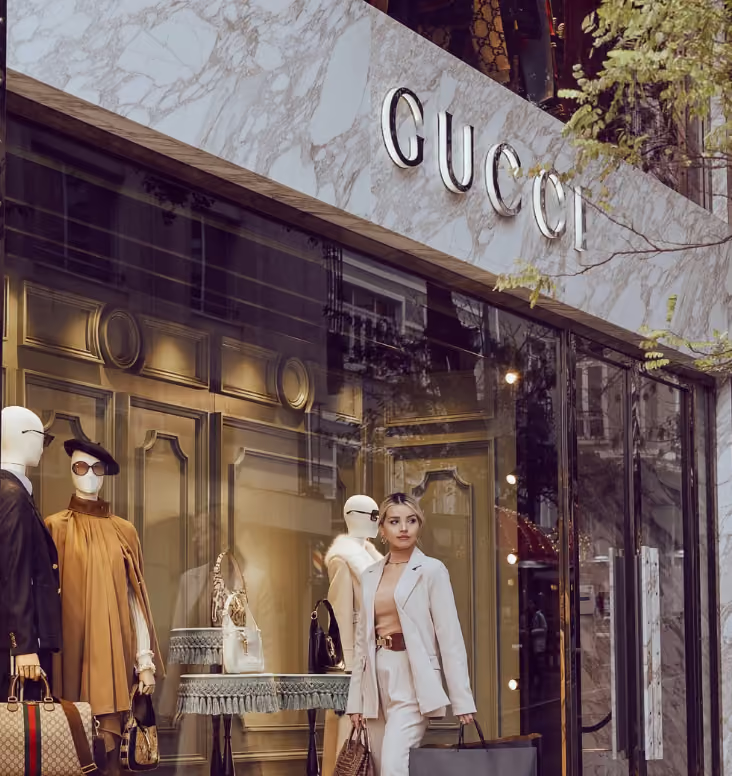
The global fashion industry is entering a period of profound change. Creative reinvention, sustainability, consumer expectations and commercial discipline are increasingly interconnected, forcing luxury and fashion brands to rethink what it means to remain relevant.
Three developments in particular capture this transformation. Demna’s new era at Gucci represents a high-stakes attempt to restore momentum to one of luxury’s most recognisable names. At the same time, the industry is confronting a growing sustainability credibility gap, as ambitious climate promises collide with economic pressures. And Victoria Beckham’s fashion and beauty business is demonstrating how diversification, brand consistency and disciplined management can turn a celebrity-backed label into a profitable enterprise.
Together, these stories reveal a fashion industry that is no longer driven solely by runway spectacle. The brands winning attention today must also demonstrate relevance, resilience and measurable business performance.
Few appointments have attracted as much attention in recent luxury fashion as Demna’s move to Gucci.
The Georgian designer, best known for transforming Balenciaga into a highly influential force in contemporary fashion, became Gucci's artistic director in July 2025. His appointment came after a prolonged period of weakness at Gucci, with Kering looking for a creative reset for its flagship luxury brand. Gucci's revenue had fallen 24% in the fourth quarter of 2024, highlighting the scale of the challenge facing the house.
Demna's arrival represents more than a change of designer. It is a bet that creative disruption can restore desirability.
His first major Gucci runway show in February 2026 introduced a softer and more sensual interpretation of the brand. The collection incorporated elements including legging-style trousers, seamless mini dresses and shimmering gowns, while drawing on Gucci's historic codes.
The strategy has also extended beyond traditional runway presentation. In May 2026, Demna presented Gucci's Cruise collection in New York's Times Square, turning one of the world's most recognisable commercial spaces into a fashion stage. The move connected Gucci's luxury heritage with New York's street culture and global entertainment identity.
The thinking behind Demna's approach appears clear: Gucci needs to feel desirable, culturally relevant and unmistakably itself.
His challenge, however, is enormous. Gucci is not simply another fashion label. It is a global luxury business whose identity has been shaped by decades of Italian craftsmanship, distinctive visual codes and highly recognisable products.
Demna therefore has to achieve a difficult balance: change enough to create excitement without changing so much that Gucci loses its identity.
His experience at Balenciaga offers an important clue. Demna previously helped turn Balenciaga into a major cultural force by combining luxury with streetwear, celebrity culture and provocative design. Gucci gives him an even larger canvas but also far greater expectations.
The early signs suggest that the brand is attempting to create a new cultural conversation around itself. Vogue's latest assessment describes Demna's Gucci direction as a combination of 1970s and 1990s references, modern proportions, sensuality and a more emotional approach to the house's identity.
Ultimately, the question is not whether Demna can generate attention. He clearly can.
The bigger question is whether that attention can translate into sustained consumer demand, stronger sales and long-term brand equity.
While designers compete to shape fashion's future aesthetically, the industry faces a much more fundamental challenge: sustainability.
For years, fashion companies have announced ambitious climate targets, carbon-reduction plans, circularity initiatives and responsible sourcing commitments. But in 2026, the industry is increasingly being asked a difficult question:
How much of this progress is actually being delivered?
Recent industry analysis shows that fashion is falling behind many of the climate targets it previously established. Business of Fashion reported in June 2026 that while companies including H&M and Kering had reduced emissions by more than one-third, many of the industry's largest brands remained behind the schedules they had established for reaching their targets.
The problem is becoming even more visible as economic pressures increase.
A recent Financial Times analysis described a broader retreat from fashion's sustainability commitments. Some brands have reduced or abandoned previously announced environmental goals, while the industry's continued reliance on low prices, rapid product cycles and high-volume consumption makes meaningful transformation difficult.
This creates a fundamental contradiction.
Fashion wants to promote newness, but sustainability requires consumers and companies to consider longevity.
Fashion thrives on frequent purchases, but environmental responsibility requires lower resource consumption.
Luxury brands promote exclusivity and craftsmanship, yet even premium products have environmental footprints across raw materials, manufacturing, transportation and retail.
The industry therefore needs to move beyond sustainability as a marketing message.
Accountability is becoming more important than ambition.
That means brands will increasingly need to demonstrate measurable progress in areas such as carbon emissions, material sourcing, waste reduction, supply-chain transparency and product longevity.
Regulation is also becoming more important. New European rules are designed to address waste and provide consumers with greater information about products, while restrictions on destroying unsold goods are pushing fashion companies to rethink inventory and product lifecycles.
The shift is significant because the future of sustainable fashion may depend less on impressive promises and more on verifiable results.
For luxury companies in particular, sustainability could become part of the definition of quality itself.
A premium product increasingly needs to offer not just beautiful design and craftsmanship, but also responsible materials, traceable production and durability.
If Gucci represents creative reinvention and sustainability represents the industry's accountability challenge, Victoria Beckham's business offers a powerful lesson in brand diversification and commercial discipline.
After years of financial losses, Victoria Beckham Holdings has achieved a major turnaround.
According to the Financial Times, the company is expected to report 2025 revenue of £129.8 million, up 15% from £112.7 million in 2024. More significantly, the business recorded an operating profit of £7.3 million, compared with an operating loss of £1.6 million the previous year.
The transformation is particularly interesting because the business is no longer dependent solely on fashion.
Beauty has become the engine of growth.
The beauty division, launched in 2019, now accounts for approximately two-thirds of the company's revenue. Products such as the Satin Kajal eyeliner have helped establish the beauty business as a significant commercial force.
This is a crucial lesson for modern fashion brands.
A strong fashion identity can create brand desirability, but diversification can create additional revenue streams and reduce dependence on a single product category.
Victoria Beckham has effectively turned her name into a broader lifestyle ecosystem encompassing fashion and beauty.
The company's turnaround has also been supported by management changes and tighter cost control. The business appointed separate leadership for its fashion and beauty operations, while maintaining a focus on product quality and consistent brand positioning.
The result demonstrates that celebrity recognition alone does not guarantee a successful fashion business.
Celebrity can create awareness. Product creates loyalty. Business discipline creates sustainability.
The company is now looking to expand its fashion offering across areas including knitwear, outerwear, shoes and leather goods, while targeting further international growth, particularly in the United States and Middle East.
That strategy could help Victoria Beckham move from being perceived primarily as a celebrity fashion label to becoming a globally recognised lifestyle brand.
Although Demna's Gucci, fashion's sustainability challenges and Victoria Beckham's turnaround appear to be separate stories, they reveal the same underlying transformation.
Fashion is becoming more demanding.
Creative directors can no longer rely purely on runway headlines. They must create products that consumers genuinely want.
Sustainability cannot remain a collection of ambitious statements. Brands increasingly need to show measurable environmental and social progress.
And celebrity-backed fashion businesses cannot depend indefinitely on fame. They need strong products, diversified revenue streams, effective leadership and financial discipline.
Gucci's strategy is built around creative reinvention.
The sustainability debate is demanding corporate accountability.
Victoria Beckham's turnaround demonstrates the power of commercial diversification.
Together, they illustrate a new formula for fashion success:
Creativity + Credibility + Commercial Discipline = Long-Term Brand Value.
The next phase of global fashion is unlikely to be defined by a single aesthetic or trend. Instead, the industry's winners will be brands capable of connecting culture, creativity, technology, sustainability and business performance.
For Gucci, Demna's challenge is to transform renewed attention into lasting consumer demand.
For the wider luxury industry, the challenge is to turn sustainability promises into measurable action.
For Victoria Beckham, the task is to build on its newfound profitability without compromising the brand identity that made its transformation possible.
These developments point to a broader reality: the fashion industry is moving from an era of hype to an era of proof.
Consumers want exciting products, but they are also increasingly interested in where products come from, how brands behave and whether businesses can deliver real value.
The future of fashion, therefore, will not belong simply to the loudest brands.
It will belong to the brands that can stay culturally relevant, operate responsibly and remain commercially resilient.
And that may ultimately be the most important trend shaping fashion in 2026.
For questions or comments write to contactus@bostonbrandmedia.com



-v3.jpg)


-v3-02.jpg)