Stay informed with our newsletter.
.webp)


EN





Europe is facing an escalating water crisis as severe drought and record-low levels in the Rhine and Danube disrupt vital economic activity. Reduced river depth is limiting cargo transport, increasing freight costs, restricting industrial operations and threatening power generation that depends on cooling water. Agriculture is also suffering from depleted soil moisture, irrigation shortages and lower crop yields. The crisis highlights Europe’s climate vulnerability and the urgent need for water management, resilient infrastructure and adaptation.
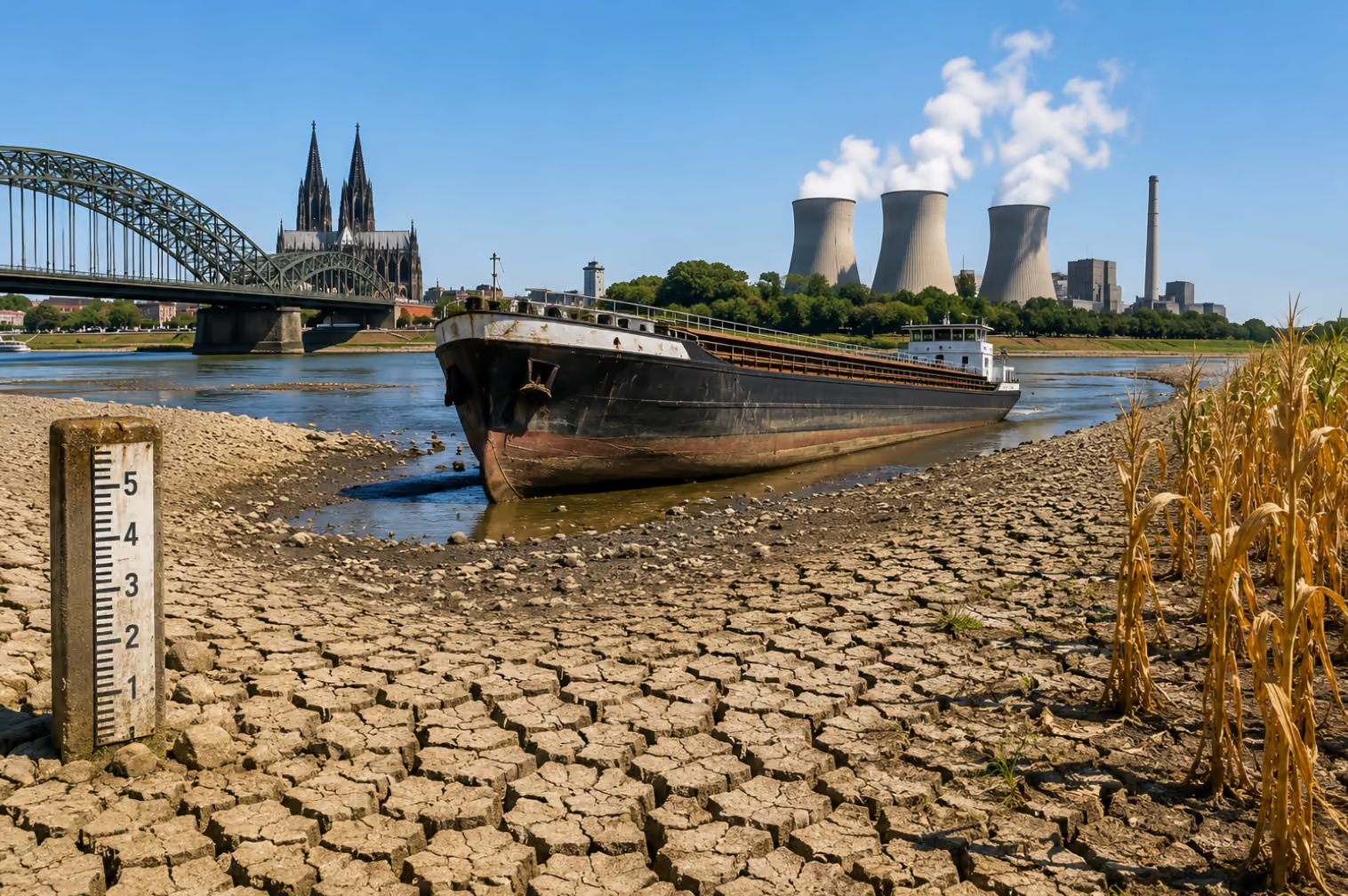
Europe is confronting a widening water crisis as prolonged heat, limited rainfall and depleted soil moisture push major rivers towards historic lows. By mid-July 2026, the European Drought Observatory described conditions as critical across most of Europe, with further deterioration in central-western regions. Copernicus data also showed that June was drier than average across large parts of western, central and eastern Europe, while river flows fell below normal in countries including France, Germany, Switzerland, Austria, Czechia, Slovakia, Hungary, Poland and Ukraine.
The crisis is especially visible along the Rhine and the Danube, two waterways supporting European trade, industry, electricity generation, farming and tourism. Low water reduces the depth available for ships, limits the cooling water power stations can safely use and intensifies competition between farms, cities, ecosystems and industry. What appears to be an environmental emergency is therefore becoming a direct economic and infrastructure shock.
The Rhine is one of Europe’s most important commercial waterways, carrying grain, minerals, ores, coal and petroleum products between industrial centres and North Sea ports. At Kaub, a critical German navigation chokepoint, navigable depth fell to about 25 centimetres at the end of July, matching the 2018 low, with a record 24 centimetres forecast. Although the river itself is deeper than this reading, ships need substantial clearance beneath their hulls to avoid grounding.
Consequently, many cargo vessels were operating at only about 20% of normal loading capacity, forcing companies to divide cargo among several barges. Reuters reported that tanker-barge freight from Rotterdam to Karlsruhe rose from approximately €45 per tonne at the end of June to €150 - €155 per tonne by July 31. These costs can spread through supply chains, increasing the price of fuel, chemicals, construction materials and industrial inputs.
Rail and road networks cannot instantly absorb all the freight displaced from rivers. Switching heavy bulk cargo to trucks requires more vehicles, drivers and fuel. Even when the Rhine remains technically open, commercially uneconomic loading levels can create bottlenecks nearly as damaging as a formal closure.
The Danube, Europe’s second-longest river, is experiencing similarly severe stress. In Romania, flow at the river’s entry point fell to around 1,700 cubic metres per second, compared with a normal July range of about 4,700 cubic metres per second. Water levels dropped to their lowest since 1996, causing suspended ferry services, idle grain barges, irrigation restrictions and tourism disruption.
The most alarming consequences have emerged in the power sector. Nuclear stations use large volumes of river water for cooling and must reduce or halt operations when water becomes insufficient or too warm. Romania shut one of the two reactors at the Cernavodă nuclear plant, which normally supplies about one-fifth of the country’s electricity. Authorities then used controlled explosions to remove a rock outcrop and redirect Danube water towards the remaining reactor, an unprecedented emergency intervention.
Hungary’s 2-gigawatt Paks nuclear plant, normally responsible for about half of national electricity generation, was operating at just over 10% of capacity after the Danube reached a record low. Governments asked households and businesses to reduce consumption, while Dacia and Ford plants in Romania agreed to halt production temporarily, reducing electricity demand by about 200 megawatts. The episode shows how hydrological drought can become a power-security and industrial-production crisis.
Hydroelectric generation is also vulnerable because turbines need adequate flow and reservoir levels. When hydropower output falls during a heatwave, electricity demand often rises because buildings and factories use more cooling. Nuclear and thermal plants may simultaneously face cooling-water constraints, tightening electricity markets and exposing weak cross-border grid connections.
For farmers, drought attacks from two directions: crops receive less rainfall while irrigation systems compete for diminishing river and reservoir supplies. In southeastern Romania, authorities restricted agricultural access to water to preserve minimum levels for nuclear cooling. Such decisions illustrate the difficult choices governments face when food production, energy generation and public water security depend on the same resource.
The European Commission’s Joint Research Centre reported that repeated heatwaves shortened the grain-filling period for winter crops and reduced EU yield forecasts by 1% to 4%. For spring and summer crops, depleted soil moisture and heat damage during flowering led to cuts of 6% to 7% in forecasts for grain maize and sunflowers. Total cereal yields were projected at about 1% below the five-year average, with further deterioration possible if hot, dry conditions persisted.
Lower harvests can affect animal feed, vegetable oils, food manufacturing and export earnings. Livestock need more water during extreme heat, while pasture and fodder production decline. The European Commission says drought- and heat-related crop losses across the EU have tripled over the past 50 years, showing that this is not merely one difficult season but a growing resilience challenge.
Drought is influenced by natural variability, but climate change is increasing the frequency and intensity of heatwaves and droughts in Europe, drying rivers, soils and lakes and pressuring agriculture, ecosystems and water supplies. Much of Europe’s infrastructure was designed around historical rainfall, snowmelt and river-flow patterns; those assumptions are becoming less reliable.
The immediate response requires dredging critical channels, improving river forecasts, coordinating water allocation and strengthening electricity interconnections. Longer-term resilience depends on water storage, efficient irrigation, drought-tolerant crops, healthier soils, restored wetlands, adaptable ships and diversified freight routes. The Danube Commission has warned that prolonged low-water periods and greater hydrological volatility are reshaping navigation and require forward-looking management across national borders.
Europe’s drying rivers are no longer only symbols of climate stress. They are becoming operational limits on how goods move, how electricity is generated and how food is produced. The Rhine and Danube crisis demonstrates that water security is economic security and that adapting Europe’s transport, energy and agricultural systems is now an urgent strategic priority.
For questions or comments write to contactus@bostonbrandmedia.com



-v3.jpg)


-v3-02.jpg)