Stay informed with our newsletter.


EN





The global automobile industry is undergoing a historic reset as Chinese automakers expand internationally, challenging established European, American, Japanese and Korean manufacturers with lower costs, faster development and competitive EV technology. Meanwhile, automakers are reconsidering EV-only strategies as hybrids regain importance and profitability becomes a critical challenge. With Chinese companies building overseas factories and Western manufacturers adopting China-developed technology, the industry's defining competition is shifting toward affordability, profitability, innovation and global manufacturing scale.
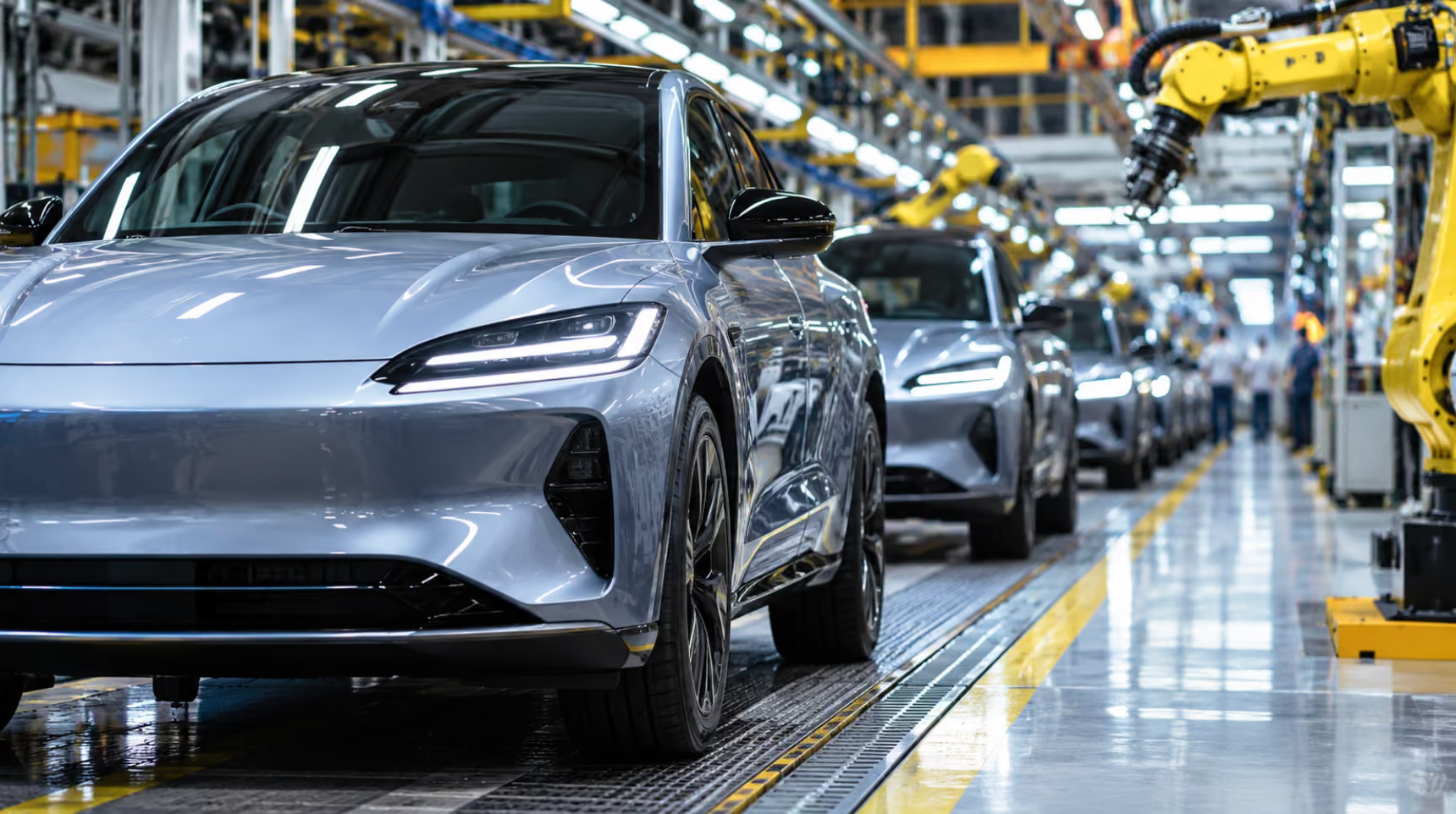
For more than a century, the global automobile industry was shaped by a familiar group of powers. Germany dominated premium engineering, Japan perfected efficient mass production, the United States built enormous automotive brands, and South Korea emerged as a formidable manufacturing force. Today, that hierarchy is being challenged by a transformation whose center of gravity is increasingly shifting toward China.
At the same time, the industry's electric future is becoming less straightforward. Electric-vehicle adoption continues to grow, but manufacturers are discovering that selling EVs and making money from EVs are two very different challenges. Hybrids are returning to strategic importance, trade barriers are rising, and traditional automakers are being forced to rethink everything from product-development cycles to where their technology is created.
Together, these forces are producing what could be described as the Great Auto Reset.
China's importance to the automotive industry once rested primarily on its enormous consumer market and manufacturing capacity. That relationship has changed dramatically. Chinese automakers are increasingly becoming global competitors, technology developers and exporters in their own right.
The scale of China's electric transition illustrates the transformation. According to the International Council on Clean Transportation, more than 9.4 million electric vehicles were sold worldwide during the first half of 2026, representing almost one-quarter of global light-duty vehicle sales. China was far ahead: electric vehicles represented 51% of all new light-duty vehicles sold in the country.
China's manufacturers have also developed a powerful advantage in speed. Reuters previously found that companies including BYD, Chery and Zeekr can bring some new vehicles from concept to market in as little as 18 months, compared with development cycles that can stretch toward five years at traditional automakers.
A 2026 Roland Berger analysis similarly estimated that Chinese manufacturers can develop vehicles 25–30% faster than European competitors while maintaining a 20–30% cost advantage. Crucially, the consultancy found that this advantage is not simply the result of cheaper labor. Much of it comes from design decisions, streamlined organizations, virtual testing, integrated suppliers and faster decision-making.
The automobile is consequently becoming something closer to a technology platform: software, batteries, computing architecture, connectivity and rapid iteration increasingly matter alongside traditional mechanical engineering.
The next phase is already beginning. Chinese automakers are no longer relying solely on shipping vehicles from Chinese ports into foreign markets. Increasingly, they are preparing to manufacture inside the markets they want to conquer.
Great Wall Motor, for example, plans to begin manufacturing its Ora 5 compact SUV in Bulgaria in the first quarter of 2027, creating its first European manufacturing base. The plant near Lovech is planned to have capacity for as many as 50,000 vehicles annually. Local production could also reduce Great Wall's exposure to European tariffs imposed on China-built EVs.
The broader significance is enormous. If Chinese brands successfully combine their cost structures and development speed with factories, suppliers, dealerships and engineering operations inside Europe, the distinction between a "Chinese import" and a "European-made car" could become increasingly blurred.
The competitive pressure is already visible. Chinese brands' share of the European automobile market has risen above 10%, according to Reuters, as manufacturers including BYD and Geely challenge established players on electric technology, software and price.
And China's automotive ecosystem is attracting competitors from entirely outside the traditional car business.
Xiaomi is perhaps the clearest example. Better known internationally for smartphones and consumer electronics, the company delivered more than 50,000 electric vehicles in October 2026 alone, its highest monthly figure of the year. Xiaomi delivered approximately 336,000 vehicles during the first ten months of 2026.
The message to traditional manufacturers is difficult to ignore: tomorrow's automotive competitor may not necessarily have started as an automotive company.
China's automotive rise has inevitably moved beyond corporate competition into geopolitics and industrial policy.
In October, China and the European Union reached an understanding designed to significantly moderate Chinese exports of hybrid and plug-in-hybrid vehicles to Europe. European Trade Commissioner Maroš Šefčovič said the arrangement could prevent several million Chinese vehicles from entering the EU over four years compared with an unchanged-trade scenario.
The scale of the underlying trade shift is striking. Chinese hybrid exports to the EU reached approximately $7.5 billion during the first half of 2026, triple the $2.5 billion recorded a year earlier. Chinese brands also captured a record 15% of Europe's EV market in the second quarter, according to data cited by Reuters.
The battle over the future of the automobile is therefore becoming a battle over factories, tariffs, subsidies, supply chains, batteries, jobs and technological sovereignty.
Meanwhile, another assumption about the industry's future is being rewritten.
For several years, automotive strategy often appeared to revolve around a relatively simple destination: move from internal-combustion engines toward fully battery-electric vehicles as quickly as possible.
That path now looks considerably more complex.
In October, General Motors revealed plans to introduce hybrid versions of popular three-row SUVs, including models based on the Chevrolet Traverse, Buick Enclave and GMC Acadia, marking an important strategic adjustment for a company that had invested heavily in a battery-electric future.
The move reflects a broader recognition that consumers, infrastructure and regulatory environments are not transitioning at identical speeds. Hybrids can serve as a bridge, allowing manufacturers to reduce fuel consumption and emissions while giving consumers the convenience of gasoline-powered range.
That does not mean EV demand is collapsing. Far from it.
In Europe, Volkswagen's EV sales increased 29% year over year, while electric vehicles account for roughly 40% of its order book. Yet Volkswagen itself has acknowledged the fundamental economic problem: it currently earns less from electric vehicles than from combustion-engine vehicles.
This distinction may define the next stage of the EV revolution.
The question is no longer simply whether consumers will buy electric cars. Increasingly, it is whether manufacturers can build them profitably enough, cheaply enough and quickly enough to survive increasingly aggressive global competition.
Few companies illustrate the challenge better than Volkswagen.
The German automotive giant reported a €5.9 billion operating loss in the third quarter of 2026, its deepest quarterly operating deficit since the Dieselgate era. The result included roughly €8 billion in one-off charges, while weakness in China and restructuring pressures added to the company's difficulties.
Yet Volkswagen's electric cars are selling.
That contradiction captures the industry's dilemma: EV adoption can rise while EV economics remain difficult.
Manufacturers must simultaneously invest billions in battery technology, software platforms, charging ecosystems and new factories while supporting profitable combustion-engine businesses that still finance much of that transformation. Chinese competition, meanwhile, is pushing vehicle prices downward.
The transition is therefore becoming an enormous test of capital efficiency.
For decades, Western automakers entered China carrying technology developed in Wolfsburg, Detroit, Stuttgart, Paris or Tokyo. Chinese operations learned from foreign manufacturers through joint ventures and partnerships.
Now that flow of knowledge is beginning to reverse.
Volkswagen announced in October that technologies developed at its Chinese research-and-development operations, including its Compact Main Platform and China Electronic Architecture, will eventually be deployed in vehicles for markets outside China, beginning with South America toward the end of the decade.
Volkswagen describes China increasingly as an innovation and technology hub for its global operations.
That may be one of the most consequential developments in the entire transformation.
China is evolving from the place where Western cars were manufactured into a place where global automotive technology itself is being developed.
The global car industry is therefore entering a more complicated era than the original EV narrative suggested.
The future will almost certainly be more electric. But it may simultaneously include battery EVs, plug-in hybrids, conventional hybrids and region-specific powertrain strategies for longer than many manufacturers originally expected.
More importantly, electrification is only one dimension of the transformation.
The deeper competition is over who can design cars fastest, manufacture them cheapest, integrate software most effectively, secure battery supply chains, navigate tariffs and still generate sustainable profits.
Chinese automakers have changed the benchmark. Traditional manufacturers are responding by restructuring factories, reducing costs, accelerating development and, increasingly, learning from the very Chinese ecosystem they once helped build.
The Great Auto Reset is therefore not simply a story about replacing gasoline with batteries.
It is a restructuring of where cars are designed, where they are built, who controls the technology inside them and which companies can make the economics work at global scale.
The automobile industry's defining question has changed. It is no longer simply, "Will the future be electric?"
The evidence increasingly suggests that it will.
The much harder question and the one that could determine the next generation of global automotive leaders, is:
Who can make that electric future affordable, profitable and scalable enough to win?
For questions or comments write to contactus@bostonbrandmedia.com