Stay informed with our newsletter.
.webp)


EN





The BRICS Plus naval exercises involving China, Russia, Iran, and South Africa underscore a growing shift in global geopolitics. Conducted amid rising international tensions, the drills highlight deeper military cooperation among emerging powers and reflect their intent to assert greater strategic influence. The exercises also signal a move toward a more multipolar world order, challenging traditional Western dominance in global security and reinforcing the Global South’s expanding role in international affairs.
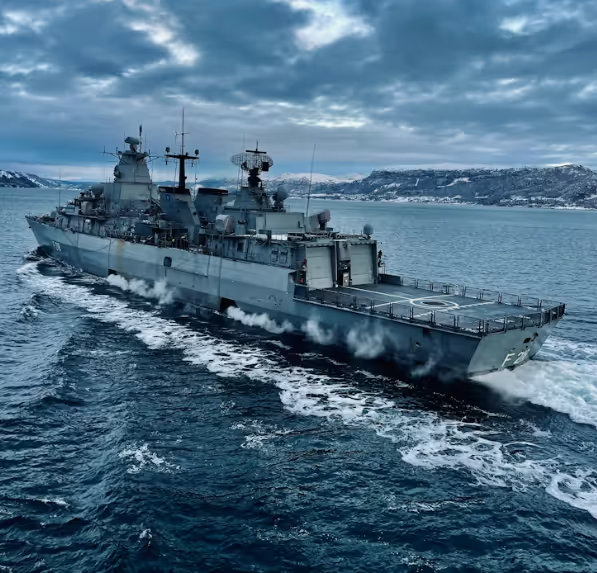
The launch of the “BRICS Plus” naval exercises off the coast of South Africa has drawn global attention, signalling a notable shift in the geopolitical landscape. With China, Russia, Iran, and South Africa participating, the drills represent more than routine military cooperation, they underscore the growing confidence and coordination among emerging powers at a time when global tensions are intensifying and traditional alliances are being questioned.
As the world navigates an era marked by economic uncertainty, regional conflicts, and competing visions of global governance, the BRICS bloc is increasingly positioning itself as a counterweight to Western-led institutions and security frameworks. The latest naval exercises serve as both a strategic and symbolic move, reinforcing the bloc’s ambitions on the global stage.
Originally formed by Brazil, Russia, India, China, and South Africa, BRICS was conceived as an economic grouping aimed at strengthening cooperation among fast-growing economies. Over the years, however, the bloc’s scope has expanded beyond trade and development, gradually incorporating political dialogue, financial coordination, and now, visible military cooperation.
The term “BRICS Plus” reflects this evolution. It signals openness to deeper engagement with non-member partners and highlights the bloc’s intent to broaden its influence across multiple domains, including security. The inclusion of Iran in the naval drills, a country that has long faced Western sanctions and political isolation, adds another layer of geopolitical significance to the exercises.
Joint naval drills are among the most visible demonstrations of military cooperation between nations. They test interoperability, communication, and coordination while also sending a message to allies and rivals alike. Conducted off South African waters, these exercises carry symbolic weight, positioning the Global South as an increasingly important arena for strategic engagement.
For participating countries, the drills offer practical benefits such as shared training, tactical learning, and experience operating in diverse maritime environments. For observers, however, the exercises highlight something larger: a willingness among BRICS-linked nations to align more closely on security matters, even in the face of criticism from Western governments.
The timing of the BRICS Plus naval exercises is particularly striking. The world is currently witnessing heightened tensions across multiple regions, from Eastern Europe and the Middle East to the Indo-Pacific. In this context, military manoeuvres take on heightened political meaning.
Western powers have traditionally dominated global security institutions and maritime presence. The visible cooperation between China, Russia, and Iran, all of whom have strained relations with the United States and its allies, is widely interpreted as a challenge to that dominance. While BRICS leaders have consistently framed their actions as defensive and cooperative rather than confrontational, the perception of rivalry is difficult to ignore.
Critics argue that such drills could deepen geopolitical divisions and contribute to a more fragmented world order. Supporters, on the other hand, see them as a natural response to what they view as an imbalanced global system that no longer reflects the realities of a multipolar world.
South Africa’s participation and hosting role is particularly noteworthy. As Africa’s most industrialised economy and a key voice in the Global South, the country has often positioned itself as a bridge between developed and developing nations. By hosting the naval exercises, South Africa reinforces its commitment to strategic autonomy and diversified partnerships.
The move also reflects a broader trend among middle powers seeking to avoid overdependence on any single bloc. For South Africa, engaging with BRICS partners on security matters aligns with its broader foreign policy goal of maintaining non-alignment while maximising diplomatic and economic options.
Each of the major players brings distinct motivations to the exercises.
Together, their participation reinforces the perception of a growing strategic alignment among countries that share concerns about Western dominance in global affairs.
It is important to note that BRICS remains, at its core, an economic grouping. Its initiatives around development finance, alternative payment systems, and trade cooperation continue to be central to its mission. However, as economic and security interests increasingly intersect, military collaboration has emerged as a natural extension of deeper political ties.
Maritime security, in particular, is closely linked to global trade, energy transport, and supply chains, areas of direct relevance to BRICS economies. The naval drills can therefore be seen as a way to protect shared economic interests while reinforcing political solidarity.
Unsurprisingly, the exercises have attracted criticism from Western policymakers and analysts, who argue that such displays risk escalating tensions and undermining existing security arrangements. Some view the drills as a deliberate attempt to project power and challenge Western influence in key maritime regions.
In response, BRICS representatives have emphasised that the exercises are not aimed at any specific country and are intended to promote cooperation, stability, and mutual understanding. This divergence in interpretation highlights the broader debate over the future of global governance and whether existing institutions can adapt to a more multipolar reality.
The BRICS Plus naval exercises may not immediately alter global power dynamics, but they are a clear indicator of changing trends. As emerging economies seek a greater voice in global affairs, their cooperation is becoming more visible, more confident, and more multidimensional.
For businesses, policymakers, and global observers, these developments underscore the importance of understanding a world that is no longer shaped by a single dominant power or alliance. Instead, influence is increasingly dispersed, negotiated, and contested across regions and platforms.
The launch of the BRICS Plus naval exercises off South Africa is a powerful symbol of a world in transition. It reflects the growing ambition of emerging powers to shape global narratives, protect their interests, and assert strategic independence. While the long-term impact of these drills remains to be seen, they undeniably highlight a shift toward a more complex and multipolar geopolitical order.
As global tensions continue to evolve, actions like these serve as reminders that the balance of power is not static and that the next chapter of international relations is being written not only in traditional centres of influence, but increasingly across the Global South.
For questions or comments write to contactus@bostonbrandmedia.com



-v3.jpg)


-v3-02.jpg)