Stay informed with our newsletter.
.webp)


EN





Advances in artificial intelligence, augmented reality, wearable devices, and voice assistants are changing how people interact with technology. Instead of relying only on smartphones, TVs, and computer monitors, users are beginning to experience more seamless and immersive digital interactions. While screens are unlikely to disappear completely, the future may involve fewer traditional displays as smart glasses, spatial computing, and AI-powered systems become more common. The shift points toward a world where technology blends naturally into everyday life.
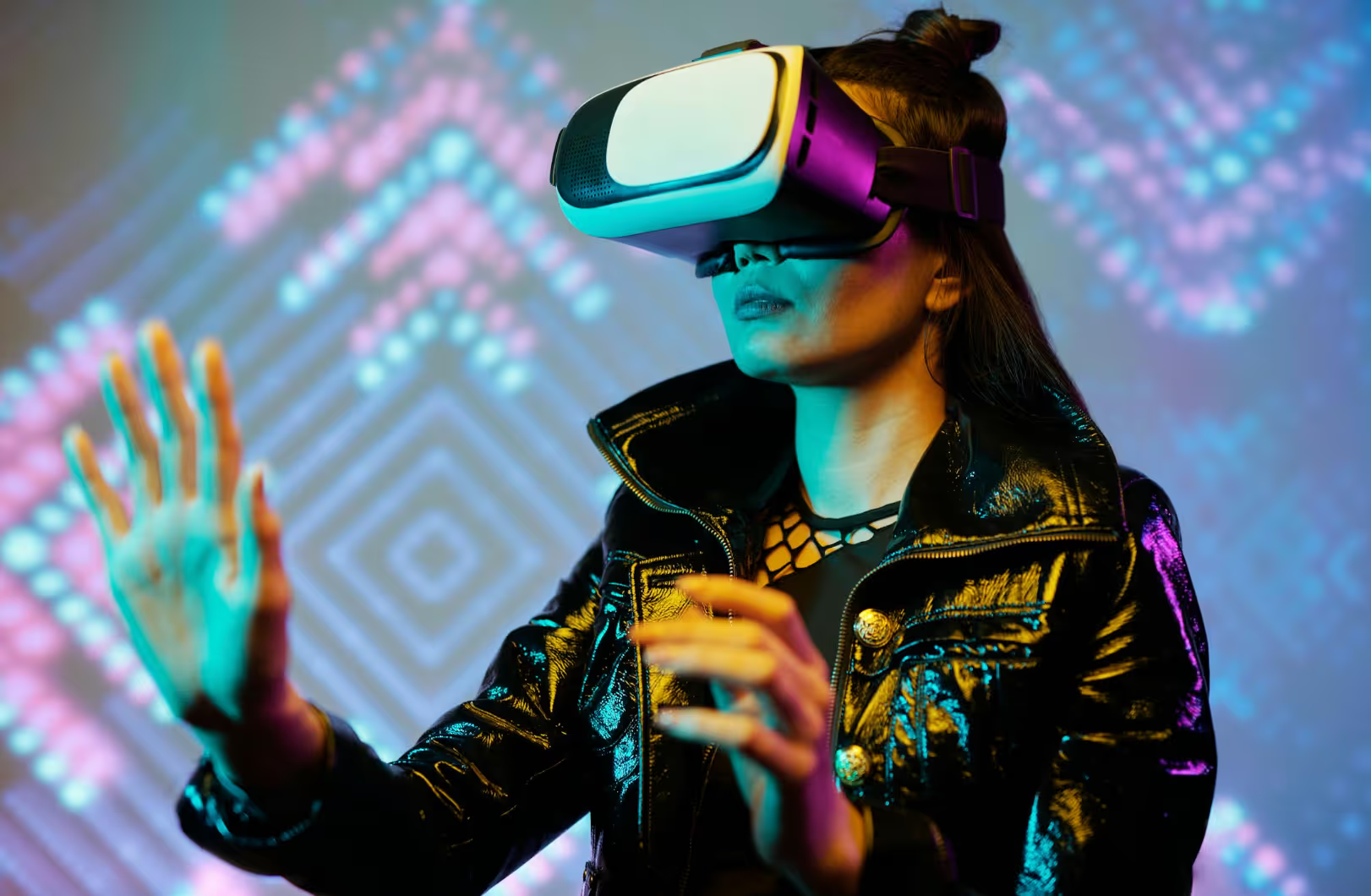
For more than half a century, screens have defined the way humans interact with technology. From bulky television sets and desktop monitors to smartphones and tablets, glowing rectangles have become the gateway to communication, entertainment, work, education, and commerce. Yet a new technological shift is raising a provocative question: are we entering a world without screens?
The idea may sound unrealistic. After all, billions of people spend hours every day staring at phones, laptops, and televisions. However, rapid advances in artificial intelligence, wearable computing, voice assistants, augmented reality (AR), virtual reality (VR), and brain-computer interfaces suggest that the future of computing may not depend entirely on traditional screens. Instead, digital experiences may increasingly blend into the physical world around us.
Technology experts often describe the next phase of innovation as “ambient” or “invisible” computing. In this model, technology fades into the background instead of demanding constant visual attention.
A major driver of this shift is voice interaction. Smart assistants such as Amazon Alexa, Apple Siri, and Google Assistant already allow users to perform tasks without touching a screen. People can set alarms, play music, control smart homes, and even shop using spoken commands.
The popularity of smart speakers demonstrates that many users value convenience over visual interfaces. Research from several market analytics firms estimates that hundreds of millions of households worldwide now use voice-enabled devices. This trend indicates that humans are increasingly comfortable interacting with machines through natural conversation instead of visual menus.
Artificial intelligence is accelerating this transformation. AI systems can understand language, recognize context, and anticipate user needs more effectively than earlier software. Instead of manually navigating apps, users may soon rely on intelligent assistants that complete tasks proactively.
Another sign of a screenless future is the rise of wearable technology. Smartwatches already reduce dependence on smartphones by delivering notifications, health tracking, navigation, and payment systems directly on the wrist.
Companies are now moving beyond watches toward lightweight AR glasses and mixed-reality headsets. Devices such as Apple Vision Pro and smart glasses developed by Meta aim to project digital information into the user’s environment rather than confining it to a phone screen.
This approach changes the relationship between humans and technology. Instead of looking down at a device, users can interact with digital objects layered over the real world. Directions may appear directly on the street ahead, messages may float in the air, and virtual workspaces could surround users without physical monitors.
Some futurists believe AR glasses may eventually replace smartphones altogether. If lightweight glasses can display information, take calls, translate languages in real time, and connect to AI assistants, carrying a separate screen device may become unnecessary.
AI is perhaps the strongest force pushing technology away from screens. Traditional computing requires users to search, click, type, and scroll. AI systems simplify this process by acting more like personal assistants than tools.
Generative AI models can summarize information, answer questions, draft emails, and perform complex tasks through conversation alone. As these systems improve, users may no longer need to navigate apps manually.
For example, instead of opening multiple travel websites, a user could simply say: “Book me the cheapest flight to Delhi next Friday and reserve a hotel near the airport.” The AI assistant would complete the task autonomously.
This conversational model reduces reliance on graphical interfaces. The screen becomes optional rather than essential.
The concept of “spatial computing” represents another major step toward reducing screens. Spatial computing refers to technology that understands and interacts with physical space.
Instead of flat displays, digital content appears integrated into the surrounding environment. Virtual keyboards may hover on desks, holographic meetings may replace video calls, and digital art may appear on empty walls.
Industries such as healthcare, manufacturing, and education are already experimenting with these technologies. Surgeons use AR overlays during operations, engineers visualize machinery in 3D space, and students explore immersive scientific simulations.
The gaming industry is also investing heavily in immersive experiences. VR platforms create entirely digital worlds where users interact naturally using gestures, eye tracking, and motion sensors rather than keyboards or touchscreens.
If these technologies become affordable and socially accepted, screens may gradually lose their dominance.
Despite rapid innovation, a completely screenless world remains unlikely in the near future. Screens continue to offer several advantages that alternative technologies struggle to match.
First, screens are efficient for displaying large amounts of information. Reading documents, editing spreadsheets, coding software, and watching films are still easier on high-resolution displays.
Second, many people prefer visual interaction over voice commands. Speaking to devices in public spaces can feel awkward or intrusive. Privacy concerns also limit the adoption of always-listening AI assistants.
Third, current AR and VR devices face technical challenges. Many headsets are expensive, heavy, and uncomfortable for long-term use. Battery life, eye strain, and motion sickness remain significant obstacles.
There are also social and ethical concerns. A world filled with wearable cameras and AI-powered glasses raises questions about surveillance, data collection, and digital addiction. Critics worry that immersive technologies could blur the line between reality and virtual experiences.
History suggests that new technologies rarely eliminate older ones completely. Radio survived television, printed books survived the internet, and cinemas survived streaming platforms.
Similarly, screens are unlikely to disappear entirely. Instead, their role may evolve.
Smartphones may become less central as wearable and voice-driven systems grow more capable. Large screens may remain dominant for entertainment and professional work, while smaller everyday interactions shift toward ambient technology.
This pattern is already visible. Many people now use smartwatches for quick interactions and reserve phones for more detailed tasks. The future may involve fewer screens, not zero screens.
One of the biggest reasons screens may persist is human psychology. Humans are visual creatures. Images, videos, text, and graphical interfaces communicate information quickly and effectively.
Screens also provide a sense of control. Tapping icons and viewing menus allows users to verify actions before they occur. Fully automated AI systems may feel unsettling if users cannot see or understand what is happening.
Moreover, screens have become deeply integrated into culture and daily life. Entertainment, social media, education, and remote work all rely heavily on visual interfaces. Replacing these habits will take time.
Rather than a completely screenless world, the most realistic future is likely a hybrid one. Screens may become less visible, less intrusive, and more integrated into everyday environments.
Instead of carrying a phone everywhere, people may use voice assistants, smart glasses, wearable sensors, and AI-powered systems that appear only when needed. Information could surround users naturally rather than trapping them behind glowing displays.
In this future, technology becomes more human-centered. The goal is not to eliminate screens entirely but to reduce friction between humans and digital systems.
The world is not abandoning screens overnight, but technology is clearly moving toward more seamless and immersive forms of interaction. Voice AI, augmented reality, spatial computing, and wearable devices are gradually reducing dependence on traditional displays.
However, screens remain practical, efficient, and deeply embedded in modern society. They are unlikely to vanish completely. Instead, the future will probably combine visible and invisible computing in ways that make technology feel more natural and less distracting.
The real transformation is not the disappearance of screens, but the changing relationship between humans and machines. As technology becomes more intelligent and integrated into our surroundings, the screen may no longer be the center of digital life.
For questions or comments write to contactus@bostonbrandmedia.com



-v3.jpg)


-v3-02.jpg)