Stay informed with our newsletter.
.webp)


EN




A landmark US appeals court ruling has overturned Amazon’s attempt to block Perplexity’s AI-powered shopping tools, allowing the technology to continue operating while the broader legal dispute proceeds. The decision could influence how courts define access, authorization, and responsibility when AI agents browse websites or assist consumers online. It also highlights growing tensions between major digital platforms and emerging AI companies over data control, security, consumer choice, and the future of agent-driven online commerce globally.
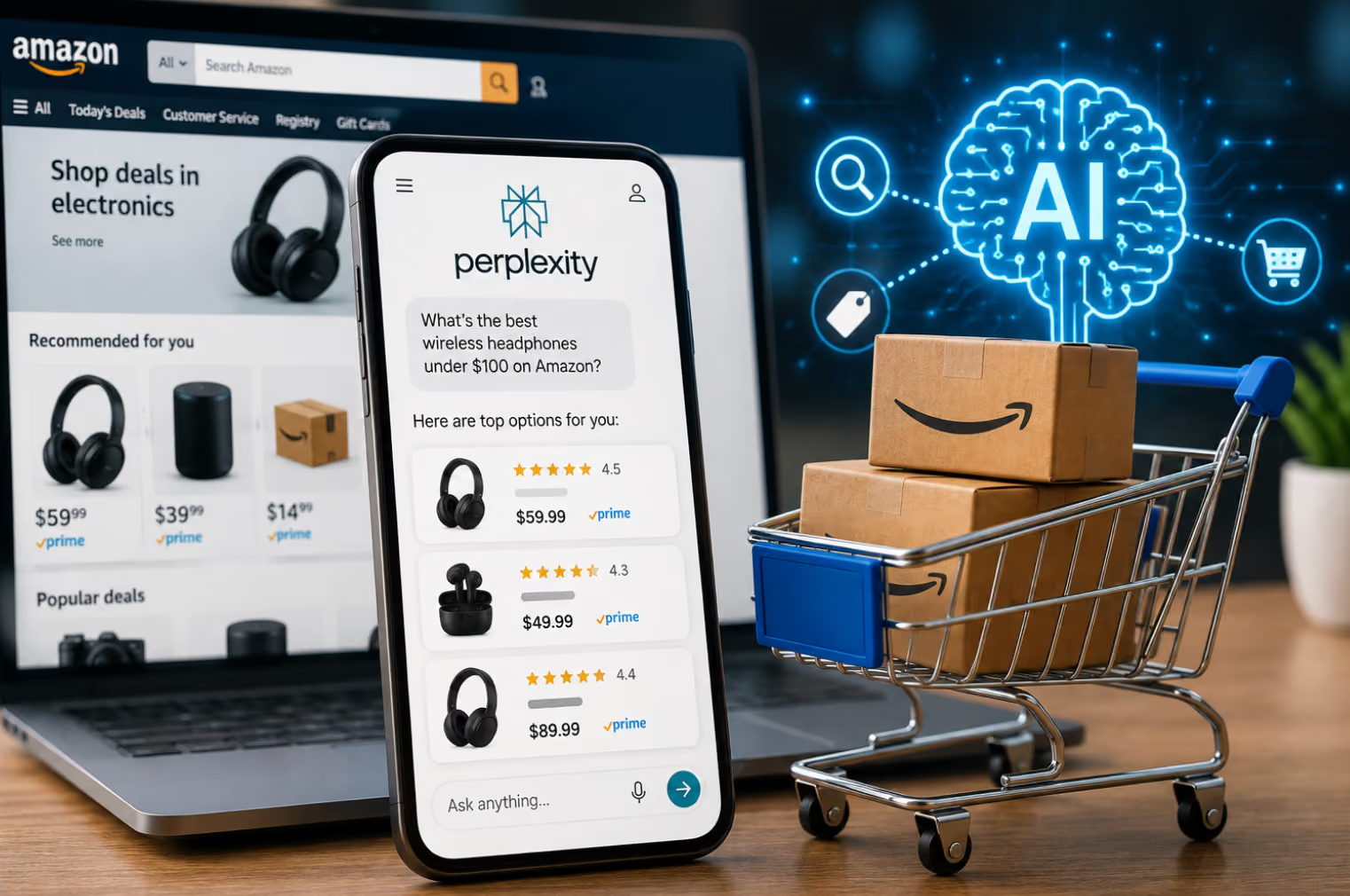
Amazon has suffered a significant setback in its legal battle with Perplexity AI after a United States appeals court overturned a preliminary injunction restricting Perplexity’s artificial-intelligence shopping tools on Amazon.com. The August 4, 2026 decision does not end the lawsuit or declare every use of Perplexity’s technology lawful, but it removes the temporary ban and returns the dispute to the lower court for further proceedings.
The case is attracting attention because it addresses a defining question for agentic artificial intelligence: when an AI assistant browses a website, compares products and performs tasks for a consumer, who legally accesses the platform, the user, the AI developer or both?
The dispute concerns Perplexity’s Comet browser and its optional AI “Assistant.” Unlike a conventional chatbot that mainly generates written answers, an agentic tool can perform online actions at a user’s direction. According to the court record, Comet users can ask the Assistant to visit Amazon, locate products and help complete shopping activities.
Comet operates locally on the user’s device. When the Assistant is activated, it examines screenshots of the browser display, sends information to Perplexity’s servers and receives instructions for navigating the site. Crucially, the appeals court found that Perplexity’s servers do not directly access Amazon’s servers; Amazon’s pages are first delivered to the user’s computer.
Amazon sued Perplexity in November 2025, alleging violations of the federal Computer Fraud and Abuse Act (CFAA) and California’s Comprehensive Computer Data Access and Fraud Act (CDAFA). Amazon argued that Comet entered password-protected customer accounts without Amazon’s authorization, obtained account information and continued operating after Amazon attempted to block it.
In March 2026, US District Judge Maxine Chesney granted Amazon a preliminary injunction. The district court concluded that Amazon had provided strong evidence that Perplexity, through Comet, accessed customer accounts with users’ permission but without Amazon’s authorization.
The lower court also cited Amazon’s evidence that the company had spent considerably more than the CFAA’s $5,000 loss threshold, including employee time used to detect and block Comet. The injunction temporarily stopped Perplexity’s AI agents from accessing protected sections of Amazon while the lawsuit continued. Perplexity appealed, and the Ninth Circuit paused the ban during its review.
The three-judge appellate panel concluded that Amazon was unlikely to prove a crucial part of its CFAA claim: that Perplexity itself “accessed” Amazon’s computers. The judges distinguished between a company directly entering another business’s servers and software assisting a user who is browsing from their own computer.
On the current evidence, the court said it was the user who accessed Amazon, with the Assistant functioning as a tool that carried out specific instructions. Although screenshots and navigation commands moved between the user’s computer and Perplexity’s servers, this did not establish that Perplexity had itself gained entry to Amazon’s systems.
The court also emphasized that the CFAA was principally designed as an anti-hacking law. It warned against interpreting the statute so broadly that routine computer-assisted behaviour could be converted into a federal crime. Under Amazon’s proposed interpretation, users might theoretically face criminal exposure under conspiracy or aiding-and-abetting principles simply for authorizing an AI assistant to help them shop.
One of the ruling’s most consequential findings concerns the legal status of an AI agent. The court observed that the CFAA applies to a person or legal entity that intentionally accesses a protected computer, whereas the Assistant is legally a tool rather than a person.
That does not give AI companies blanket immunity. The panel deliberately limited its conclusion to the existing evidence. It said a future case could reach a different outcome if the record showed that a developer exercised enough control over an agent to gain direct entry to another company’s servers.
Amazon argued that Comet could damage its shopping experience by failing to select the best prices, delivery options or product recommendations. It also raised cybersecurity concerns, citing research about risks associated with AI-powered browsers.
The appellate judges did not say that agentic-browser risks are imaginary. Instead, they found Amazon’s evidence too limited to support the extraordinary remedy of a preliminary injunction. The court noted that Amazon’s expert had not fully reproduced certain alleged risks, Perplexity said it had addressed vulnerabilities, and one cited shopping-related security example did not specifically involve Amazon.com.
The panel found that the potential harm to Amazon did not outweigh the burden on Perplexity, which had spent substantial sums developing Comet. It also said blocking conduct that was unlikely to violate the cited computer-access laws would reduce consumer choice and unnecessarily restrict the development of an emerging technology.
The decision vacates the preliminary injunction and sends the case back to the district court. It is a major procedural victory for Perplexity, but it is not a final judgment resolving every claim in the dispute.
Amazon may continue pursuing the lawsuit, present additional evidence and evaluate further legal options. The Ninth Circuit also made clear that the ruling does not prevent Amazon from controlling its platform through private terms of service. It means only that, on the current record, Amazon is unlikely to regulate this activity successfully by invoking the CFAA and California’s related computer-access law.
Amazon said it respectfully disagreed with the preliminary-injunction decision, remained confident in its case and was evaluating its next steps. Perplexity said it would continue fighting for internet users’ right to choose the AI tools they use.
Reuters described the decision as the first federal appeals-court ruling to examine whether AI agents acting for users may legally access online platforms. Its significance therefore extends beyond Amazon and Perplexity to retailers, airlines, banks, publishers and other digital businesses confronting AI tools that can search, compare, book and transact.
For shoppers, AI agents promise faster comparisons, fewer repetitive steps and less dependence on a platform’s own recommendations. For online businesses, they create serious questions about customer data, security, advertising revenue, platform control and accountability.
The court has not settled all those tensions. It has, however, established an influential early distinction: an AI assistant operating through a user’s browser is not automatically equivalent to an AI company hacking a platform. As agentic commerce grows, that distinction could reshape website access rules, commercial partnerships and the relationship between consumers, digital platforms and AI intermediaries.
For questions or comments write to contactus@bostonbrandmedia.com



-v3.jpg)


-v3-02.jpg)