Stay informed with our newsletter.
.webp)


EN




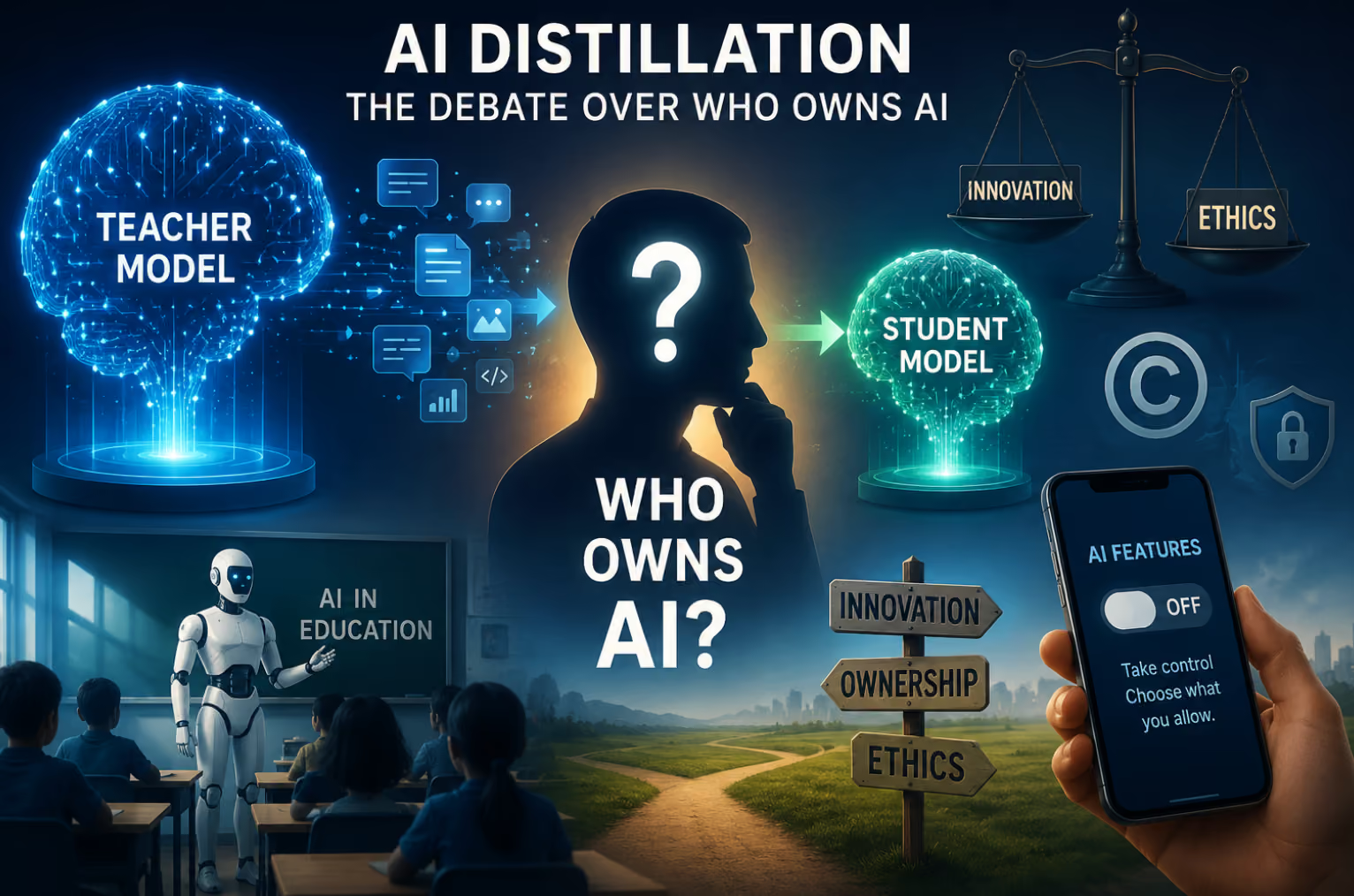
AI distillation is rapidly becoming one of the technology industry’s most debated concepts, as companies explore ways to train smaller, cheaper models using outputs from more powerful AI systems. The rise of competitive models such as Moonshot AI’s Kimi K3 has intensified concerns over model ownership, training ethics, intellectual property, and data use. At the same time, growing resistance to AI in classrooms and everyday apps is fueling a broader debate over control, consent, and human agency.
Artificial intelligence has generated an endless stream of new terminology, but one word is suddenly dominating conversations from Silicon Valley to Washington: “distillation.”
The technique itself is not new. What has changed is its importance in the global AI race, particularly after Chinese artificial intelligence company Moonshot AI released its powerful Kimi K3 model in July 2026.
At the same time, resistance to artificial intelligence is appearing far beyond laboratories and government offices. A proposed humanoid robot teaching assistant in a New York school has faced strong opposition from educators, while librarians are running popular workshops teaching ordinary consumers how to switch off unwanted AI features.
Together, these developments reveal a larger tension surrounding artificial intelligence: society is increasingly asking not only how powerful AI should become, but also who controls it, how it learns and where it belongs.
In simple terms, knowledge distillation involves using a powerful AI system, known as the “teacher,” to help train another model, known as the “student.”
Instead of building every capability independently from the beginning, developers can use outputs generated by an advanced model as training signals for another system. The objective is often to create a model that is smaller, cheaper or faster while retaining much of the capability of the larger model.
The concept has existed for years. A landmark 2015 paper by Geoffrey Hinton, Oriol Vinyals and Jeff Dean described methods for transferring knowledge from large neural networks or ensembles into systems that are easier and less expensive to deploy.
That makes distillation itself neither unusual nor inherently questionable. It is an established technique for AI model compression and efficiency.
The controversy begins when one company's proprietary AI system is allegedly queried at enormous scale so its outputs can be used to train a rival system.
The debate exploded following the release of Kimi K3 on July 16, 2026.
Moonshot describes Kimi K3 as a 2.8-trillion-parameter, natively multimodal model with a one-million-token context window, designed for areas including coding, knowledge work and reasoning.
Its performance quickly attracted attention because Chinese open-weight AI models are increasingly approaching the capabilities of expensive proprietary systems developed by leading American companies. Reports following the launch described Kimi K3 as competitive with leading offerings from companies including Anthropic and OpenAI.
But its rapid progress also triggered allegations from Washington.
Michael Kratsios, director of the White House Office of Science and Technology Policy, alleged that Moonshot had used outputs from Anthropic's Fable model during the development of Kimi K3, including through an internal system designed to conduct distillation at scale. Those claims remain allegations and have intensified discussions over the boundaries between legitimate learning and proprietary technology appropriation.
The issue is becoming part of the broader US-China technology rivalry.
Yet the industry itself is divided. While some policymakers and AI companies want stronger protection against large-scale extraction of proprietary model capabilities, technology companies have also warned against overly broad restrictions on open-weight AI models, arguing that such rules could reduce competition and push innovation elsewhere.
The controversy also raises an uncomfortable question.
The world's biggest AI companies themselves trained systems using enormous collections of internet text, books, images, code and other digital material, leading to ongoing disputes over copyright, compensation and consent.
Now, frontier AI companies are increasingly concerned that their own models' outputs could become training material for competitors.
The situations are not legally identical. Publicly accessible internet content, copyrighted works, proprietary datasets and outputs obtained through commercial AI services can involve very different contractual and intellectual-property considerations.
But ethically, the comparison is difficult to ignore.
When does learning from someone else's work become copying?
That question once focused largely on writers, artists and publishers. Distillation means AI developers themselves are increasingly confronting versions of the same debate.
Meanwhile, another argument over AI is unfolding inside classrooms.
The Salamanca City Central School District in New York announced plans for a pilot involving a Realbotix humanoid robot and digital AI teaching assistant for students in its STEAM programme.
The district said the technology would support teachers rather than replace them and would use district-approved curriculum and instructional materials.
But educators reacted strongly.
The New York State United Teachers union argued that children require relationships with real educators and criticized the expansion of humanoid technology into classrooms. Teachers and community members also raised questions about student privacy, human interaction and the appropriate role of AI in education.
The proposed robot reportedly cost $57,590.
Following the backlash and concerns surrounding student data protections, reports on July 26 said the district had paused the pilot while working with education authorities and community stakeholders.
The dispute illustrates a critical challenge for education technology: something can be technically possible without automatically being socially acceptable.
At the opposite end of the AI revolution, some people are not asking for better artificial intelligence.
They are asking how to turn it off.
At the South Philadelphia Library, librarian Charlie Bailey has been running an “Avoiding AI” workshop showing people how AI tools work and how to disable unwanted features on phones, computers, apps and websites.
A June 29 session was scheduled for an hour, while another workshop was listed for July 28. The library describes the programme as a way for users to learn how to disable AI functions they do not want.
TechCrunch reported that around 20 adults attended Bailey's workshop, where participants were shown how to disable features including Apple Intelligence and Google's Gemini. Bailey said the idea grew from frustration among consumers who felt AI features were increasingly being added to products without them actively requesting them.
That frustration may become increasingly important.
Consumers are not necessarily rejecting technology altogether. Instead, many appear to be demanding something that was once taken for granted: the ability to choose whether they use AI at all.
Distillation, humanoid teachers and AI-avoidance workshops may appear unrelated, but each revolves around the same fundamental question: Who gets to decide how artificial intelligence is used?
AI companies want control over their intellectual property. Developers want access to powerful models. Governments want technological security. Schools want new learning tools. Teachers want human relationships protected. And consumers increasingly want control over which AI systems enter their everyday lives.
The next phase of the artificial intelligence revolution therefore may not be defined simply by which company builds the smartest model.
It could be defined by the struggle to establish boundaries around AI, what machines are allowed to learn from, where they should operate, what humans should be able to opt out of and how innovation can continue without sacrificing trust, consent and human agency.
AI is becoming more capable. The harder question now is whether society can become equally capable of deciding where that intelligence belongs.
For questions or comments write to contactus@bostonbrandmedia.com



-v3.jpg)


-v3-02.jpg)