Stay informed with our newsletter.
.webp)


EN





AI-powered robots are moving intelligence from screens into the physical world. By combining humanoid machines, autonomous equipment, and foundation models, robots could learn new tasks across factories, warehouses, logistics, agriculture, and construction without requiring individual programming. This shift could lower automation costs, improve productivity, and reshape physical labour globally. However, widespread adoption still depends on reliability, safety, affordability, and adaptability, raising important questions about jobs, skills, and how human work evolves alongside increasingly capable machines.
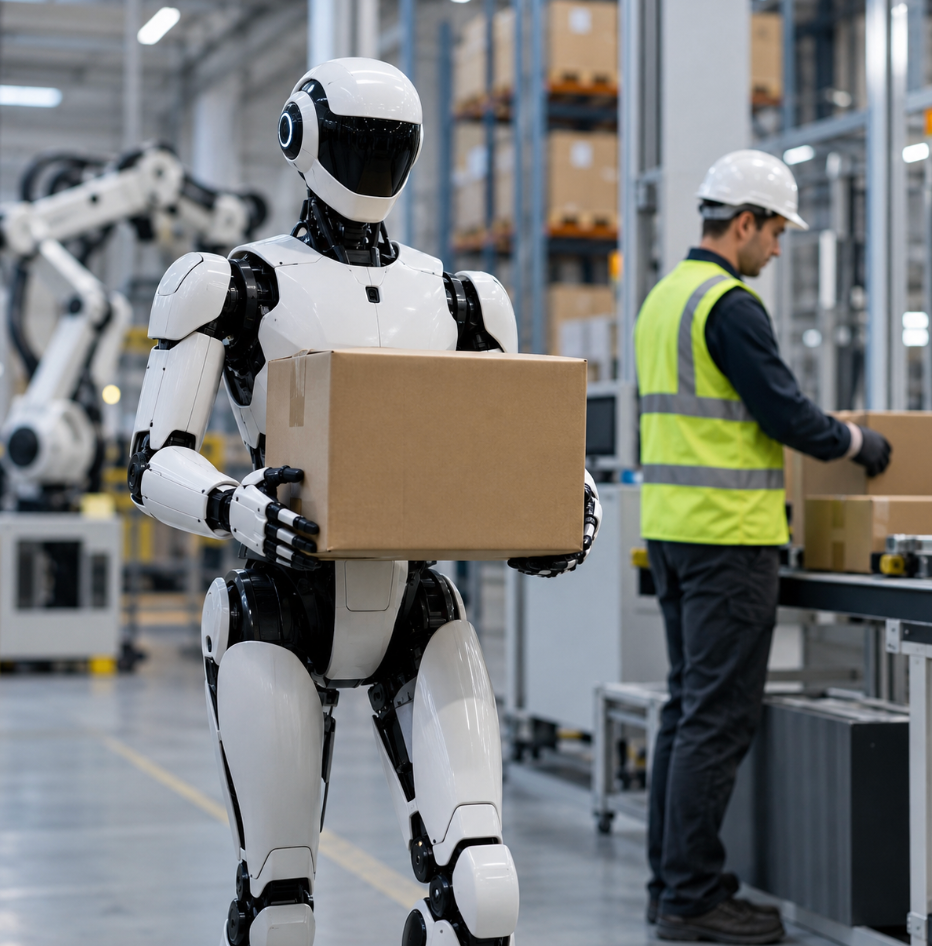
For most of the artificial intelligence boom, AI has lived behind a screen. It could write, analyse, generate images, translate languages and answer questions, but it could not pick up a box, load a truck, harvest a crop or operate machinery.
That boundary is beginning to change.
A new generation of humanoid robots, autonomous machines and AI-powered robotic systems is combining increasingly capable hardware with foundation models that can interpret language, understand visual environments and translate instructions into physical actions.
The result is sometimes called “embodied AI” or “physical AI”, artificial intelligence that does not simply process information but can perceive the physical world and act within it.
If the technology works reliably and becomes affordable, the implications could extend far beyond robotics. AI could begin changing the economics of physical labour in much the same way software automation has transformed information work.
Industrial robots are not new. Automotive factories have used robotic arms for decades to weld, paint and assemble vehicles.
But traditional industrial automation has an important limitation: most robots are designed around highly structured, repetitive tasks.
An engineer may spend significant time programming a robot's movements, configuring safety zones and redesigning part of a production line around the machine.
Foundation models could change that relationship.
Google DeepMind's Gemini Robotics 2, announced in July 2026, is designed to convert visual and language information into robotic actions. According to DeepMind, the model can control entire humanoid bodies, coordinate movement from feet to fingertips and adapt to unfamiliar situations.
NVIDIA has been pursuing a similar direction with its GR00T family of humanoid foundation models. Its original GR00T N1 model was trained using combinations of human video, real robot trajectories, simulation and synthetic data so robots could perform multiple manipulation tasks rather than learning only one fixed sequence.
That distinction matters enormously.
The economic breakthrough would not simply be building a robot capable of performing one job. It would be creating a robotic platform capable of learning many jobs through software.
Instead of buying one machine for palletising, another for sorting and another for inspection, companies could eventually deploy adaptable robots and download or train additional skills.
Manufacturing is likely to remain one of the most important proving grounds.
Mercedes-Benz has already tested Apptronik's Apollo humanoid robots in facilities in Germany and Hungary, with applications focused partly on repetitive and physically demanding manufacturing activities.
The scale of broader automation ambitions is becoming significant. In September 2026, Toyota said it could spend around 1 trillion yen, approximately $6.4 billion annually, from 2028 on factory modernisation and automation involving its operations, group companies and major suppliers. Toyota estimated roughly 400,000 humanoid and non-humanoid robots could ultimately be required for replacing equipment and expanding capabilities.
Humanoid robots are attractive because factories, tools, shelves, doors and workstations were originally designed around human dimensions.
Rather than redesigning every workplace around robots, companies are trying to design robots that can operate inside workplaces built for humans.
Logistics may provide one of the clearest early examples.
GXO Logistics began commercially deploying Agility Robotics' Digit humanoid robot after an earlier warehouse trial. Digit has been used for repetitive material-handling work such as removing totes from autonomous mobile robots and transferring them onto conveyors.
Agility later reported that Digit had moved more than 100,000 totes during the deployment, providing an early example of a humanoid performing repeated productive work rather than simply appearing in technology demonstrations.
Warehouses are especially attractive environments for robotics because labour costs are significant and many activities involve repetitive walking, lifting, sorting and moving.
But general-purpose robots could change automation economics further.
Historically, companies often had to justify expensive automation around extremely high-volume processes. If robots become more flexible, smaller warehouses could automate without rebuilding entire facilities.
That could broaden the addressable market dramatically.
The physical-AI revolution will not necessarily always look humanoid.
A tractor does not need legs.
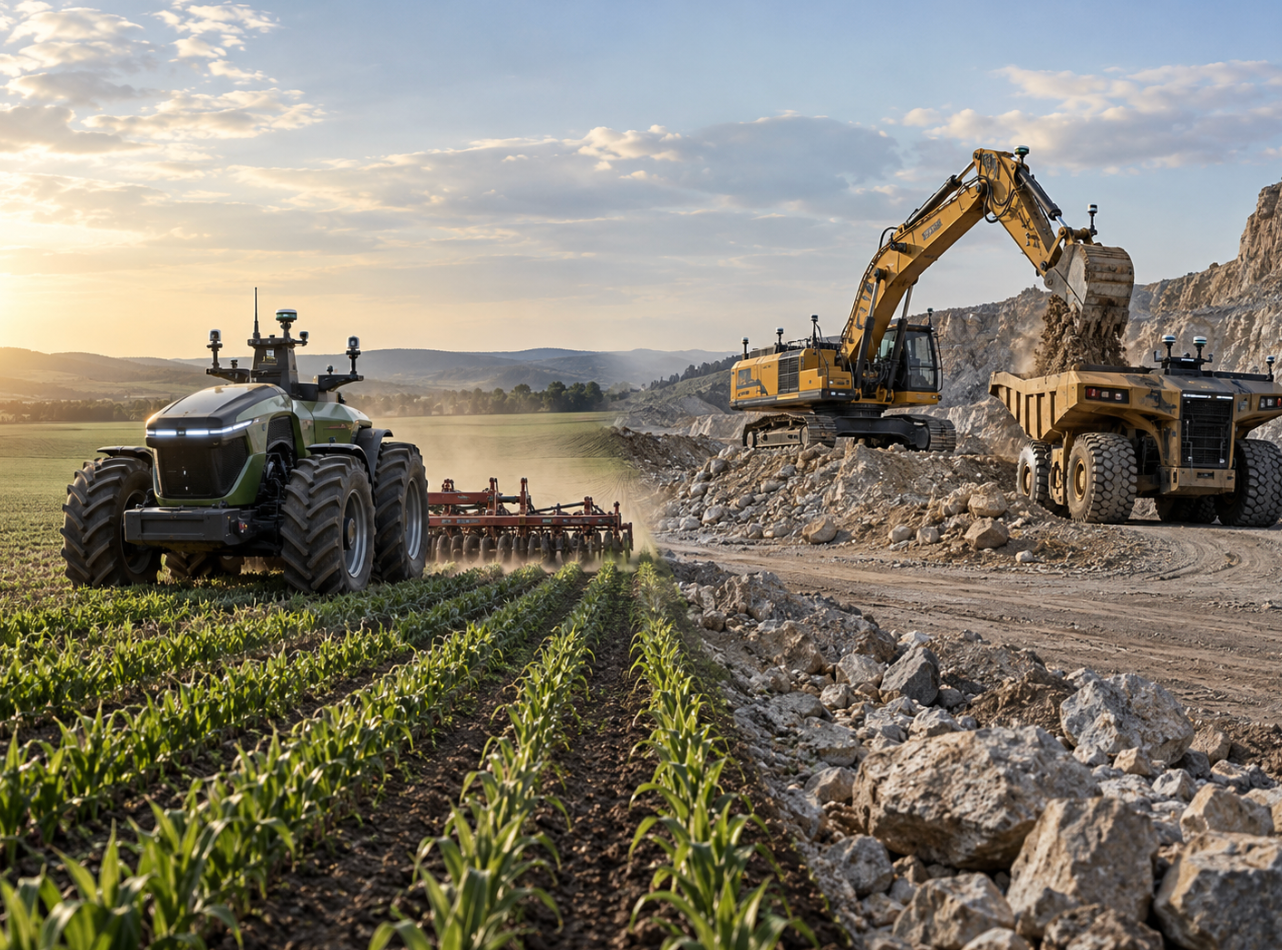
An excavator does not need hands.
John Deere has been expanding autonomous machinery across agriculture, construction and landscaping. Its second-generation autonomy technology combines computer vision, artificial intelligence, cameras and other sensors to allow machines such as tractors and quarry trucks to operate autonomously.
In farming, autonomous machines could perform operations during narrow planting, spraying and harvesting windows while reducing dependence on scarce labour.
Construction presents a harder environment because every worksite changes continuously. Yet robotics is advancing there as well. In 2026, autonomous construction-machine developers including Bedrock Robotics and Gravis Robotics were attracting investment and conducting work on real construction sites.
The likely future is therefore not a world filled exclusively with humanoids.
Physical AI may consist of humanoid workers, autonomous tractors, robotic forklifts, delivery machines, intelligent excavators and specialised robots all sharing increasingly general AI systems.
This is where the technology becomes economically profound.
Human labour has several unavoidable costs: wages, recruitment, training, scheduling, healthcare, workplace injuries, turnover and limits on working hours.
Robots have different costs: hardware, electricity, maintenance, software, financing and supervision.
Once the total hourly cost of operating a robot drops below the cost of employing someone for certain tasks, automation becomes financially attractive.
Foundation models could accelerate that shift because the cost of teaching a robot a new skill may gradually become a software problem rather than an engineering project.
One robot could potentially perform several tasks across different shifts.
Robots could also operate for longer periods, making expensive equipment productive for more hours per day.
But economic history suggests the result will not simply be “robots replace workers.”
Research by economists Daron Acemoglu and Pascual Restrepo describes competing effects. Automation can create a displacement effect, where machines perform tasks previously done by workers. But productivity gains can increase production and generate demand elsewhere, while entirely new tasks and occupations can create what the researchers call a reinstatement effect.
The distribution of those gains is crucial.
Earlier research into industrial robot adoption found increased productivity but also evidence that some workers performing highly automatable tasks experienced pressure on employment and earnings.
Despite extraordinary investment and attention, humanoid robotics remains at an early stage.
According to International Federation of Robotics data reported by Reuters, approximately 7,000 humanoid robots were sold globally for professional and industrial applications in 2025.
For comparison, around 542,000 conventional industrial robots were installed during 2024 alone. Many humanoids sold in 2025 also went to research organisations or companies developing AI rather than replacing workers in normal commercial operations.
Robots still struggle with problems humans solve instinctively: manipulating unfamiliar objects, maintaining balance, recovering from mistakes, navigating unpredictable environments and working safely around people.
Reliability matters enormously.
A robot that completes a demonstration successfully nine times out of ten may look impressive on video. A factory running millions of operations requires reliability approaching industrial standards.
Hardware cost, battery life, maintenance, data requirements, safety certification and liability also remain major challenges.
The deeper transformation may arrive when robotics follows the economics of computing.
Computers were once expensive specialised machines. Eventually they became flexible platforms capable of running thousands of different applications.
Smartphones repeated the pattern.
Robots could potentially become another programmable platform.
A warehouse robot might learn unloading today, inventory handling tomorrow and quality inspection later. A construction machine might receive improved autonomous capabilities through software updates. Agricultural equipment could continuously learn from data collected across thousands of farms.
The robot would no longer be the product by itself. The combination of the machine, foundation model, data and continuously expanding skill library would become the product.
That would represent a fundamental shift in automation.
The central question would no longer be: Can a robot perform this particular job?
It would become:
How quickly can the robot learn the next one?
And if that learning becomes cheap, reliable and transferable across millions of machines, the consequences could reach almost every industry dependent on physical work.
For the first time, the AI revolution would no longer be confined to screens, servers and digital information.
Intelligence would have entered the physical economy and acquired a body.
For questions or comments write to contactus@bostonbrandmedia.com



-v3.jpg)


-v3-02.jpg)





.png)