Stay informed with our newsletter.


EN





Startups are evolving from disruptive businesses into builders of strategic global infrastructure. Zipline’s $1.5 billion funding round and $21.5 billion valuation highlight growing confidence in autonomous drone delivery, while Europe’s €525 million semiconductor initiative aims to strengthen its chip-design ecosystem and technological independence. Together, these developments reveal a major shift in startup investment toward capital-intensive technologies spanning logistics, manufacturing and semiconductors, where innovation increasingly intersects with economic competitiveness, infrastructure and technological sovereignty.
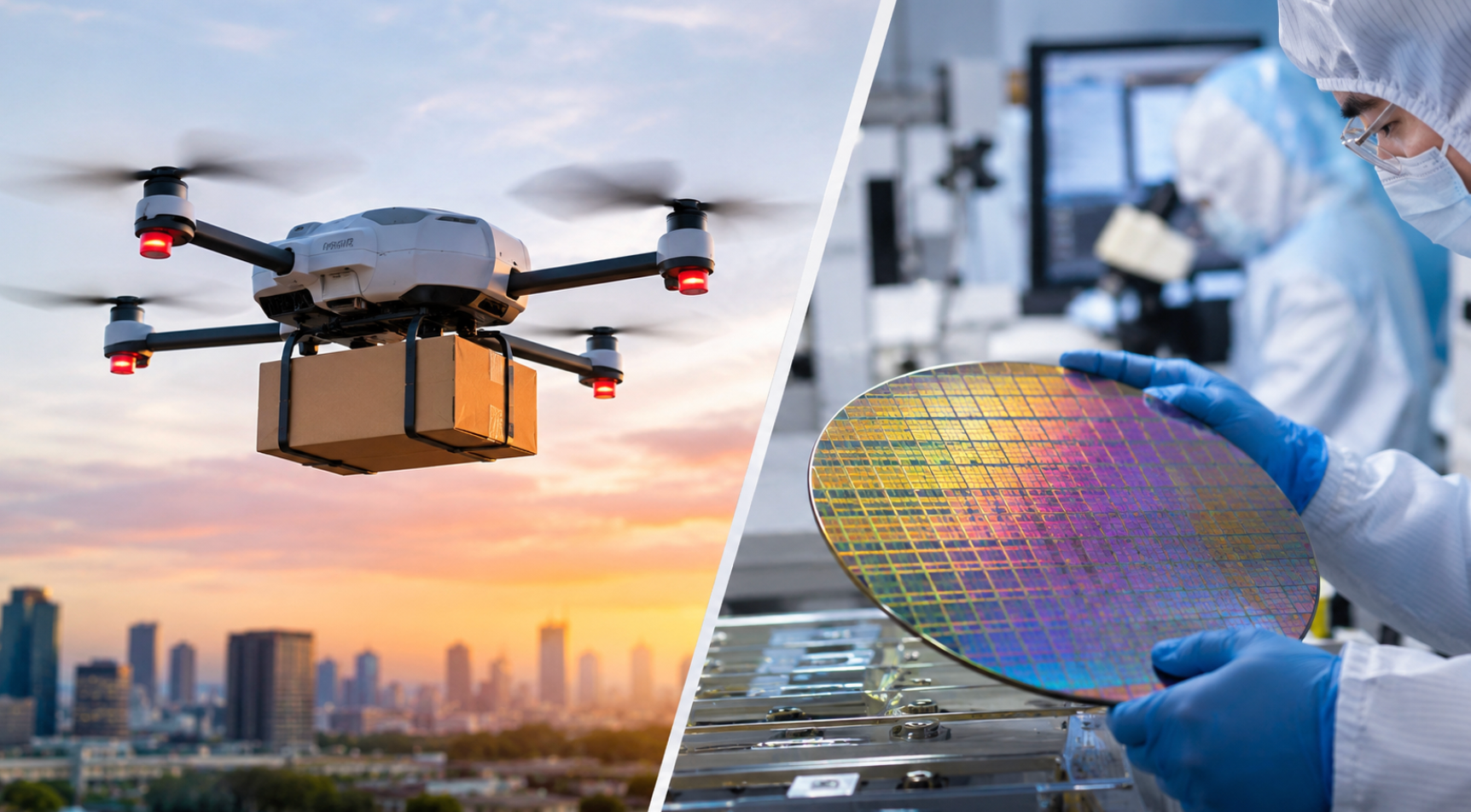
For decades, the stereotypical startup story followed a familiar formula: a small company identifies an underserved market, attracts venture capital, scales rapidly and, if everything goes well, becomes the next technology giant. But two major developments in the United States and Europe suggest that the startup economy is moving into a very different era.
In the United States, autonomous delivery company Zipline has raised $1.5 billion at a $21.5 billion valuation, placing an enormous investor bet on a future where everyday products travel through the sky rather than along congested roads. Meanwhile, the European Union is mobilizing €525 million to support a new generation of semiconductor design startups, attempting to strengthen Europe's position in one of the world's most strategically important industries.
The businesses could hardly appear more different. One builds autonomous aircraft. The other initiative supports companies designing microscopic electronic components.
Yet they represent the same powerful trend: startups are increasingly being asked to build infrastructure that entire economies may eventually depend upon.
Few recent funding rounds illustrate investor enthusiasm for physical technology as dramatically as Zipline's.
On November 5, the drone-delivery company announced a $1.5 billion financing round, valuing it at $21.5 billion post-money. The round was led by Paradigm, WCM Investment Management and Layer Global, with participation from investors including Uber, Tiger Global, Fidelity, J.P. Morgan and Salesforce Ventures.
The valuation is particularly remarkable because Zipline had been valued at $7.6 billion following a $600 million fundraising earlier in 2026. In roughly ten months, its valuation has therefore nearly tripled.
But investors are not simply betting on drones.
They are betting on the possibility of creating an entirely new delivery infrastructure.
Zipline plans to use the capital to expand its U.S. manufacturing facilities, increase hiring and build a nationwide autonomous delivery network. Its ambitions are growing alongside its commercial partnerships: the company says it and Walmart are working to launch 300 additional delivery sites under a new multiyear national agreement. Zipline also partnered with Uber in August to bring autonomous drone deliveries to Uber Eats customers.
The idea is straightforward but potentially transformative. Instead of placing an order and waiting for a car, van or motorcycle to navigate traffic, an autonomous aircraft can transport relatively small items directly through the air.
For medicine, food and everyday retail products, that could radically alter the economics of the last mile — traditionally one of the most complicated and expensive parts of logistics.
Zipline's story is unusual because its commercial journey did not begin primarily in Silicon Valley or another major American market.
Regulatory restrictions around operating drones beyond the visual line of sight initially made large-scale U.S. operations difficult. That pushed Zipline to develop its commercial model internationally.
Today, according to Reuters, the company operates across four continents.
That international experience helped transform what could have remained a futuristic drone experiment into a functioning logistics platform.
Now the American market is accelerating.
Competition is also intensifying. Amazon plans to expand its own drone-delivery service from 11 locations to around 500 U.S. locales by the end of 2026, according to Reuters. Alphabet's Wing and other companies are also developing autonomous delivery networks.
This is becoming less a competition over who can build the best drone and more a race to determine who controls the next generation of delivery infrastructure.
There are still major obstacles. Regulatory approval remains critical, while communities have concerns about noise, safety and the prospect of large numbers of autonomous aircraft operating above populated areas.
Nevertheless, $1.5 billion of new capital sends a clear message: major investors increasingly believe autonomous delivery is moving from experiment toward commercial infrastructure.
Across the Atlantic, Europe is confronting another strategic challenge.
The modern economy runs on semiconductors.
They power smartphones, automobiles, telecommunications networks, medical devices, industrial equipment, defense systems, data centers and increasingly powerful artificial-intelligence infrastructure.
Yet Europe has a striking weakness in one crucial part of this industry: chip design.
According to the European Commission, European chip-design companies currently account for less than 1% of global revenues in the segment.
That helps explain the EU's latest intervention.
On November 4, the European Commission launched the European Chip Design Platform, an initiative intended to mobilize €525 million to stimulate a new generation of European semiconductor design companies.
Of that amount, €440 million will be provided through grants to help startups cover the enormous cost of turning semiconductor designs into commercially viable chips. Another €85 million will support the European Chips Design Platform itself.
This is not merely startup funding.
It is an attempt to correct a strategic weakness in Europe's technology ecosystem.
Designing a semiconductor is extraordinarily expensive and technically demanding.
A brilliant engineering team can have an innovative chip architecture yet still struggle to access the software, intellectual property and manufacturing resources required to transform that design into physical silicon.
Europe's new platform is designed to address precisely those barriers.
It will provide startups with access to chip-design software, technical design services, intellectual-property blocks, training and manufacturing capacity — resources that the European Commission describes as among the most expensive and difficult for young companies to obtain independently.
Funding could reach up to €100,000 for early-stage startups and up to €16 million for more mature companies.
The objective extends beyond creating successful startups.
Europe wants those companies to generate demand for the semiconductor factories it is simultaneously attempting to develop.
As EU technology chief Henna Virkkunen argued when launching the initiative, Europe cannot strengthen its position in the semiconductor industry without becoming stronger in chip design. A successful design ecosystem, in turn, creates demand for domestic manufacturing and strengthens the wider semiconductor value chain.
This is where startup policy begins to resemble industrial strategy.
Semiconductors have become one of the defining strategic resources of the modern world.
The United States, China, South Korea, Taiwan, Japan and Europe are competing for positions across the semiconductor supply chain because dependence on foreign technology can become an economic and geopolitical vulnerability.
Europe's wider Chips Act has sought to increase the bloc's share of global semiconductor production to 20% by 2030, although achieving that target remains challenging.
The new €525 million initiative therefore represents something larger than another European grant program.
It reflects the growing concept of technological sovereignty - the idea that major economies must possess sufficient domestic technological capability to avoid becoming dangerously dependent on foreign suppliers for critical infrastructure.
And startups are increasingly central to that strategy.
Zipline and Europe's semiconductor initiative reveal how radically the meaning of startup innovation is expanding.
Zipline is effectively asking investors to help finance an aerial logistics network. European policymakers are asking semiconductor startups to help rebuild an entire continent's technological capabilities.
Both require more than clever software.
They demand factories, advanced engineering, manufacturing capacity, regulatory frameworks, highly specialized talent and enormous amounts of capital.
This could signal a broader change in global venture investing.
For much of the previous technology boom, some of the most celebrated startups built apps, digital marketplaces and software platforms. Those businesses could often scale internationally without constructing enormous physical infrastructure.
The next generation of strategic startups may look very different.
They could build autonomous transportation networks, semiconductor architectures, robotics systems, energy infrastructure, advanced manufacturing platforms and other technologies embedded directly into the physical economy.
The rewards could be enormous, but so could the capital requirements and risks.
The startup world's favorite symbol has long been the unicorn: a privately held company valued above $1 billion.
But valuation alone may increasingly be the wrong measure of significance.
The more important question could become: What does the world depend on this company to do?
A startup capable of moving millions of packages autonomously could reshape cities, logistics and retail. A semiconductor startup developing strategically important chip architectures could influence industrial competitiveness and technological independence.
That is why the stories unfolding around Zipline and Europe's semiconductor initiative matter far beyond their headline numbers.
The $21.5 billion valuation and €525 million public investment are impressive. But the larger story is where the money is going.
Capital is increasingly flowing toward companies capable of building the systems on which tomorrow's economies may operate.
The startup race is no longer only about creating the next successful company.
Increasingly, it is about building the infrastructure of the future and determining which companies, countries and regions will control it.
For questions or comments write to contactus@bostonbrandmedia.com