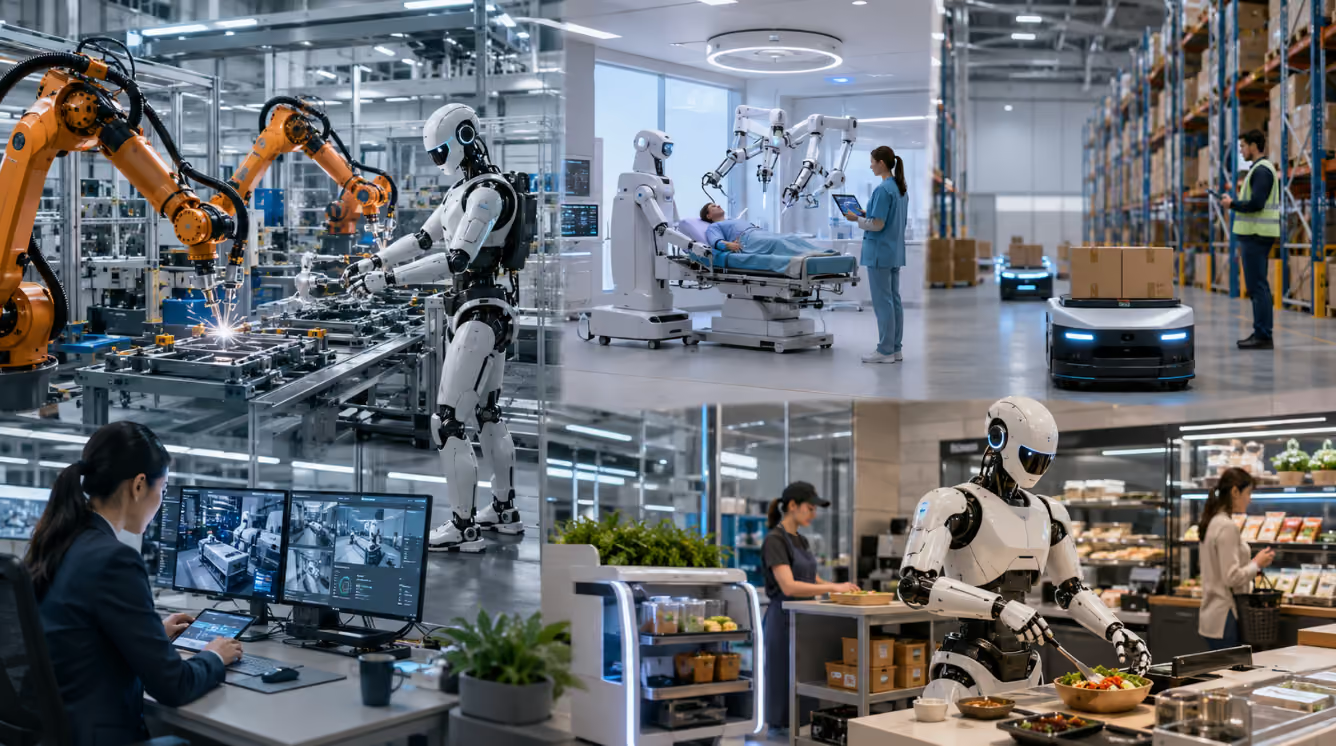
Stay informed with our newsletter.
.webp)


EN





Artificial intelligence is transforming the workplace by automating routine tasks, enhancing productivity and changing the skills employers value most. Rather than simply replacing workers, AI is reshaping roles, creating new opportunities and making human judgment, creativity, adaptability and digital literacy increasingly important. As AI assistants become more common, workers and businesses must learn to collaborate effectively with technology. The future of work will depend on reskilling, responsible adoption and balancing automation with uniquely human capabilities.
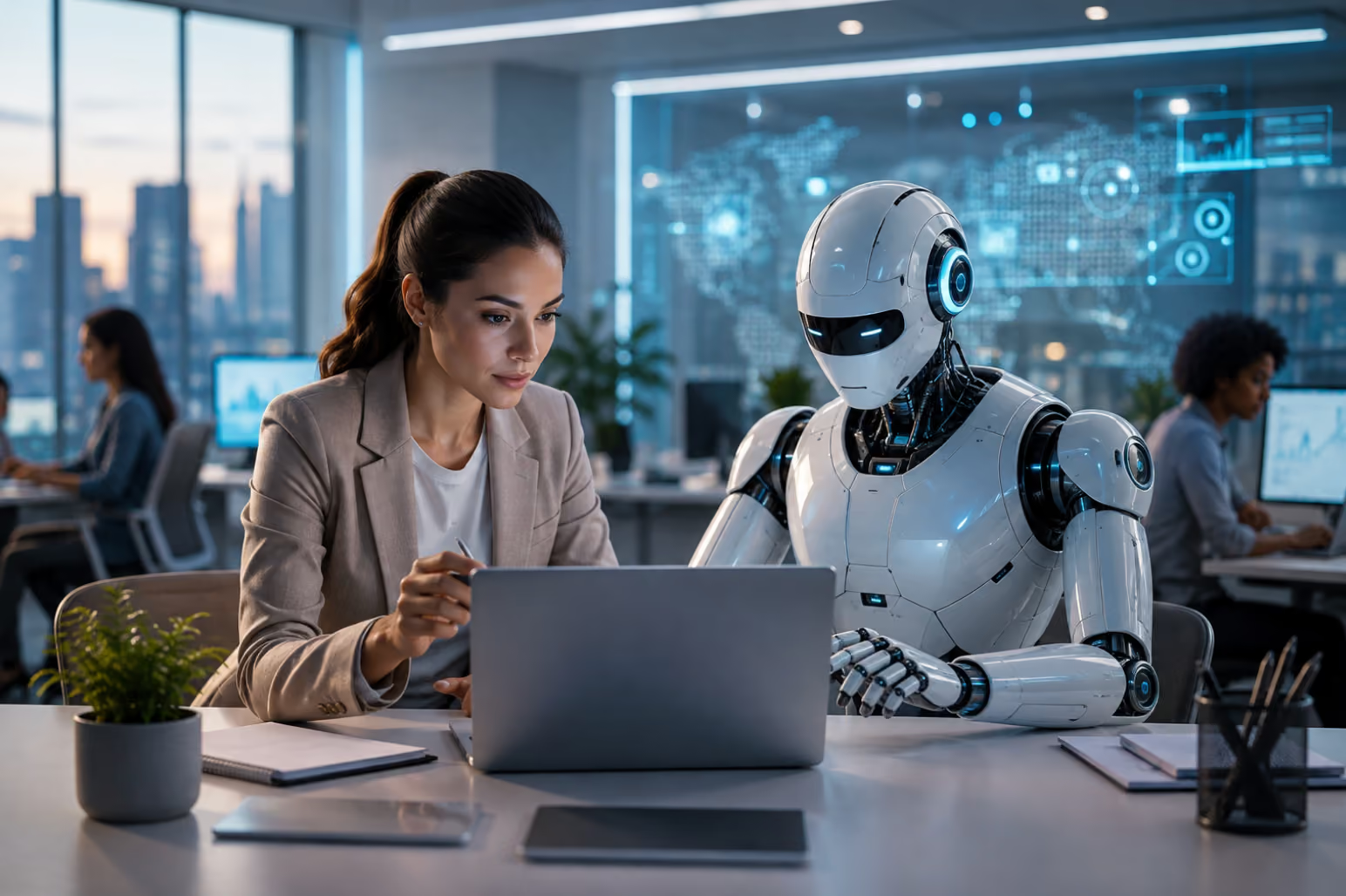
Artificial intelligence is no longer simply a technology story. It is becoming a workforce, productivity and business-transformation story that is changing how companies hire, how employees perform their jobs and which skills will command value in the years ahead.
From generative AI assistants that draft reports and analyse data to autonomous agents capable of completing multi-step workflows, AI is rapidly moving from an experimental workplace tool to a layer of everyday business infrastructure. The important question is therefore no longer simply, “Will AI take jobs?” It is: Which tasks will AI perform, which jobs will change, what new work will emerge, and how quickly can workers adapt?
The scale of potential disruption is substantial.
The International Labour Organization's 2025 global assessment found that approximately one in four workers worldwide is employed in an occupation with some exposure to generative AI. However, only 3.3% of global employment falls into the highest-exposure category. The ILO's central conclusion is particularly important: because most occupations still require substantial human involvement, job transformation is more likely than complete job replacement.
Exposure is also uneven. The ILO estimated that around 34% of employment in high-income countries has some degree of GenAI exposure, compared with approximately 11% in low-income countries. Clerical work remains particularly exposed, while advances in AI are increasingly affecting professional and technical occupations including financial analysis, programming and multimedia work.
The IMF takes an even broader view of artificial intelligence, estimating that almost 40% of global employment could be affected by AI. In advanced economies, exposure could reach approximately 60% of jobs, reflecting the larger proportion of knowledge-intensive and cognitive occupations.
These figures do not mean 40% or 60% of jobs will disappear. Exposure can mean automation, augmentation or substantial redesign.
The World Economic Forum's Future of Jobs Report 2025 projects significant labour-market restructuring through 2030. Across technological, demographic, economic and green-transition forces not AI alone, the WEF estimates that 170 million jobs could be created while 92 million are displaced, producing a net increase of 78 million jobs. Overall structural change could affect approximately 22% of today's formal jobs.
Technology-related occupations are among the fastest-growing, including AI and machine-learning specialists, big-data specialists and fintech engineers. At the same time, jobs involving repetitive administrative activities face greater pressure. Cashiers, administrative assistants and several clerical occupations are among roles expected to decline.
The future of employment, therefore, is unlikely to be a simple contest between humans and machines. It will increasingly involve humans who can effectively work with machines competing with workers and organizations that cannot.
The first generation of workplace generative AI largely functioned as an assistant: summarising meetings, drafting emails, producing code, searching documents and generating presentations.
The next stage is increasingly focused on AI agents capable of planning and executing several connected tasks.
Microsoft's 2025 Work Trend Index, based partly on a survey of 31,000 workers across 31 countries, found that 81% of leaders expected AI agents to be moderately or extensively integrated into their AI strategies within 12–18 months. Another 82% expected digital labour to expand workforce capacity, while 78% of leaders were considering recruitment for new AI-related roles even as 33% considered headcount reductions.
This suggests that future teams could consist of employees supervising networks of specialist AI systems—an analyst working with research agents, a marketer directing content and analytics agents, or an engineer coordinating coding and testing agents.
Managing AI may consequently become a normal professional capability rather than a specialist technical function.
Perhaps AI's most immediate economic impact is productivity.
Stanford University's 2026 AI Index reports that organizational AI adoption reached 88% of surveyed organizations in 2025, while 70% reported using generative AI in at least one business function.
Experimental evidence also demonstrates measurable gains in some occupations. Research summarised by Stanford found that conversational AI helped customer-support workers resolve 14–15% more issues per hour, developers using GitHub Copilot produced 26% more pull requests, and multimodal AI increased output per worker in one marketing experiment by approximately 50%.
But AI does not automatically make every worker faster.
Stanford also highlights research in which developers working on complex open-source projects were 19% slower with AI assistance. Productivity benefits appear strongest when tasks are structured, outputs can be measured and mistakes can be quickly identified. Deep reasoning, ambiguous decisions and highly contextual work remain harder to augment reliably.
The lesson for companies is significant: buying an AI tool is not the same as achieving an AI productivity gain. Workflow design, employee training, data quality, governance and human review determine whether the technology creates genuine value.
One emerging concern is the effect AI could have on junior employees.
Traditionally, graduates acquire expertise by completing relatively routine assignments before progressing to harder work. Those tasks, basic research, initial drafts, simple coding, documentation, data processing and administrative analysis, are precisely where generative AI can often perform well.

Stanford's 2026 AI Index reports early evidence that labour-market effects are disproportionately visible among younger workers in exposed professions. It notes that employment among 22-to-25-year-old software developers declined nearly 20% from 2024, although broader economy-wide mass unemployment attributable to AI has not materialised.
Companies may therefore face a paradox: automating junior tasks can reduce short-term costs, but eliminating too many entry-level opportunities could weaken the pipeline through which tomorrow's experienced professionals are developed.
Workers do not necessarily need to become AI engineers. But increasingly, they will need to understand how to use AI, evaluate its output and know when not to trust it.
The WEF estimates that almost 40% of skills required on the job could change by 2030, while 59 out of every 100 workers may require training or reskilling. AI and big data, cybersecurity and technological literacy are among the fastest-growing skill areas.
Yet the same research finds that distinctly human abilities remain essential. Analytical thinking, creative thinking, resilience, flexibility, leadership, collaboration and lifelong learning are all expected to retain or increase their importance.
That combination may define the most valuable employee of the AI era: someone with technological fluency and human judgement.
AI will eliminate some tasks, reduce demand for certain occupations and create new professions. But its largest effect may be the redesign of existing jobs.
The worker of the future may spend less time producing first drafts, searching databases or performing repetitive calculations and more time setting objectives, verifying outputs, solving exceptions, exercising judgement, building relationships and making decisions.
For employers, this makes reskilling a business strategy rather than an HR initiative. The WEF reports that 77% of employers plan to upskill employees in response to AI, even while 41% anticipate workforce reductions where tasks can be automated.
The defining workforce divide of the coming decade may therefore not be humans versus artificial intelligence.
It may be between organizations and individuals that learn how to combine human intelligence, expertise and creativity with increasingly capable AI systems and those that do not.
AI is changing what machines can do. The future of work will depend on how quickly society decides what humans should do with them.
For questions or comments write to contactus@bostonbrandmedia.com



-v3.jpg)


-v3-02.jpg)