Stay informed with our newsletter.


EN





The world now has 6.3 billion internet users, representing around 76% of humanity, but connectivity remains deeply unequal. While internet usage reaches 93% in high-income countries, it stands at only 32% in low-income economies. The disparity becomes even greater with 5G coverage - 86% versus just 4%. As artificial intelligence transforms economies, unequal access to high-speed networks, affordable data, devices and digital skills could create an even more consequential global digital and economic divide.
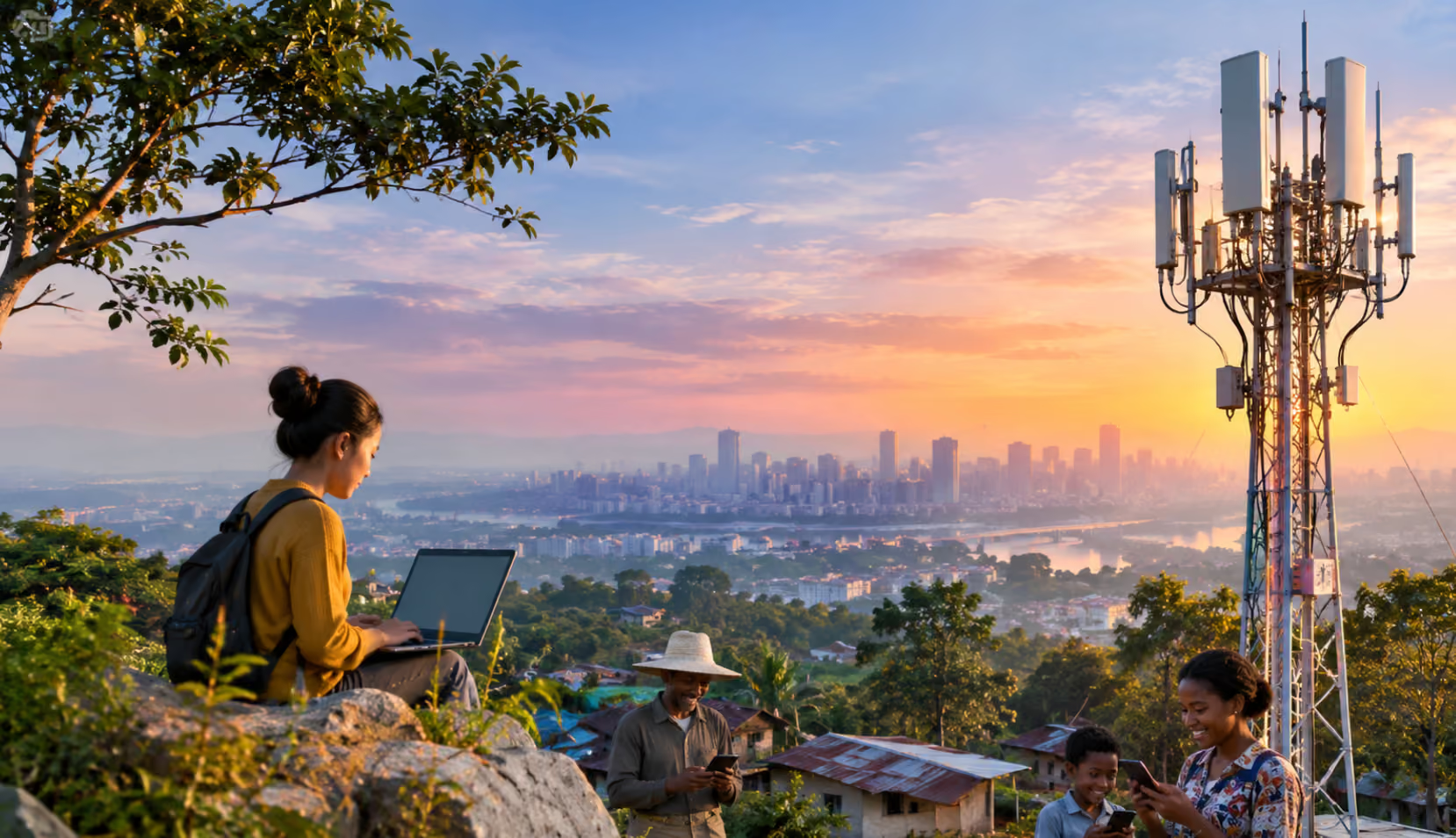
The world has crossed another extraordinary digital milestone. In 2026, an estimated 6.3 billion people are using the internet, meaning roughly 76% of humanity is now online.
That is an enormous transformation. Just a generation ago, internet access was largely concentrated in wealthier economies and among relatively small groups of users. Today, digital connectivity underpins banking, education, healthcare, entertainment, commerce, government services and increasingly the global employment market.
But the latest figures from the International Telecommunication Union reveal an uncomfortable reality behind that achievement: the digital divide has not disappeared. It is evolving.
According to the ITU's newly released Facts and Figures 2026, internet use increased from a revised 6.1 billion people, or 74% of the global population, in 2025 to 6.3 billion in 2026. Yet approximately 2 billion people remain offline. More importantly, the quality, affordability and technological sophistication of connectivity available to those who are online vary enormously.
As artificial intelligence and data-intensive digital services become embedded in economic life, the next great inequality may no longer be simply between people who have internet access and those who do not.
It may increasingly be between those connected to the fast digital economy and those connected to a much slower version of it.
The headline global internet penetration rate of 76% disguises enormous differences between economies.
In high-income countries, 93% of people use the internet. In low-income countries, the figure is only 32%.
That represents a staggering 61-percentage-point gap.
Regional differences are similarly striking. Internet use has reached between 87% and 93% across Europe, the Americas and the Commonwealth of Independent States. Approximately 80% of people in Asia-Pacific and 74% in the Arab States are online.
In Africa, however, only 42% of the population uses the internet.
Least developed countries remain even further behind, with just 41% of their populations online, although internet use in these economies grew by an encouraging 8.7% in 2026.
This means billions of people are entering a global economy increasingly designed around digital participation without having equivalent access to its infrastructure.
Perhaps the most revealing statistic in the ITU report concerns mobile-network technology.
An estimated 97% of humanity now lives within reach of at least a 3G mobile network. At first glance, that suggests the world's connectivity infrastructure is approaching universality.
But look at 5G and an entirely different picture emerges.
Globally, 59% of people are now covered by 5G networks.
In high-income countries, coverage has already reached 86%.
In low-income countries?
Just 4%.
That 82-percentage-point difference matters because internet connectivity is no longer binary.
A person using basic mobile broadband and another using high-speed 5G are technically both "online," but their ability to participate in increasingly sophisticated digital ecosystems can be dramatically different.
Cloud computing, advanced telemedicine, immersive education, industrial automation, real-time collaboration and many emerging AI applications benefit from fast, reliable and low-latency networks.
As these technologies become more important to productivity, countries without advanced connectivity risk being disadvantaged not only technologically but economically.
The digital divide could therefore become a productivity divide.
Another extraordinary statistic illustrates this disparity.
In high-income countries, average monthly mobile broadband traffic reaches approximately 20 GB per subscription.
In low-income economies, it is just 3.4 GB.
People in richer economies are therefore consuming almost six times as much mobile data per subscription.
That difference reflects more than entertainment consumption.
Data increasingly represents participation.
Streaming educational content, attending video meetings, operating online businesses, accessing cloud applications, completing digital training and experimenting with emerging technologies all require bandwidth.
The world's connectivity challenge is consequently shifting from "Can people get online?" to "What can people actually do once they are online?"
Infrastructure is only part of the problem.
Affordability remains one of the most significant barriers to meaningful connectivity.
Globally, the median price of a basic mobile-data broadband package has fallen to approximately 1.2% of gross national income per capita.
But averages conceal extraordinary inequalities.
In low-income countries, a basic mobile-data package costs the equivalent of roughly 8% of monthly income per person - around 20 times the median burden in high-income economies, according to ITU officials discussing the report.
For households already struggling with food, housing, transportation and energy costs, internet access can therefore remain a luxury rather than an everyday utility.
The ITU reports that three in ten economies still meet neither the fixed nor mobile broadband affordability target.
There has nevertheless been progress. For the first time, landlocked developing countries and Small Island Developing States met the widely recognized affordability target of 2% of GNI per capita for mobile broadband.
Least developed countries remain far behind, however, with the median cost standing at 6.1% of GNI per capita.
Digital inequality also exists within countries.
Worldwide, approximately 79% of men use the internet compared with 74% of women.
Age creates another divide. Around 86% of people aged 15 to 24 are online, compared with 74% of the rest of the population.
Geography matters too.
Approximately 82% of urban residents use the internet, compared with only 63% of people living in rural communities.
Even device ownership reveals inequality. Globally, 84% of people aged ten and older own a mobile phone, rising above 95% in high-income economies but falling to only 57% in low-income countries.
These statistics demonstrate why simply building networks will not solve the problem.
Meaningful digital participation also requires affordable devices, affordable data, digital literacy and relevant online services.
The timing of this divide is particularly consequential because the world is entering the age of artificial intelligence.
AI is rapidly becoming embedded in education, scientific research, finance, healthcare, business operations, software development and professional services.
Countries with advanced digital infrastructure, widespread connectivity and strong digital skills will be positioned to adopt these technologies faster.
Those without them could fall further behind.
As ITU Secretary-General Doreen Bogdan-Martin warned when releasing the figures, being offline in the AI era increasingly means being excluded from opportunities ranging from education to employment.
But even being technically online may eventually prove insufficient.
The real question will increasingly become whether people have the speed, affordability, devices and skills required to participate meaningfully in an AI-powered economy.
Reaching 6.3 billion internet users deserves recognition as one of the remarkable infrastructure achievements of the modern era.
But the next challenge is considerably more complicated.
Connecting the remaining 2 billion people matters enormously. Yet governments and technology companies must simultaneously confront the widening differences in connection quality, affordability, data consumption, digital skills and next-generation network access.
The first digital revolution divided the world between the connected and disconnected.
The next may divide it between those with basic connectivity and meaningful connectivity.
And with 86% 5G coverage in high-income countries compared with just 4% in low-income economies, that new divide is already becoming visible.
The world may be approaching universal access to some form of mobile broadband, but universal access to the digital opportunities that increasingly determine economic competitiveness and social mobility remains much further away.
The internet succeeded in connecting most of humanity. The challenge now is ensuring that it does not connect humanity at two radically different speeds.
For questions or comments write to contactus@bostonbrandmedia.com