Stay informed with our newsletter.
.webp)


EN





The U.S.–Iran conflict has entered a fragile pause after weeks of escalating military exchanges, creating an important opening for diplomacy. Iran has indicated it will hold back further attacks while the United States maintains its pause in strikes. However, tensions remain high as unresolved disputes threaten Gulf security, the Strait of Hormuz, global energy markets, and international shipping. The coming negotiations could determine whether the pause develops into lasting de-escalation or renewed confrontation.
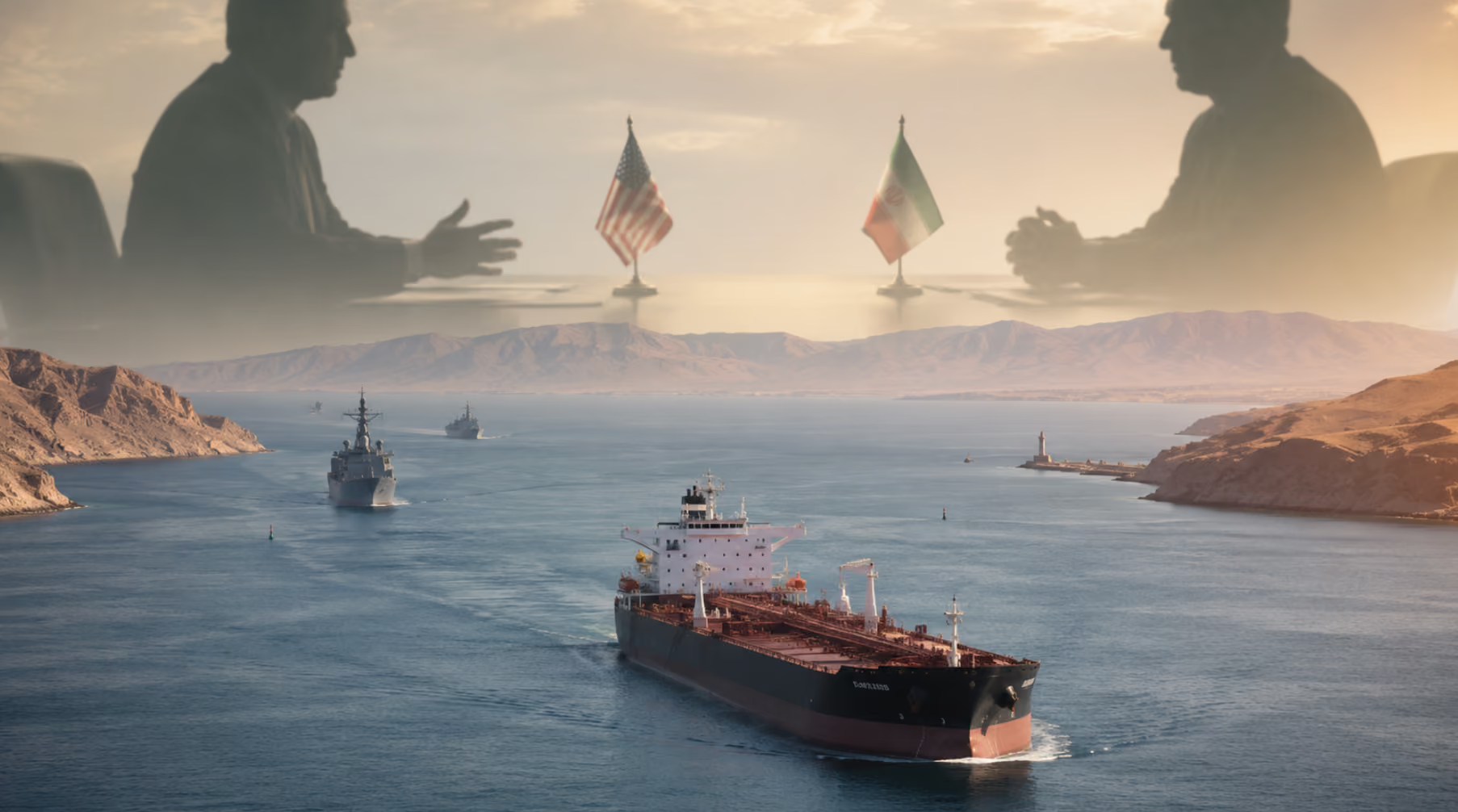
The escalating conflict between the United States and Iran has entered one of its most consequential moments yet. After nearly two weeks of intensifying military exchanges, both sides have temporarily halted attacks, creating a narrow diplomatic opening that could either lead toward de-escalation or collapse into another round of confrontation.
Iran has indicated that it will continue to hold fire as long as the United States maintains its pause in strikes, while Washington has also temporarily suspended its bombing campaign. The pause follows 13 nights of increasingly intense U.S. airstrikes, according to Reuters, and represents a significant shift from the cycle of retaliation that had threatened to destabilize the wider Middle East.
But this is not yet a peace agreement. It is a fragile operational pause, and the conditions that produced the conflict remain unresolved.
The latest pause comes after a period in which U.S. and Iranian forces exchanged attacks across the region, with military infrastructure, shipping routes and strategic assets increasingly drawn into the confrontation.
Iranian attacks on vessels operating near the Strait of Hormuz became one of the central triggers for renewed U.S. military action. Washington subsequently launched additional strikes against Iran, while Tehran and Iran-aligned groups responded with attacks and threats across the region. Bahrain and Kuwait were among the Gulf states affected by Iranian drone and missile attacks during the escalation.
By mid-July, the conflict had widened further, with both the United States and Iran striking military and infrastructure targets while competing for strategic influence over the Strait of Hormuz.
The current pause is therefore significant precisely because it interrupts a pattern in which each attack created pressure for another response.
Diplomatic efforts, including mediation involving Oman, are now attempting to use that pause to revive negotiations and prevent another escalation. However, major disagreements remain, including issues surrounding Iran’s nuclear program, regional security and maritime access.
At the center of the crisis is one of the world’s most strategically important waterways: the Strait of Hormuz.
The narrow channel connecting the Persian Gulf with the Gulf of Oman is a critical route for global oil and gas shipments. Any disruption can quickly influence energy prices, shipping costs, insurance premiums and inflation expectations far beyond the Middle East.
Even during the latest diplomatic pause, shipping through Hormuz remained subdued. Reuters reported that only six commodity-carrying vessels transited the strait on Monday, highlighting how commercial operators remain cautious despite the easing in military activity.
The United States has also demanded assurances that the waterway will remain open and that commercial vessels will no longer face attacks, making freedom of navigation one of the central issues in the wider confrontation.
This matters because the economic consequences of the conflict extend well beyond military targets.
A prolonged disruption to Gulf shipping could affect oil-exporting economies, global manufacturers, airlines, logistics companies and consumers through higher fuel and transportation costs.
Financial markets have already demonstrated how closely the conflict is tied to global energy prices.
As hopes of diplomatic progress increased, oil prices fell sharply. On July 28, Brent crude declined 2.86% to $85.83 per barrel, while West Texas Intermediate fell 2.40% to $80.63, taking both benchmarks to their lowest levels since July 17.
The previous day brought an even stronger market reaction, with oil prices dropping approximately 7% to 9% as investors responded to the shift from active military confrontation toward negotiations.
That movement illustrates an important reality: markets are currently pricing not only the supply of oil, but the probability of further escalation.
Should strikes resume or shipping through Hormuz deteriorate further, energy prices could quickly reverse direction.
Conversely, a sustained ceasefire accompanied by improving tanker traffic could reduce the geopolitical risk premium that has pushed prices higher.
The conflict is not limited to Washington and Tehran.
The broader regional security environment includes Israel, Gulf Arab states, Yemen’s Houthi movement, commercial shipping operators and multiple Iran-aligned groups.
Saudi Arabia has already intercepted drones associated with Iran-aligned forces, while the Houthis have claimed attacks against strategic Saudi oil infrastructure, including the East-West Pipeline linking the kingdom’s eastern oil-producing region with the Red Sea export terminal at Yanbu.
These developments underline why a U.S.–Iran confrontation can quickly become a regional security crisis.
Even if direct American and Iranian attacks remain paused, activity by allied or aligned groups could trigger retaliation and undermine negotiations.
The Bab el-Mandeb Strait, another major maritime chokepoint connecting the Red Sea with the Gulf of Aden, has also become increasingly important.
Shipping activity there recently increased to 28 vessels in one day, the highest level in four days, suggesting some cautious confidence among operators. However, that figure remained below the month’s peak of 46 vessels, demonstrating that normality has not returned.
The pause provides negotiators with something they did not have during continuous military escalation: time.
Oman and other intermediaries are attempting to transform the temporary cessation of attacks into a more durable arrangement.
But diplomacy faces several obstacles.
The United States wants stronger guarantees around shipping, regional security and Iran’s nuclear activities. Tehran, meanwhile, has repeatedly demanded an end to military pressure and restrictions before accepting wider agreements.
The challenge is therefore not simply persuading both countries to stop shooting.
It is creating a framework in which neither side believes it must strike first to protect its strategic interests.
That requires mechanisms for communication, verification and restraint, particularly around naval operations and commercial shipping.
Investors appear to view the pause as encouraging, but not definitive.
Oil prices have fallen, while broader markets have shown relatively limited disruption. Yet continuing tension around shipping, inflation and regional infrastructure means investors are unlikely to treat the crisis as resolved.
The next major signal will be whether commercial traffic through Hormuz begins returning toward normal levels.
Analysts cited by Reuters noted that a more significant decline in oil prices would likely require improved tanker flows through the strait, not merely a temporary absence of airstrikes.
For businesses, this means geopolitical developments could continue influencing energy costs, freight rates, supply chains, currencies and investment decisions.
The current pause could ultimately become remembered as the moment the U.S.–Iran conflict began moving toward diplomacy.
Or it could simply become an interruption between two phases of fighting.
For now, both Washington and Tehran have demonstrated that they are willing to temporarily step back from direct confrontation.
That alone is significant.
But a genuine resolution will require more than silence in the skies. It will require agreements addressing shipping security, military restraint, regional proxy activity and the broader political disputes dividing the two countries.
The stakes are unusually high.
A renewed confrontation could again threaten the Strait of Hormuz, Gulf infrastructure and global energy markets, with economic consequences felt around the world.
A successful diplomatic breakthrough, however, could reduce regional tensions, restore confidence in maritime trade and remove some of the geopolitical uncertainty currently affecting energy prices.
For the moment, the world is watching a fragile ceasefire-like pause rather than a settled peace.
And in a conflict where events have repeatedly escalated within hours, what happens next may matter far beyond Washington and Tehran.
For questions or comments write to contactus@bostonbrandmedia.com



-v3.jpg)


-v3-02.jpg)