Stay informed with our newsletter.
.webp)


EN





Tesla has discontinued its Model S and Model X vehicles as Elon Musk shifts the company’s strategic focus toward robotics and artificial intelligence. The move signals a major realignment of Tesla’s priorities, as resources are redirected from legacy premium models to next-generation technologies. While the decision marks the end of two flagship vehicles, it underscores Tesla’s long-term vision of becoming a leader in robotics, automation, and AI-driven innovation beyond electric cars.
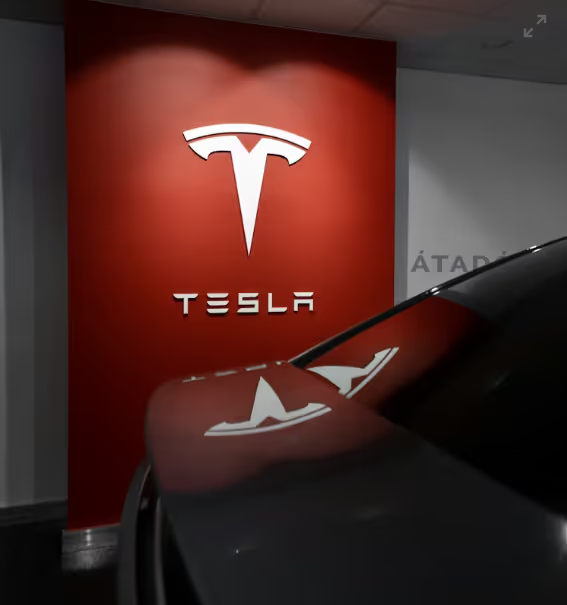
Optimism around Tesla’s Optimus humanoid robot lifted investor sentiment and helped the company outperform market forecasts, even as annual revenue slipped and its core car business continued to struggle. In what appears to be the strongest indication yet of Tesla moving away from electric vehicles, CEO Elon Musk told investors during Wednesday’s earnings call that production of the Model X SUV and Model S sedan would be phased out.
Musk said the company had reached a point where continuing the Model S and X no longer made sense and confirmed plans to shut down their production in the next quarter. He added that Tesla’s Fremont, California facility, currently used to manufacture the Model S and X, would be repurposed to build the company’s upcoming Optimus robots.
Tesla’s latest quarterly earnings highlighted weakening vehicle sales and falling revenue, as Musk increasingly positions the company’s future around artificial intelligence and robotics. The company itself described the past year as a difficult transition, shifting from a hardware-focused automaker to what it calls a “physical AI” company. Despite reporting its first-ever year-over-year revenue decline of 3%, Musk’s expansive vision for AI-powered growth reassured investors and helped Tesla beat Wall Street expectations. The company posted fourth-quarter earnings per share of $0.50, surpassing analyst forecasts of $0.45, while revenue reached $24.9 billion, slightly above projections.
Automotive revenue fell sharply, dropping 11% in 2025. Earlier this month, Tesla disclosed that vehicle deliveries declined 16% year over year in the fourth quarter, driven largely by weakening demand in Europe. Tesla shares initially jumped as much as 4% in after-hours trading before gains moderated. As car sales have slowed, Musk has doubled down on AI-led initiatives such as Optimus robots and fully autonomous Robotaxis. While these technologies remain largely untested, unavailable at scale, and unprofitable for now, they have allowed Musk to promise extraordinary future growth despite limited present-day results.
Musk has repeatedly called Optimus the most important product Tesla will ever make, suggesting robots and autonomous vehicles could help create a future without poverty. According to the earnings report, Tesla aims to begin Optimus production before the end of 2026, with consumer sales expected in 2027. The company also disclosed a $2 billion investment in xAI, Musk’s artificial intelligence venture.
Tesla CFO Vaibhav Taneja revealed that the company plans to spend $20 billion in capital expenditures, a figure far exceeding most analyst estimates. Although Tesla’s stock suffered during Musk’s controversial period in government last year, it surged to a record high in December amid intense investor enthusiasm for AI and Musk’s vision of deploying a “robot army.” A month earlier, shareholders approved a compensation package that could ultimately grant Musk up to a trillion dollars if ambitious performance targets are achieved.
Not all of Tesla’s once-futuristic offerings have delivered on expectations. The Cybertruck, which Musk recently described as Tesla’s best vehicle ever, experienced a steep 48% sales drop last year, according to Kelley Blue Book data. Meanwhile, Tesla faces mounting pressure from competitors, especially China’s BYD, which surpassed Tesla in 2025 to become the world’s largest electric vehicle maker. BYD’s sales climbed 28% last year, aided by more affordable models that appealed to cost-conscious consumers across multiple markets.
For questions or comments write to contactus@bostonbrandmedia.com
Source: theguardian



-v3.jpg)


-v3-02.jpg)