Stay informed with our newsletter.
.webp)


EN





Samsung’s Major Automotive Tech Acquisition: A Strategic Bet on the Future of Mobility highlights how Samsung’s €1.5 billion purchase of ZF Friedrichshafen’s ADAS business strengthens its automotive technology portfolio. The move underscores Samsung’s ambition to play a bigger role in smart, connected, and software-defined vehicles. By combining advanced driver-assistance systems with digital cockpit expertise, the deal signals growing tech-industry influence on safer, more intelligent mobility solutions.
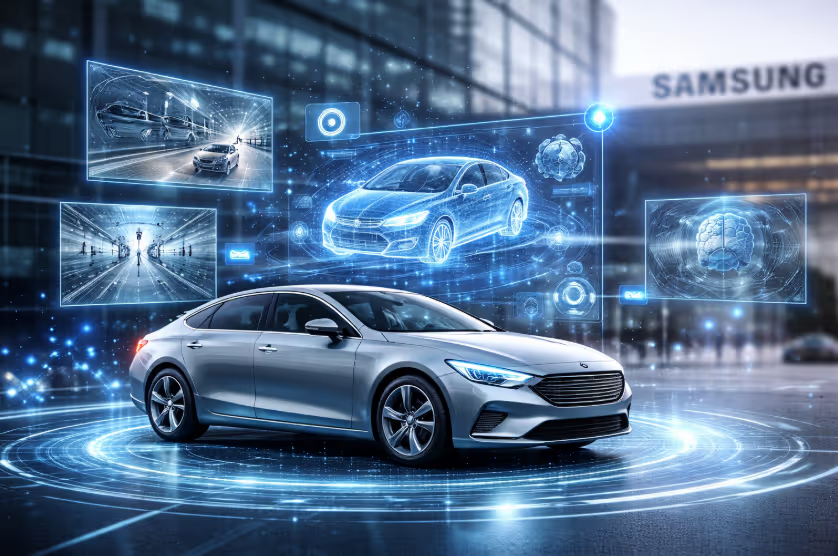
Samsung Electronics has made headlines with a bold move into the automotive technology space, securing a €1.5 billion acquisition of the Advanced Driver Assistance Systems (ADAS) business from Germany’s ZF Friedrichshafen AG. This deal, expected to close in the second half of 2026, marks a significant strategic shift for Samsung and its subsidiary HARMAN International, signaling deeper involvement of tech conglomerates in the rapidly evolving world of connected, autonomous, and software-defined vehicles.
The acquisition is far more than just another headline-grabbing transaction. It represents a deliberate repositioning of Samsung’s automotive footprint, from a supplier of components to a key player shaping the future of mobility. As vehicle architectures increasingly prioritize intelligence, connectivity, and safety, the combination of HARMAN’s digital cockpit expertise with ZF’s ADAS technology creates a powerhouse capable of delivering an integrated hardware-software platform that OEMs (original equipment manufacturers) will find hard to overlook.
Before diving into the implications of the acquisition, it’s important to understand ADAS itself. Advanced Driver Assistance Systems are technologies designed to improve vehicle safety and assist drivers with critical functions, such as automated braking, lane keeping, pedestrian detection, and adaptive cruise control.
These systems rely on a mix of sensors, cameras, radars, and increasingly sophisticated compute platforms to interpret the vehicle’s environment in real time. As cars become more connected and autonomous, ADAS transitions from being a luxury feature to a core component of safety and automation.
ZF has been a key player in this space, producing smart cameras, radar systems, and software that support a range of ADAS functions in millions of vehicles globally. Its technologies are now installed in a wide range of cars and are considered foundational for the next steps toward fully autonomous driving.
Samsung’s automotive strategy has been building for several years, but this acquisition accelerates that vision. HARMAN International, acquired by Samsung Electronics in 2017, has grown from an audio specialist into a major automotive technology supplier, particularly known for digital cockpit systems that integrate vehicle infotainment, connectivity, and in-car user experiences.
By adding ZF’s ADAS capabilities, including compute solutions, smart cameras, radar, and associated software, HARMAN can now combine driver assistance, safety systems, and digital cockpit platforms under a unified, centralized compute architecture. This is a crucial advantage as carmakers pivot toward software-defined vehicles (SDVs), vehicles where software, not hardware, defines key features and capabilities.
Centralized computing replaces the old model of dozens of separate electronic control units (ECUs) with a single powerful platform capable of executing multiple functions simultaneously. This not only simplifies vehicle architecture for OEMs but also enables more rapid innovation, easier updates, and improved safety performance.
Combining HARMAN’s cockpit systems with ZF’s ADAS technology positions Samsung as a key provider of integrated safety and driver assistance solutions. As global regulations push for higher safety standards and as consumers demand more autonomous features, this combined portfolio allows Samsung to serve carmakers with end-to-end solutions, from user interface tech to core vehicle intelligence.
2. Strengthening the Software-Defined Vehicle Play
SDVs represent the future of the automotive industry. These vehicles depend on powerful centralized computing, modular software updates, and cross-domain data integration to deliver advanced features and keep pace with consumer expectations. By owning both the cockpit interface and driver assistance technology, Samsung can help OEMs build more seamless and intelligent platforms, shortening development cycles and reducing system complexity.
3. Leveraging Global Scale and Ecosystem Integration
Samsung’s broader ecosystem, from smartphones to home devices, offers unique opportunities for connected experiences. Imagine a future where a car’s interface communicates smoothly with a driver’s smartphone, home devices, and cloud services. This “home-to-car, car-to-home” vision of mobility is now more achievable with integrated ADAS and cockpit technology under one roof.
4. Helping ZF Refocus and Grow
For ZF, divesting the ADAS business helps sharpen its focus on its core strengths, such as chassis, driveline, and powertrain systems, while reducing its financial liabilities. At the same time, it ensures that its ADAS technology, developed over years of industry leadership, will continue to grow under a company with a strong automotive and electronics strategy.
The automotive industry has been undergoing a seismic shift for the past decade. Cars are no longer mechanical machines alone; they’re rapid innovation platforms that blend hardware, software, and user experience. This acquisition underscores several broader trends:
Samsung’s move is part of a broader pattern where technology giants, not just traditional OEMs or automotive suppliers — are taking prime positions in vehicle tech. From Google and Apple exploring car software and interfaces to semiconductor leaders expanding automotive silicon portfolios, the industry’s boundaries are reconfiguring around software, data, and connectivity.
The lines between carmakers, software developers, and technology suppliers are blurring. SDVs require expertise in operating systems, high-performance computing, AI, and integrated safety systems, areas where tech firms naturally excel. Samsung’s acquisition accelerates this trend and raises the competitive stakes for players who can’t deliver integrated solutions.
Consumer safety and regulatory compliance are also major drivers of ADAS adoption. With regulations mandating advanced braking, lane-keeping, and collision avoidance systems in many regions, automakers need reliable partners to deliver these technologies at scale. Samsung’s new ADAS capability makes it a go-to source for OEMs looking for turnkey solutions.
As Samsung and HARMAN work toward closing the deal in 2026, several key developments are likely to shape the company’s trajectory:
Samsung will need to integrate ZF’s technologies with its existing automotive platforms. This includes aligning engineering teams, harmonizing software stacks, and ensuring scalability for OEM partners. The payoff, however, could be significant: a unified platform that supports advanced automated driving features, intuitive user experiences, and scalable upgrades.
Vehicle manufacturers will be watching closely. Those seeking to accelerate their SDV strategies may find Samsung’s expanded portfolio especially attractive. Strategic partnerships or co-development agreements could emerge, particularly in EV segments and premium vehicle lines.
Samsung’s broader ecosystem, from Galaxy devices to smart home platforms — might be leveraged to redefine in-car user experiences. Imagine seamless transitions from daily life to driving scenarios with context-aware interfaces and synchronized services.
Samsung’s acquisition of ZF’s ADAS business through HARMAN is far more than a headline acquisition. It’s a strategic anchor in the company’s long-term vision of shaping the next generation of intelligent, connected, and safer vehicles.
By combining world-class digital cockpit systems with advanced driver assistance technology, Samsung is positioning itself at the intersection of safety, autonomy, and user experience, all of which define the future of mobility. As the automotive industry continues its transformation, the companies that can bring integrated hardware-software solutions to market fastest will lead the way. And with this acquisition, Samsung has signaled it intends to be among them.
For questions or comments write to contactus@bostonbrandmedia.com



-v3.jpg)


-v3-02.jpg)