Stay informed with our newsletter.
.webp)


EN




Today’s consumer is informed, connected, and increasingly selective. Purchase decisions now move across search, social media, video, reviews, communities, and AI-powered discovery, making traditional linear journeys less reliable. Businesses need first-party research to understand what customers value, where friction occurs, and how expectations change. By combining surveys, interviews, analytics, social listening, and CRM insights, organizations can turn customer knowledge into better products, stronger experiences, smarter decisions, and sustainable long-term business growth in an unpredictable marketplace.
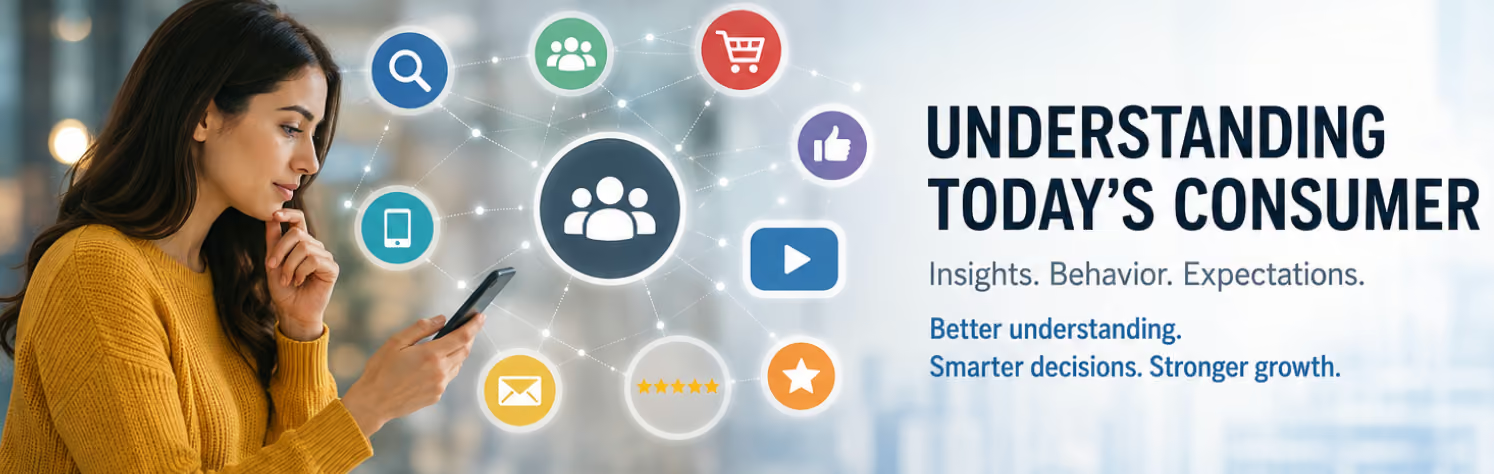
Understanding consumers has always been fundamental to business success, but in 2026, the challenge is no longer simply knowing who customers are. Organizations must understand how people research, compare, evaluate, purchase, and communicate with brands across an increasingly complex range of touchpoints.
Consumers today have access to more information than at any point in the traditional buying journey. Search engines, social platforms, online reviews, video demonstrations, expert articles, digital communities, AI-powered tools, and recommendations from friends or creators can all influence a single purchase decision.
Google’s consumer research illustrates just how fragmented this journey has become. In 2025, Google reported that 8 in 10 online purchase journeys involved multiple touchpoints, reinforcing the idea that modern buying behavior rarely follows a simple path from awareness to consideration to purchase. Consumers may discover a product through social media, research it through Google, watch demonstrations on YouTube, read reviews, compare competitors, and return days later to make a decision.
For businesses, this means one thing: assumptions about customers are increasingly risky.
The modern customer can independently investigate a brand before ever speaking to a salesperson.
A prospective buyer might compare prices online, examine customer reviews, research alternatives, ask questions in online communities, watch demonstration videos, or use an AI-powered search experience to understand a complicated product.
This abundance of information gives customers greater control over the buying process. It also raises expectations.
Consumers increasingly expect brands to provide information that is clear, relevant, trustworthy, accessible, and useful wherever they choose to research.
Google and Ipsos research across multiple markets found that 75% of consumers wanted brands to demonstrate that they understand their needs, while 61% wanted that understanding reflected in branded communications.
That is an important distinction. Effective personalization is not simply inserting someone's name into an email. It means understanding what information, service, solution, or experience is relevant to that person.
Industry reports provide useful benchmarks, but they cannot answer every question about an individual organization’s customers.
That is where first-party research becomes valuable.
First-party research refers to information a business gathers directly from its own customers, prospects, users, or stakeholders. It can reveal issues and opportunities that broader industry research may never identify.
Useful research methods include:
Customer satisfaction surveys, which can track satisfaction and identify recurring problems.
One-on-one interviews, which allow businesses to understand motivations and experiences in greater depth.
Focus groups, which can explore perceptions, expectations, reactions, and ideas.
Website and digital analytics, which reveal how users actually navigate, engage, and convert.
Social listening, which helps organizations understand conversations, concerns, questions, and sentiment.
CRM analysis, which can identify patterns in purchasing, retention, engagement, and customer relationships.
Each method answers different questions. The strongest research programs therefore combine quantitative data, what is happening, with qualitative insight, why it is happening.
This article highlights Netflix as an example of a company that uses customer information to guide recommendations and content decisions. Viewing behavior, searches, engagement patterns, and user feedback can provide signals about what audiences value and how they interact with content.
The broader lesson extends far beyond streaming.
Every business generates customer signals.
A healthcare organization may identify patterns in appointments and cancellations. A retailer may study repeat purchases. A financial services business may analyze common support questions. A B2B company may examine which educational content attracts the most qualified prospects.
Data becomes valuable when organizations ask the right question:
What is customer behavior telling us that we do not already know?
This article identifies several expectations increasingly influencing customer decisions:
Personalization. Convenience. Sustainability. Fast customer support. Transparent communication. Ethical business practices.
These expectations should not be treated as isolated trends. Together, they point toward a broader shift: customers expect brands to make interactions easier while demonstrating that they understand and respect the people they serve.
Convenience without trust can feel impersonal.
Personalization without transparency can feel intrusive.
Technology without responsive human support can create frustration.
Successful customer strategy therefore requires balance.
One of the biggest mistakes businesses make is collecting customer data without creating a clear process for acting on it.
A survey alone does not improve customer experience.
A dashboard alone does not improve retention.
An analytics platform alone does not create growth.
Research creates value when insight leads to action.
This article provides an illustrative healthcare example: declining appointment retention prompted a provider to survey patients. Feedback indicated that communication rather than clinical care was the major issue. Improvements to reminders and follow-up communication were then used to address that pain point.
The process is simple but powerful:
Identify the problem.
Gather evidence.
Find recurring patterns.
Prioritize improvements.
Test solutions.
Measure results.
Refine continuously.
This creates a cycle of customer-led improvement rather than occasional research projects.

Organizations sometimes measure what is easy instead of what is useful.
Thousands of website visits may look impressive, but did those visitors find what they needed?
High social engagement may create visibility, but did it improve brand consideration?
A large customer database may look valuable, but is the organization actually learning from it?
The objective of consumer research should not be to create more data. It should be to create better decisions.
Research can help organizations answer questions such as:
Why are customers choosing us?
Why are others choosing competitors?
Where is friction appearing?
Which customer groups have different needs?
What creates loyalty?
What causes customers to leave?
Which products, services, or experiences should we improve?
Those answers can influence everything from product development and marketing to customer service, pricing, communications, and long-term strategy.
Technology will continue to reshape how consumers discover products and interact with businesses. AI will accelerate research and personalization. Digital channels will continue to multiply. Consumer expectations will keep changing.
But the foundation of good business strategy remains remarkably consistent:
Understand people before making decisions for them.
Businesses that continuously listen to customers can identify emerging needs earlier, reduce uncertainty, improve experiences, and make more informed investments.
In a marketplace defined by abundant information and rapidly changing behavior, organizations do not necessarily need more assumptions, more campaigns, or more technology.
They need better customer understanding.
And that begins with research.
For questions or comments write to contactus@bostonbrandmedia.com



-v3.jpg)


-v3-02.jpg)