Stay informed with our newsletter.
.webp)


EN





Nepal is facing a devastating humanitarian crisis after a massive flash flood struck the Nepal-China border on August 26, 2026. The disaster was triggered by a glacier collapse that sent water, ice, rocks and mud through Himalayan river valleys, destroying communities and critical infrastructure. More than 600 people have died and nearly 3,000 remain missing, while thousands have been rescued. Search operations continue despite difficult terrain and secondary flood risks. Nepal now faces billions of dollars in reconstruction costs.
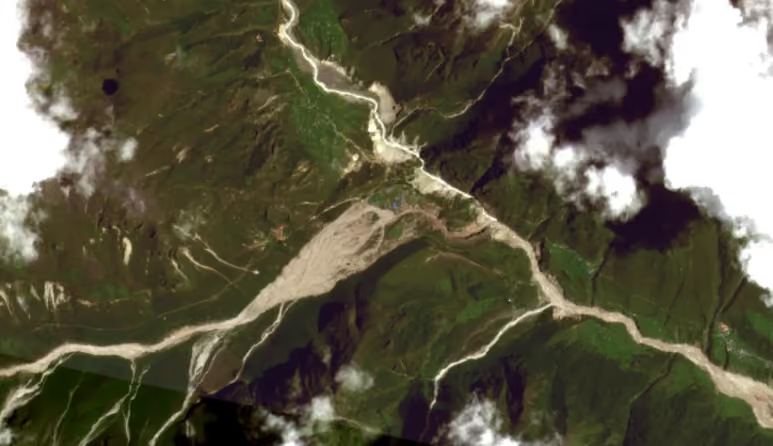
KATHMANDU, Nepal — Nepal is facing a devastating humanitarian crisis after catastrophic flash floods swept through communities along the country's northern border with Tibet on August 26, leaving hundreds dead and thousands missing.
The disaster was not a conventional monsoon flood. It was triggered by a massive glacier collapse in the Himalayas that sent an enormous surge of water, ice, rocks, mud and debris rushing through mountain river valleys. The powerful flood destroyed homes, bridges, roads, hydropower facilities and other critical infrastructure in a matter of minutes.
As rescue teams continue searching through devastated areas, Nepal's authorities reported at least 669 deaths in the country as of August 29, while seven additional deaths were reported in Tibet. Nearly 3,000 people remain missing across the affected areas. The numbers are expected to change as emergency teams reach remote locations that remain difficult to access.
The immediate cause of the disaster was a glacier collapse high in the Himalayan region near the Nepal-Tibet border. Experts believe an ice avalanche and associated rock and debris movement sent a huge volume of material into the river system, creating a sudden and extremely powerful flood.
Unlike a normal river flood, which may provide communities with hours or even days of warning, this event developed with extraordinary speed. Water and debris rushed down steep Himalayan valleys, leaving little time for people living or working near the rivers to escape.
The floodwaters carried enormous amounts of mud, rocks and other debris. This dramatically increased the destructive force of the water and helped destroy infrastructure along the river corridor.
Experts have also warned that a changing Himalayan climate may increase the vulnerability of glaciers and mountain slopes. Rising temperatures can contribute to glacier retreat and instability, while changes in frozen ground and mountain structures can increase the risk of landslides, avalanches and other glacier-related hazards. However, scientists are still examining the exact chain of events behind this particular collapse, and it would be too early to attribute it to climate change alone.
Nepal's geography made the disaster particularly dangerous. The country is dominated by steep mountains and narrow river valleys, with communities and infrastructure often located along waterways that connect the high Himalayas with lower elevations.
When a huge quantity of water and debris suddenly enters one of these valleys, the flow can accelerate rapidly. Instead of gradually rising, the river can transform into a destructive wall of water, mud and rock.
The August 26 disaster destroyed bridges and roads and severely damaged buildings and power facilities. Officials have reported that dozens of bridges were destroyed and large sections of roads were damaged, making it extremely difficult for rescuers to reach some of the worst-hit communities.
The destruction has also affected important transportation and trade routes between Nepal and China, adding an economic dimension to the humanitarian crisis.
The scale of the human tragedy continues to emerge.
Hundreds of people have died, while thousands remain missing. Among those missing are foreign nationals who were traveling through the Himalayan region, including people on pilgrimage and tourism trips.
Many families have been left waiting for information about relatives whose whereabouts remain unknown. In some areas, entire communities have been devastated, while emergency workers have had to establish temporary facilities to handle the large number of recovered bodies.
Authorities are also preparing to collect DNA samples to help identify victims whose remains cannot immediately be recognized.
For survivors, the crisis is only beginning. Many have lost homes, possessions, jobs and access to basic services. Others remain stranded in areas cut off from the main road network.
Nepal has resumed large-scale search-and-rescue operations after poor weather temporarily interrupted efforts.
Military personnel, police officers and emergency workers have been deployed across the affected region. Helicopters have become particularly important because damaged roads and destroyed bridges have left some communities accessible only by air.
Rescue teams are searching collapsed structures, tunnels and areas buried beneath mud and debris. The difficult terrain and continuing risk of additional flooding have made the operation extremely dangerous.
Nepal has requested specialized international assistance for particularly difficult rescue and recovery operations. India and China have also provided personnel, equipment and other assistance as the two countries work alongside Nepal to respond to the disaster.
Even as rescuers search for survivors, authorities remain concerned about the possibility of additional flooding.
The original disaster created or altered water bodies in the mountainous region, raising concerns that unstable lakes could suddenly release large quantities of water.
Authorities have been monitoring these areas closely. One newly formed lake near the border has reportedly begun draining naturally, reducing the immediate danger, but officials continue to monitor the situation because the Himalayan terrain remains unstable.
This means the disaster response is not simply a search for survivors. Emergency teams must also consider the possibility of another sudden flood or landslide.
The floods have caused extensive damage to Nepal's infrastructure.
Roads have been washed away, bridges destroyed and power facilities damaged. In some areas, mud and debris have covered buildings and roads several feet deep.
Hydropower infrastructure has been particularly vulnerable because many facilities are located close to rivers and mountain valleys. Damage to these facilities could affect electricity supplies and the country's economy.
The destruction of roads and bridges has created another major challenge: getting food, medicine, drinking water and other necessities to people who are trapped in isolated communities.
Satellite imagery released after the disaster has shown the dramatic changes to river channels and surrounding areas.
The immediate priority remains finding survivors and providing emergency assistance, but Nepal is already facing the enormous task of rebuilding.
The government has estimated that reconstruction could cost between $4 billion and $5 billion. Roads, bridges, power stations, homes and other infrastructure will need to be repaired or rebuilt.
The economic consequences could extend well beyond the directly affected communities. Trade routes with China have been disrupted, tourism has been affected and thousands of people have lost their livelihoods.
For families who have lost homes and income, recovery could take years.
The disaster has renewed concerns about the increasing risks facing Himalayan communities.
The Himalayas are experiencing significant environmental changes as temperatures rise. Glaciers are retreating in many parts of the region, while scientists are studying how warming conditions could affect glacier stability, mountain slopes and glacial lakes.
That does not mean climate change directly caused every individual flood or glacier collapse. Natural geological processes, weather conditions and local terrain can all play important roles.
But scientists increasingly warn that a warmer Himalayan environment can create conditions in which certain hazards become more dangerous.
The Nepal disaster demonstrates why early-warning systems, satellite monitoring, glacier surveillance and emergency communication networks are becoming increasingly important.
For Nepal, the immediate focus is finding the missing, rescuing survivors and delivering emergency supplies.
The country must then move toward a much longer recovery process. Communities will need temporary and permanent housing. Roads and bridges will have to be rebuilt. Schools and hospitals will need repairs. Electricity and communications networks must be restored.
The government will also face difficult questions about how to make infrastructure safer in a region increasingly exposed to extreme natural hazards.
International cooperation will be critical. Nepal's mountainous geography means that neighboring countries and international organizations can play an important role in providing satellite information, technical expertise, emergency equipment and financial assistance.
The Nepal floods of August 2026 are more than a story about extreme flooding. They are a reminder of the extraordinary forces shaping life in the Himalayas.
A glacier collapse high in the mountains can trigger a chain reaction capable of destroying communities many miles downstream. For people living in narrow valleys, the difference between safety and disaster can sometimes be measured in minutes.
As rescue teams continue their work on August 29, families across Nepal and around the world are still waiting for news about missing loved ones.
The floodwaters may eventually recede, but Nepal's recovery will take much longer.
The country now faces the enormous task of rebuilding its communities, restoring critical infrastructure and preparing for a future in which Himalayan disasters may become increasingly difficult to predict.
For questions or comments write to contactus@bostonbrandmedia.com



-v3.jpg)


-v3-02.jpg)