Stay informed with our newsletter.
.webp)


EN





Massive wildfires are threatening Bordeaux and several regions of Spain as extreme heat, drought, and dry vegetation create dangerous fire conditions across Europe. Thousands of residents have been evacuated while firefighters battle rapidly spreading flames near communities, forests, and tourist areas. The crisis highlights Europe’s growing vulnerability to prolonged heatwaves and increasingly severe wildfire seasons, raising urgent concerns about public safety, environmental damage, economic disruption, and the need for stronger climate adaptation and disaster preparedness.
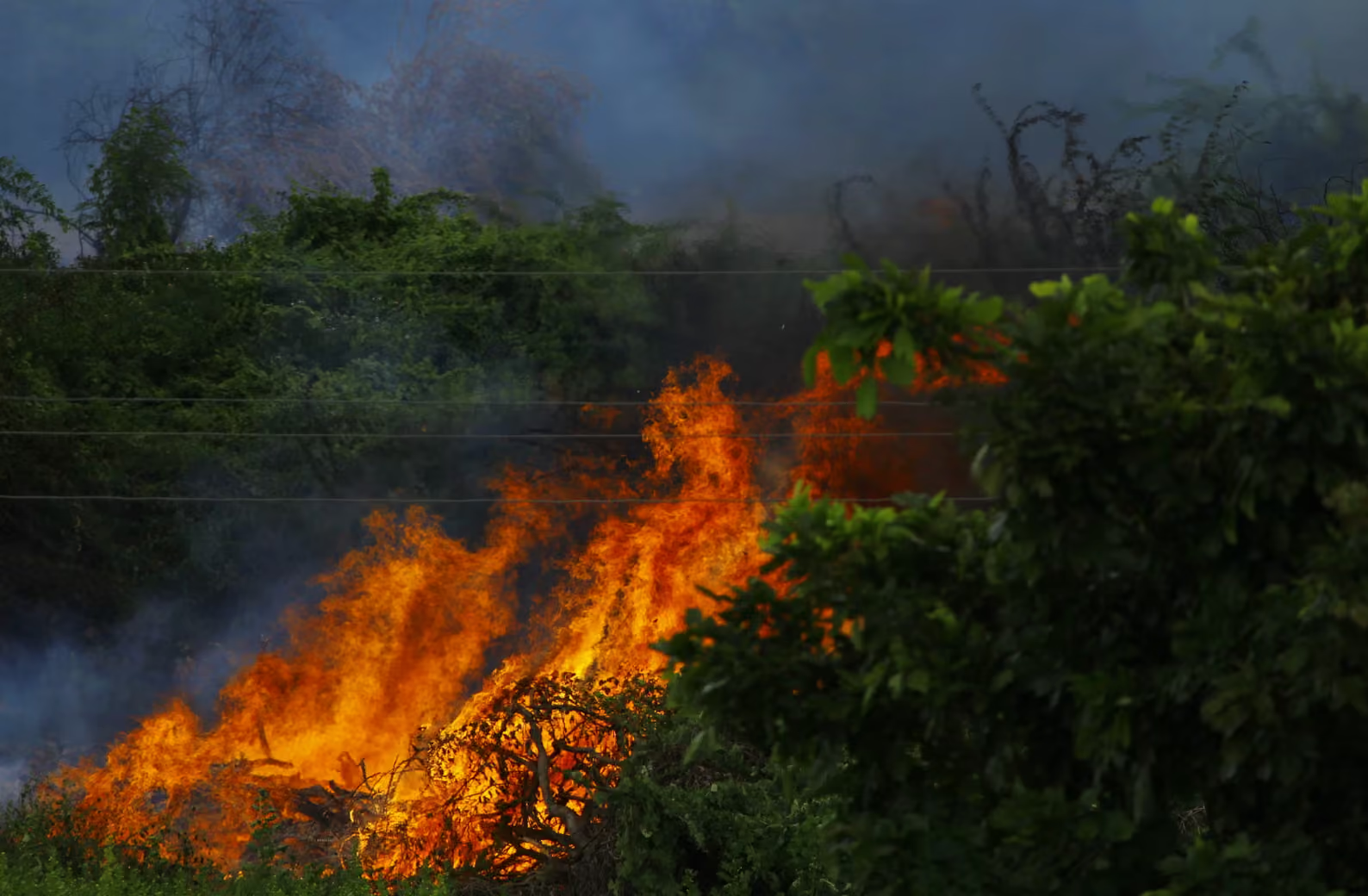
Europe is once again confronting the destructive consequences of extreme heat, prolonged drought and fast-moving wildfires, as major fires threaten southwestern France and large parts of Spain. Around the historic French city of Bordeaux, firefighters are fighting to prevent flames from advancing toward populated suburbs, while Spain has declared a national emergency amid multiple large fires.
The scale of the crisis has become extraordinary. By July 26, around 220,000 people had been evacuated in France, while approximately 75,000 people had been evacuated in Spain, according to Reuters. Fires have threatened communities, tourist destinations, forests, infrastructure and agricultural areas across both countries.
The emergency is being intensified by a combination scientists and emergency authorities have warned about for years: high temperatures, dry vegetation, drought and strong winds. Together, these factors can turn an ignition into a rapidly spreading wildfire capable of overwhelming local firefighting resources.
Southwestern France has become one of the focal points of the European wildfire emergency.
By July 26, fires were reported to have advanced to roughly 15 kilometers from Bordeaux's city limits, placing authorities under intense pressure to protect one of France's largest metropolitan areas as well as the surrounding wine-producing region. The wider Aquitaine area has experienced mass evacuations, while firefighters have worked to establish defensive lines between the flames and populated communities.
Earlier, fires had already prompted evacuations in communities including Le Haillan, Eysines and Mérignac, with displaced residents being taken to Bordeaux's main exhibition center. Reuters reported that 167,000 people had been evacuated from the Gironde region as the situation deteriorated. The French army was also deployed to support emergency operations.
Particular concern has surrounded the Cap Ferret peninsula and Arcachon Bay, popular Atlantic holiday destinations west of Bordeaux. One rapidly spreading fire in the area forced more than 10,000 people to leave homes and campsites, with hundreds of firefighters deployed as flames spread through exceptionally dry vegetation.
For Bordeaux, the threat extends beyond the immediate danger to residents. The wider region is internationally famous for its vineyards, forests, tourism industry and agricultural economy, meaning widespread fires could create environmental and economic consequences that continue long after the flames are extinguished.
Across the border, Spain is fighting multiple major wildfires simultaneously.
The Spanish government declared a national emergency as fires spread through several regions, enabling greater coordination of resources and emergency support. Fires have affected areas around Madrid, Ávila, Valencia and other parts of central and eastern Spain, while emergency services have struggled with high temperatures and changing winds.
One of the most serious fires has been burning in Ávila, where more than 50,000 hectares were reported scorched. Additional fires have affected Castellón and environmentally important natural areas. By July 26, more than 150,000 hectares had burned across Spain during 2026, approximately six times the area recorded at the same stage of the previous year, according to Reuters.
The human cost is also mounting. Spanish authorities confirmed at least one death in a wildfire around Manises in Valencia, illustrating how quickly these disasters can become deadly when communities, roads and homes lie in the path of advancing flames.
The current emergency follows a devastating recent history for the Iberian Peninsula. Copernicus reported that in 2025, Europe experienced a record 1,034,552 hectares of burned land, with Spain and Portugal accounting for roughly 65% of Europe's total burned area. Spain had recorded around 380,877 hectares burned by the end of August 2025, about 4.6 times its 2006–2024 average for the same period.
One of the defining features of the current crisis is the extraordinary heat.
In France's Aquitaine region, the average July temperature was reported at approximately 32.2°C, around 7.3°C above historical July norms. Such temperatures rapidly remove moisture from soils, grasses, shrubs and forests, creating what firefighters often describe as tinderbox conditions.
Wildfires still need an ignition source, which may be human activity, infrastructure failures or natural causes such as lightning. But once a fire starts, weather and vegetation conditions determine how aggressively it can spread.
The Fire Weather Index, used by the European Forest Fire Information System, considers factors including temperature, humidity, wind and rainfall to evaluate conditions favorable to wildfire development. Copernicus had already warned in early July of high fire risk across Spain and France.
Climate change does not mean every individual wildfire is directly caused by global warming. However, rising temperatures and more severe heat and drought conditions can create environments in which fires ignite more easily, spread faster and become harder to control.
The situation in France and Spain is not occurring in isolation.
Copernicus has documented significant wildfire events across Europe during recent years, while its emergency mapping service recorded incidents during July 2026 in France, Spain, Germany, Croatia and the United Kingdom, among other locations.
Countries including Greece, Italy, Portugal and Turkey have provided support to firefighting efforts, including aircraft and personnel, underscoring how major wildfire emergencies increasingly require international cooperation.
The challenge is also forcing governments to rethink wildfire policy. Firefighting aircraft, emergency evacuations and ground crews remain essential, but prevention is becoming just as important. Authorities are increasingly focusing on forest management, vegetation clearance, controlled grazing, firebreaks, water management, early-warning systems and restrictions during periods of extreme fire danger.
The fires approaching Bordeaux and burning across Spain offer another stark warning about the vulnerability of European communities to extreme weather.
Thousands of firefighters may eventually bring the current blazes under control, but the broader conditions behind the crisis will remain. Hotter summers, prolonged dry periods and increasingly combustible landscapes could make large-scale wildfires a recurring threat rather than an exceptional disaster.
For France and Spain, the immediate priority is saving lives, protecting communities and preventing further destruction. For Europe as a whole, however, the crisis raises a much larger question: how can countries adapt quickly enough to a climate in which extreme heat and wildfire risk are becoming increasingly difficult to ignore?
What is unfolding around Bordeaux and across Spain is therefore more than a regional emergency. It is a warning about the growing intersection of climate, public safety, infrastructure, agriculture, tourism and economic resilience and about the enormous cost of being unprepared for Europe's increasingly dangerous fire seasons.
For questions or comments write to contactus@bostonbrandmedia.com



-v3.jpg)


-v3-02.jpg)