Stay informed with our newsletter.
.webp)


EN





The closure of Hampshire College reflects a growing crisis in liberal arts education, driven by declining student enrollment, rising operational costs, and shifting preferences toward career-oriented degrees. Once a hub for progressive, interdisciplinary learning, the college’s shutdown signals broader challenges facing similar institutions worldwide. As students increasingly prioritize job-ready skills and financial returns, traditional liberal arts models are losing relevance, prompting urgent questions about their future and the need for innovation in higher education.
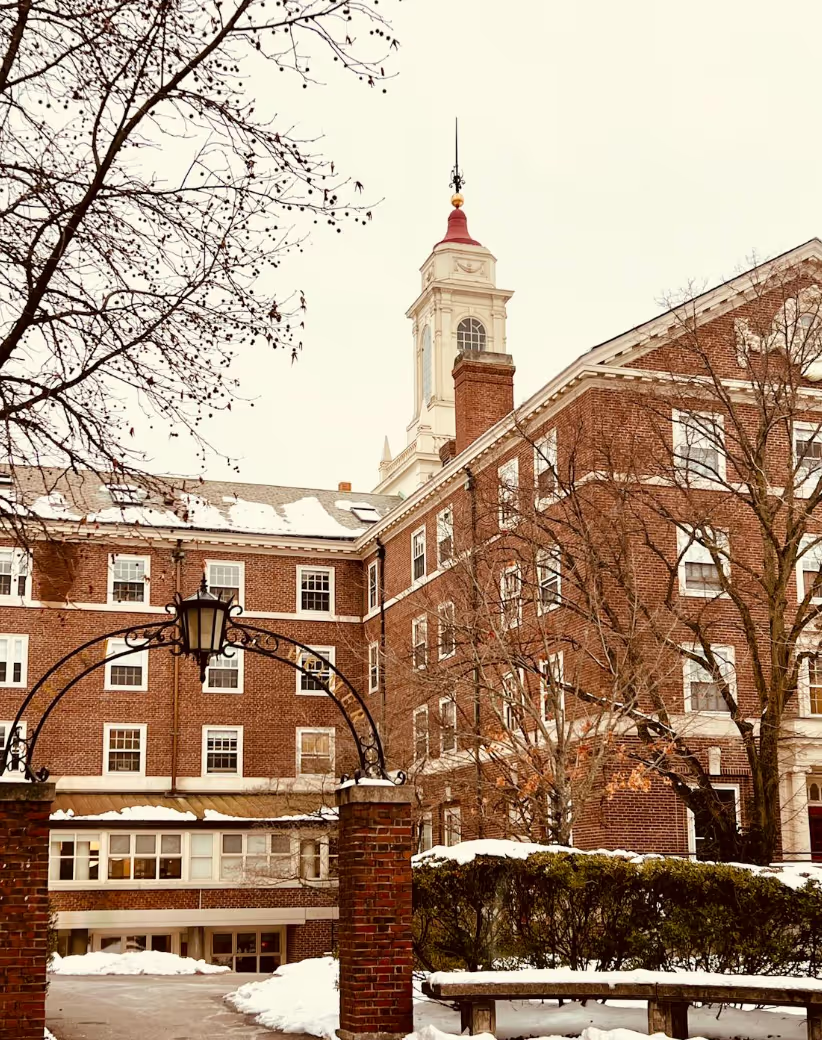
The sudden closure of Hampshire College has sent shockwaves through the global education community, marking the end of an institution that long stood as a symbol of progressive, student-driven learning. Founded in 1970 in Amherst, Massachusetts, Hampshire College was never a conventional college. It rejected grades, emphasized narrative evaluations, and encouraged students to design their own interdisciplinary courses of study. For decades, it attracted those seeking an alternative to rigid academic structures. Its shutdown, however, underscores a deeper and more troubling shift in higher education worldwide.
At the heart of Hampshire College’s closure are three interlinked challenges: declining enrollment, rising operational costs, and a waning interest in liberal arts education. Over recent years, the college struggled to attract a steady stream of applicants. This trend is not unique to Hampshire; many small liberal arts institutions across the United States and beyond have reported similar declines. As tuition fees continue to climb, students and families are increasingly questioning the return on investment of a traditional liberal arts degree.
The financial model of colleges like Hampshire has become increasingly unsustainable. With smaller student bodies, these institutions rely heavily on tuition revenue, making them particularly vulnerable to enrollment fluctuations. At the same time, operational costs—including faculty salaries, campus maintenance, and student services, have risen sharply. Without large endowments or consistent funding streams, progressive colleges often find themselves in precarious financial positions.
Equally significant is the shifting mindset of today’s students. There is a growing preference for career-oriented programs that promise clear job pathways and financial stability. Fields such as technology, business, healthcare, and engineering are seeing surging enrollments, while traditional liberal arts disciplines, history, philosophy, literature, are witnessing a decline in interest. The emphasis has moved from intellectual exploration to employability, driven in part by economic uncertainty and rising student debt.
Hampshire College’s unique educational model, once seen as its greatest strength, may also have contributed to its challenges. Its rejection of grades and standardized curricula appealed to a niche audience but made it harder to compete in a higher education landscape that increasingly values measurable outcomes and rankings. Employers and graduate schools often rely on conventional metrics like GPAs and standardized transcripts, putting Hampshire graduates at a potential disadvantage despite their strong critical thinking and problem-solving skills.
The closure also raises broader questions about the future of liberal arts education. Institutions rooted in Liberal Arts Education have traditionally played a crucial role in fostering creativity, critical thinking, and civic engagement. These skills are essential not just for individual success but for the health of democratic societies. Yet, as education becomes more commodified, the intrinsic value of a well-rounded intellectual foundation is being overshadowed by immediate economic considerations.
Globally, the implications are significant. Universities in Europe, Asia, and other regions have long looked to the American liberal arts model as a benchmark for holistic education. The struggles of institutions like Hampshire signal a potential decline in the influence of this model. Countries that once sought to emulate the U.S. system may now pivot toward more vocational and industry-aligned approaches.
However, it would be premature to declare the end of liberal arts education. Instead, this moment may represent a turning point, a call for reinvention. Many universities are already experimenting with hybrid models that combine liberal arts principles with practical skills. Programs that integrate humanities with data science, ethics with artificial intelligence, or communication with business strategy are gaining traction. These approaches aim to preserve the core values of liberal education while aligning with contemporary workforce demands.
The story of Hampshire College is also a reminder of the importance of adaptability in education. Institutions that fail to evolve risk becoming obsolete, no matter how innovative they once were. The challenge lies in balancing tradition with transformation, retaining what is valuable while embracing change.
For students, educators, and policymakers, the closure serves as a wake-up call. It highlights the need to rethink how education is structured, funded, and valued. Should universities prioritize job readiness over intellectual exploration? Can the two coexist? And how can institutions ensure accessibility and affordability without compromising quality?
In many ways, the fall of Hampshire College is not just about one institution but about a broader shift in societal priorities. As the world becomes more complex and interconnected, the demand for specialized skills will continue to grow. Yet, the need for critical thinkers, ethical leaders, and creative problem-solvers remains just as urgent.
The challenge moving forward is to ensure that education systems do not lose sight of this balance. Hampshire College may be closing its doors, but the ideas it championed, student autonomy, interdisciplinary learning, and education as a transformative experience, still hold relevance. Whether these ideals can survive and adapt in a rapidly changing world will determine the future of liberal arts education on a global scale.
For questions or comments write to contactus@bostonbrandmedia.com



-v3.jpg)


-v3-02.jpg)