Stay informed with our newsletter.
.webp)


EN





Global investment is being reshaped by forces that extend far beyond traditional stock-market movements. Artificial intelligence, semiconductors, robotics, energy demand and economic growth are creating new opportunities across the U.S., China, India, Japan, Europe and South Korea. As capital flows increasingly follow technology, infrastructure and productivity trends, investors must balance long-term growth potential with risks including high valuations, geopolitical tensions, energy constraints and concerns over a possible AI-driven market bubble.
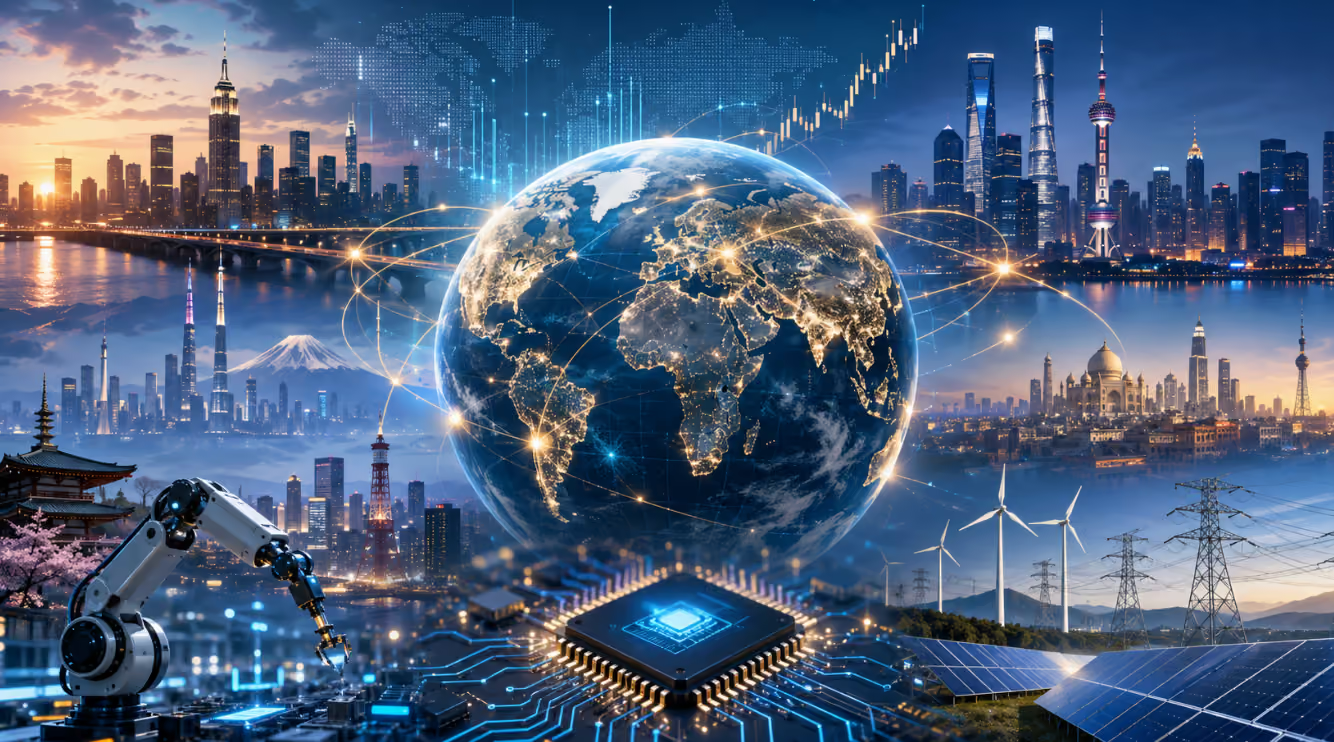
Global investing is no longer simply a question of whether Wall Street, Shanghai or Mumbai had a good trading session. Increasingly, the forces moving capital across borders are much bigger: artificial intelligence, semiconductors, robotics, electricity infrastructure, industrial policy and economic growth.
From American data centres and South Korean memory chips to Chinese robots, Indian consumption and Japanese corporate reform, a new investment map is emerging. The biggest opportunity may not belong to any single country. Instead, investors are confronting an interconnected global system in which technology developed in one market creates demand, profits and bottlenecks thousands of kilometres away.
The macroeconomic backdrop remains uneven. The International Monetary Fund expects the world economy to grow around 3.0% in 2026, before accelerating to 3.4% in 2027. Its projections show substantial differences between major economies: approximately 2.3% growth for the United States, 4.6% for China, 6.4% for India, 0.6% for Japan and 0.9% for the euro area in 2026.
Those differences matter—but increasingly, so does each economy's position within the global technology race.
The United States remains the gravitational centre of global AI investment.
Technology companies are spending extraordinary amounts on data centres, processors, networking equipment and power infrastructure. Reuters reported that annual capital expenditure among major U.S. technology companies has climbed above $1 trillion in 2026, while total AI-related commitments could exceed $3 trillion when some off-balance-sheet obligations are considered.
The spending is translating into corporate profits. Second-quarter earnings among S&P 500 companies grew 33.5% year-on-year, according to data cited by Reuters, while enthusiasm surrounding AI continues to support equity valuations.
Nvidia illustrates the scale of the boom. Its latest quarterly data-centre revenue more than doubled from a year earlier, while the company has forecast approximately 70% revenue growth for its next fiscal year, reflecting continuing demand for AI computing infrastructure.
But the American opportunity comes with an obvious question: how much future success is already priced into today's technology shares?
High valuations, enormous capital expenditure and market concentration mean investors increasingly need to distinguish between companies selling the infrastructure for AI and companies merely promising to benefit from it.
China offers a very different technology proposition.
While the United States dominates many areas of advanced AI computing, China combines AI with immense manufacturing capacity, particularly in electric vehicles, batteries, automation, electronics and robotics.
China installed approximately 295,000 industrial robots in 2024, representing 54% of worldwide installations, according to the International Federation of Robotics. Its operational fleet has now exceeded 2 million industrial robots.
Investment is moving toward generative AI as well. Alibaba recently announced a US$10.2 billion share placement to help finance AI chips, computing infrastructure and model development. Its AI cloud and computing revenue has also been growing rapidly, although massive spending has placed pressure on short-term profits.
Yet China's technology excitement carries speculative risk. Humanoid robot manufacturer Unitree surged 460% on its Shanghai market debut before subsequently falling sharply, highlighting how quickly enthusiasm around new technologies can run ahead of proven commercial applications.
China therefore offers both industrial scale and technological optionality—but also policy, geopolitical and valuation risk.
If technology defines much of the U.S.-China competition, India's greatest investment advantage remains economic expansion and domestic demand.
The IMF projects approximately 6.4% growth for India in 2026, considerably faster than most major economies.
The long-term case rests on rising incomes, digitalisation, manufacturing investment, financial inclusion, infrastructure development and one of the world's largest consumer markets.
But strong economic growth does not automatically mean strong stock-market returns.
Indian shares have faced pressure in 2026, while foreign investors have sold roughly ₹2.4 trillion, or US$25.1 billion, of equities during the year. At the same time, profits among Nifty 50 companies increased around 18% in the second quarter, showing the tension between healthy corporate fundamentals and investor concerns around valuation, currency movements and energy costs.
India also has an increasingly powerful domestic-investor base. Monthly systematic investment plan contributions reached more than ₹319 billion in July, providing local markets with a source of capital less dependent on foreign portfolio flows.
For global investors, India may therefore represent a long-duration growth opportunity where entry valuation remains critical.
Japan's investment appeal is increasingly about more than the yen or the Nikkei.
A combination of corporate-governance reforms, shareholder pressure, automation and restructuring is changing how Japanese companies deploy capital.
The government is considering additional incentives encouraging companies to sell non-core operations and reinvest proceeds into higher-return businesses. Around 65% of Japanese corporate capital is estimated to remain tied up in relatively low-return operations, suggesting significant room for improved capital efficiency.
Japan is also an automation heavyweight. It installed about 44,500 industrial robots in 2024 and maintains an operational stock exceeding 450,000 units.
The opportunities are accompanied by currency and monetary-policy uncertainty, particularly as authorities confront a weak yen and changing inflation dynamics.
European markets provide another form of diversification.
Corporate earnings across the STOXX 600 rose 24.1% year-on-year in the second quarter of 2026, while European shares trade at approximately 14.6 times forward earnings, around a 26% valuation discount to U.S. equities.
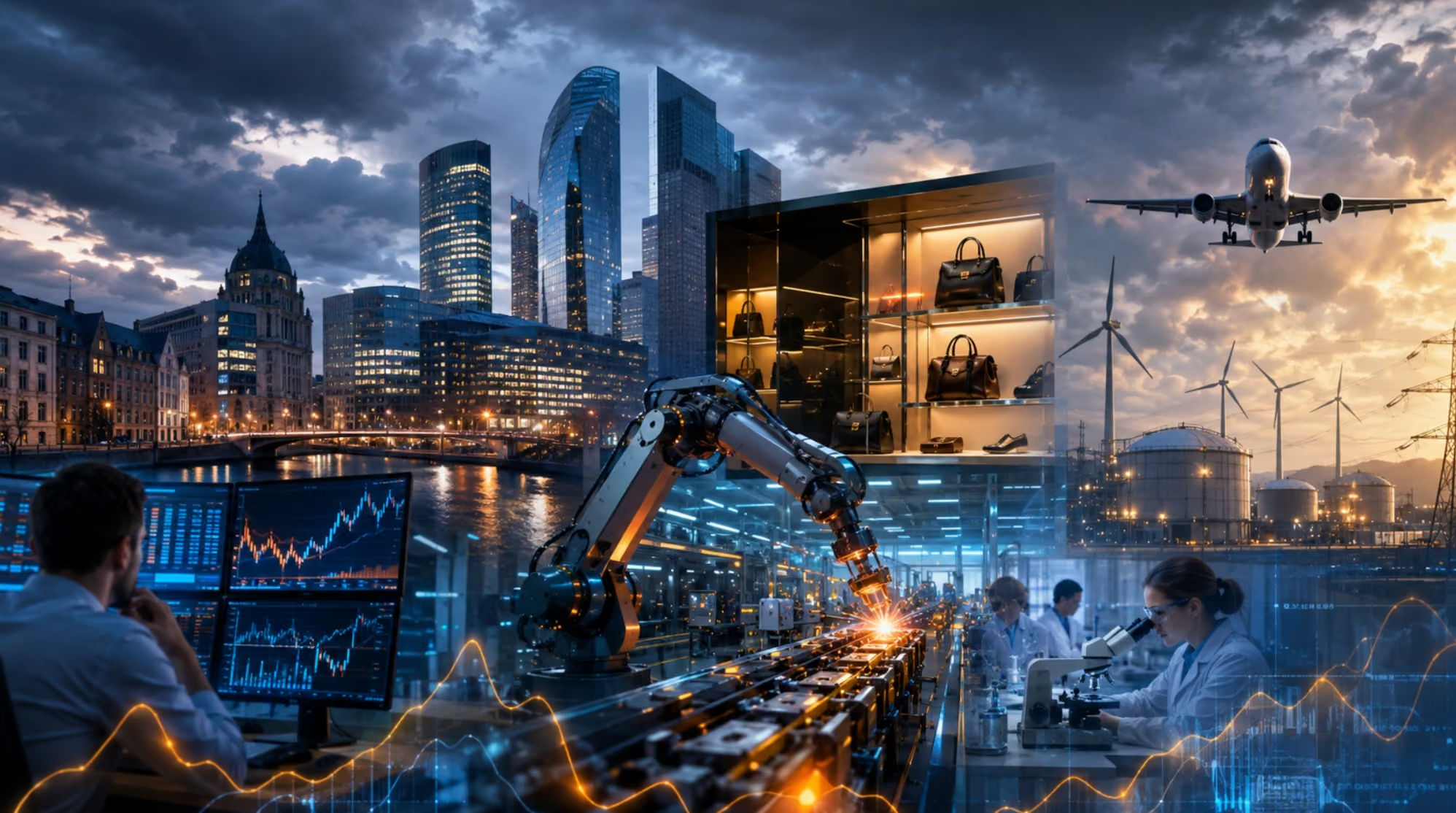
Europe offers exposure to industrial automation, healthcare, luxury goods, financial services, aerospace, defence and energy infrastructure - sectors quite different from the technology-heavy U.S. market.
However, energy prices remain a major vulnerability. European economies are particularly sensitive to disruptions in global oil and gas markets, while inflation could force monetary policy to remain tighter than investors would prefer.
Few countries illustrate the interconnected nature of modern markets better than South Korea.
AI models may be developed in California, but they depend heavily on advanced memory manufactured by Korean companies.
SK Hynix holds an estimated 58% share of the global high-bandwidth-memory market, a critical technology used alongside advanced AI processors. The company has approved approximately 54.3 trillion won, or US$38.3 billion, of investment through 2031.
South Korea is also establishing a 5 trillion won semiconductor investment fund, alongside enormous private-sector plans for new chip production facilities.
This makes Korea one of the clearest ways investors can gain exposure to the physical infrastructure underlying artificial intelligence.
Behind every AI model sits another requirement: electricity.
Global data-centre electricity consumption increased approximately 17% in 2025, according to the International Energy Agency. Looking forward, worldwide electricity demand is projected to expand by an average 3.6% annually between 2026 and 2030, driven by data centres, industry, electric vehicles and cooling.
That creates potential investment opportunities far beyond technology companies, in power generation, grids, transformers, energy storage, nuclear power, renewables, natural gas and electrical equipment.
AI may therefore prove as much an electricity story as a software story.
The uncomfortable comparison is with the dot-com era.
There are genuine warning signs. Technology spending is enormous, valuations are elevated, and Reuters reports that only 11% of companies discussing AI have quantified its use, while just 2% have quantified its impact on earnings.
Yet today's boom also has measurable industrial foundations.
World Semiconductor Trade Statistics expects global semiconductor sales to grow by more than 25% in 2026 to approximately US$975 billion, approaching the historic US$1 trillion threshold. Memory and logic-chip sales are both forecast to expand more than 30%.
The more useful question, therefore, may not be “Is AI a bubble?” but rather “Where is the bubble?”
Some companies will convert AI investment into productivity, revenue and durable competitive advantage. Others may never generate enough cash to justify today's expectations.
The next phase of global investing is unlikely to be defined by choosing one winning country.
The United States supplies AI platforms and capital, South Korea provides advanced memory, Japan contributes automation expertise, China brings manufacturing scale, India delivers rapid economic growth, and Europe offers industrial depth and valuation diversification.
Meanwhile, every region depends increasingly on the same scarce resources: semiconductors, electricity, infrastructure, skilled workers and capital.
That is why the most important investment map today may no longer have national borders.
The defining opportunity of the coming decade could lie in understanding the global chains connecting intelligence, chips, machines, energy and economic growth - while remembering that transformational technologies can create both extraordinary wealth and extraordinary excess.
For questions or comments write to contactus@bostonbrandmedia.com



-v3.jpg)


-v3-02.jpg)