Stay informed with our newsletter.
.webp)


EN





Europe is moving closer to building a sovereign alternative to SpaceX’s Starlink, with the European Union expanding its ambitious IRIS² satellite network. The revised plan adds 66 high-LEO satellites focused on defense and secure communications, increasing the constellation’s capacity as geopolitical tensions and concerns over reliance on foreign space infrastructure grow. The project is designed primarily for governments, defense users and critical infrastructure, rather than directly competing with Starlink’s consumer broadband business. IRIS² is expected to become operational around 2029.
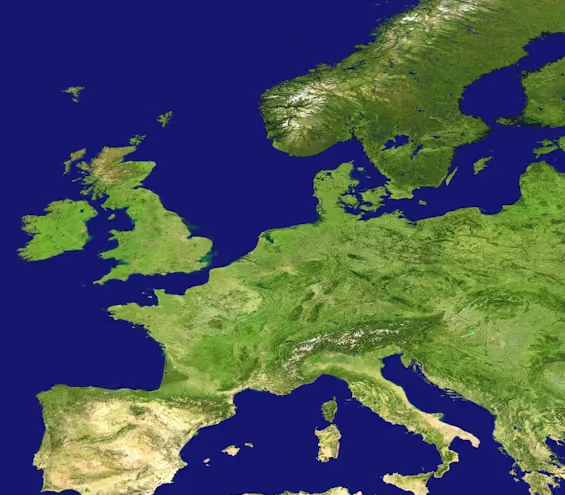
Europe is taking another major step toward reducing its dependence on foreign satellite communications, expanding the European Union’s IRIS² constellation as competition in space-based connectivity intensifies.
The European Commission announced on August 7 that it had signed an agreement with the SpaceRISE consortium to move the project into a faster development and deployment phase. The expanded architecture is intended to provide Europe with secure, resilient communications while strengthening its strategic autonomy in space.
The development has quickly been framed as Europe’s answer to SpaceX’s Starlink. But that comparison needs an important qualification: IRIS² is not simply a European copy of Starlink.
While Starlink has built its business around large-scale commercial broadband, IRIS² is being designed with government, defense, emergency response and critical infrastructure needs at its core.
The latest expansion adds 66 high-LEO satellites dedicated to defense users. The revised architecture is expected to significantly increase secure government capacity across Europe and globally, while providing a substantial boost to defense communications during crises.
The broader constellation is planned to include 330 high-LEO satellites and 18 medium-Earth-orbit satellites, with additional options for polar and lower-LEO satellites for specialized missions.
That represents a significant evolution from the earlier plan for a roughly 290-satellite multi-orbit constellation.
The European Commission describes IRIS² as a strategic communications infrastructure capable of serving EU institutions, governments, businesses and citizens. Its multi-orbit architecture is intended to combine the lower latency associated with low-Earth orbit with the broader coverage provided by higher orbits.
The push for IRIS² is about more than faster internet.
Satellite connectivity has become increasingly important for military operations, emergency response, disaster recovery and communications in areas where terrestrial networks are damaged or unavailable.
The war in Ukraine has also highlighted the strategic importance of commercial satellite networks. Starlink has demonstrated how a privately operated constellation can become an important communications asset during a major conflict.
For European governments, that creates a strategic vulnerability: relying heavily on infrastructure controlled outside Europe could become problematic during a geopolitical crisis.
IRIS² is designed to address that concern by giving European institutions access to infrastructure over which Europe has greater control.
The EU itself describes the project as part of its effort to strengthen digital sovereignty, security and resilience.
Calling IRIS² a "Starlink rival" makes for an attractive headline, but the two systems are being built for different priorities.
Starlink has deployed thousands of low-Earth-orbit satellites and has become a major provider of consumer and business broadband.
IRIS², meanwhile, is deliberately structured as a multi-orbit system. It is expected to combine LEO and MEO satellites, while also integrating capabilities from existing European government satellite communications infrastructure.
The EU's stated objective is therefore not simply to beat Starlink on the number of satellites or consumer internet subscribers.
Instead, Europe wants a communications network that can remain available to governments and critical services when terrestrial networks fail and one that is not dependent on a privately controlled American constellation.
The latest developments also highlight the growing role of European satellite companies.
Spain's Hispasat has been selected to lead important elements of the IRIS² program, including antennas, control systems and ground links. The company will also spearhead development of the low-Earth-orbit segment intended to support direct-to-device and Internet of Things connectivity.
Spain has separately indicated that it could invest between €1.6 billion and €2 billion in satellite capabilities connected to the European program, underlining how IRIS² is becoming intertwined with national defense and space strategies.
The IRIS² program represents a major European investment in space infrastructure.
The overall program budget is approximately €15.6 billion, with the European Commission and industry partners sharing responsibility for building the system and its supporting infrastructure.
That price tag reflects the fact that IRIS² is much more than a collection of satellites.
The project includes ground infrastructure, secure communications systems, network management, launch services and technologies designed to connect satellite communications with terrestrial networks.
The system is also being developed with future security technologies in mind, including potential quantum-secure communications capabilities.
Despite the momentum, Europe is not about to replace Starlink overnight.
The EU's own plans point toward an operational system around 2029, while other European Commission material has described the constellation reaching full operational capacity around 2030.
Starlink, by contrast, already has a mature global network with thousands of satellites in orbit.
That means IRIS² will initially be competing on a different battlefield: security, sovereignty and resilience rather than simply consumer broadband scale.
For Europe, however, that distinction may be precisely the point.
The expansion of IRIS² comes as governments increasingly view satellite networks as strategic infrastructure rather than simply telecommunications businesses.
The United States has Starlink and Amazon's growing satellite ambitions. Europe is developing IRIS². NATO members are also exploring additional multinational space communications capabilities.
The result is a rapidly changing satellite landscape in which connectivity, defense and national sovereignty are becoming increasingly intertwined.
For Europe, IRIS² represents an attempt to ensure that when communications become strategically critical, the continent has an infrastructure of its own.
It may never look exactly like Starlink and that may not be the goal.
Instead, Europe's emerging satellite network is designed to give governments something Starlink cannot provide by itself: a European-controlled communications backbone capable of supporting governments, defense forces and critical services when reliability and independence matter most.
For questions or comments write to contactus@bostonbrandmedia.com



-v3.jpg)


-v3-02.jpg)





.png)