Stay informed with our newsletter.
.webp)


EN





Data centers have emerged as critical battlegrounds in the digital age, where power, security, and technological dominance intersect. As demand for compute and electricity surges, these facilities underpin economies, AI systems, and modern military operations. Their growing strategic importance makes them prime targets for cyber threats and geopolitical leverage. Control over infrastructure, energy, and supply chains will define the future of digital warfare and global influence in an increasingly data-driven world.
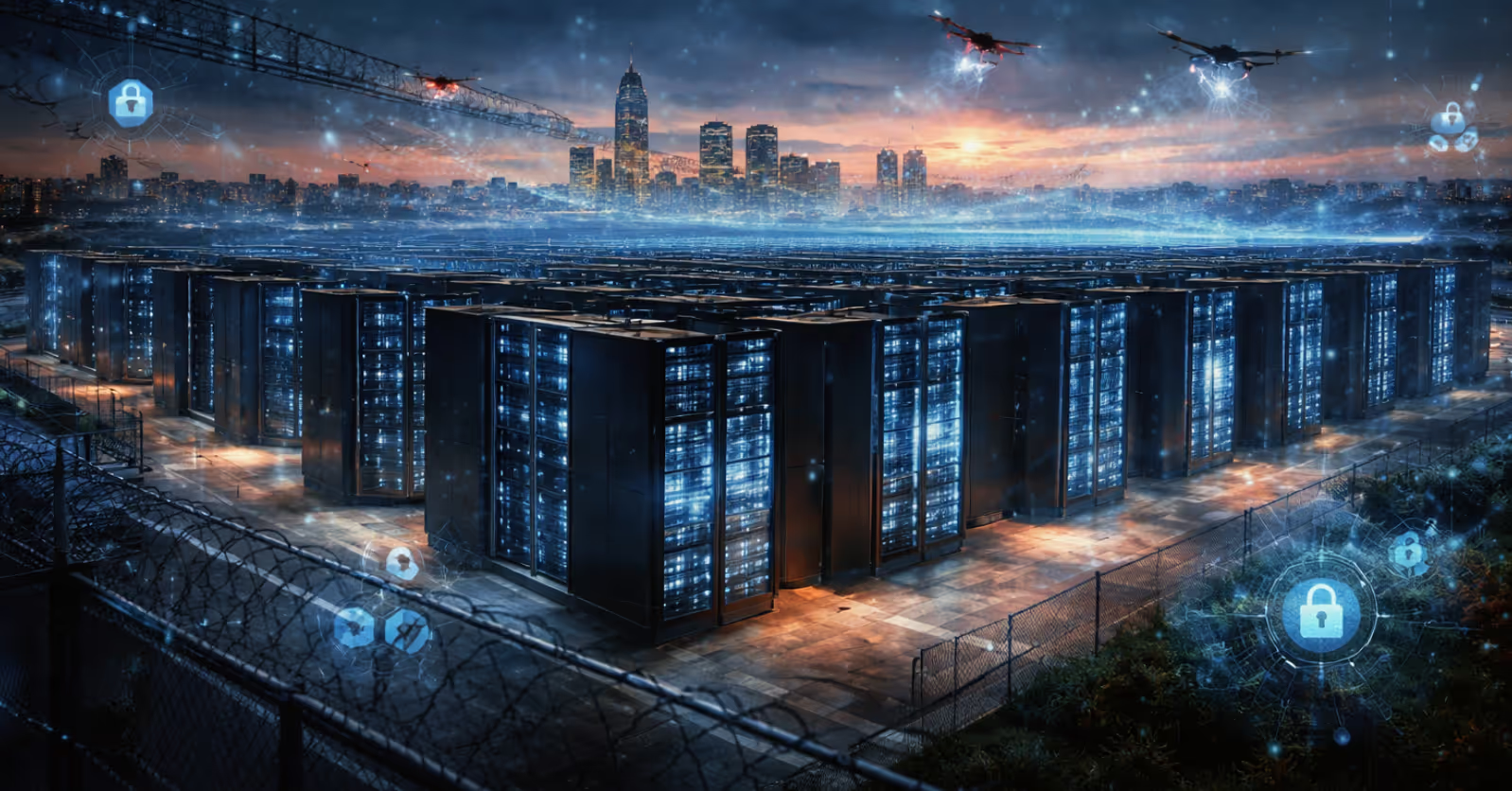
In the 20th century, wars were fought over land, oil, and industrial capacity. In the 21st century, the decisive terrain is increasingly invisible, buried beneath warehouses of servers, fiber optic cables, and cooling systems. Data centers have quietly emerged as the backbone of the global economy and, more critically, as strategic assets in modern geopolitical competition. Today, the world runs on data and data runs on electricity, infrastructure, and control.
The scale of this transformation is staggering. In 2024 alone, U.S. data centers consumed approximately 183 terawatt-hours (TWh) of electricity, roughly equivalent to the annual power consumption of an entire nation like Pakistan. By 2030, that demand is projected to increase by 133%, driven largely by artificial intelligence workloads, cloud computing, and the proliferation of connected devices. This exponential growth is not just a technological story, it is an energy story, a security story, and increasingly, a military one.
At the heart of the data center boom lies a simple but profound reality: compute requires power. Vast amounts of it. Hyperscale data centers, those operated by companies like Amazon Web Services, Google, Meta, and Microsoft, are among the largest energy consumers on the planet. Together, these four firms control approximately 42% of U.S. data center capacity, and their combined capital expenditure plans for 2025 alone exceed $330 billion.
This spending is not just about scaling infrastructure, it is about securing dominance in an increasingly competitive digital ecosystem. AI training models, real-time analytics, and global cloud services all depend on uninterrupted, high-density compute environments. As a result, access to reliable, affordable electricity has become a strategic priority.
Governments and corporations alike are now competing for power capacity, often co-locating data centers near renewable energy sources or negotiating long-term energy contracts. In some regions, data centers are already straining local grids, forcing policymakers to confront difficult trade-offs between economic growth and energy sustainability.
In traditional warfare, logistics determines outcomes, fuel, supply chains, and transportation networks dictate operational capability. In the digital age, compute has become the new logistics layer. Instead of moving tanks or ammunition, modern systems move data, vast quantities of it, in real time.
Military operations increasingly rely on cloud-based infrastructure for everything from satellite imaging and drone coordination to cyber defense and intelligence analysis. AI-driven decision-making systems require immense computational resources, often housed in centralized or distributed data centers. The ability to process, store, and transmit information efficiently is now as critical as the ability to move physical assets.
However, this new form of logistics shares many of the same vulnerabilities as its predecessor:
These constraints make data infrastructure both powerful and fragile, a combination that adversaries are increasingly eager to exploit.
As the backbone of digital economies, data centers have become high-value targets for a wide range of threat actors. Cybercriminal groups, insider threats, and nation-state actors all recognize the strategic importance of these facilities.
A successful attack on a major data center could disrupt financial systems, cripple communication networks, and paralyze critical services. Cloud outages already demonstrate how deeply embedded these systems are in everyday life, affecting everything from banking and healthcare to transportation and national defense.
Nation-state actors, in particular, are investing heavily in capabilities designed to exploit data center vulnerabilities. These include:
The implications are profound. In a future conflict, disabling an adversary’s data infrastructure could be as impactful as targeting traditional military assets. The battlefield is no longer confined to physical terrain, it extends into server racks and network nodes.
Beyond direct attacks, control over the data center supply chain represents another critical dimension of digital power. Here, geopolitical dynamics play a decisive role.
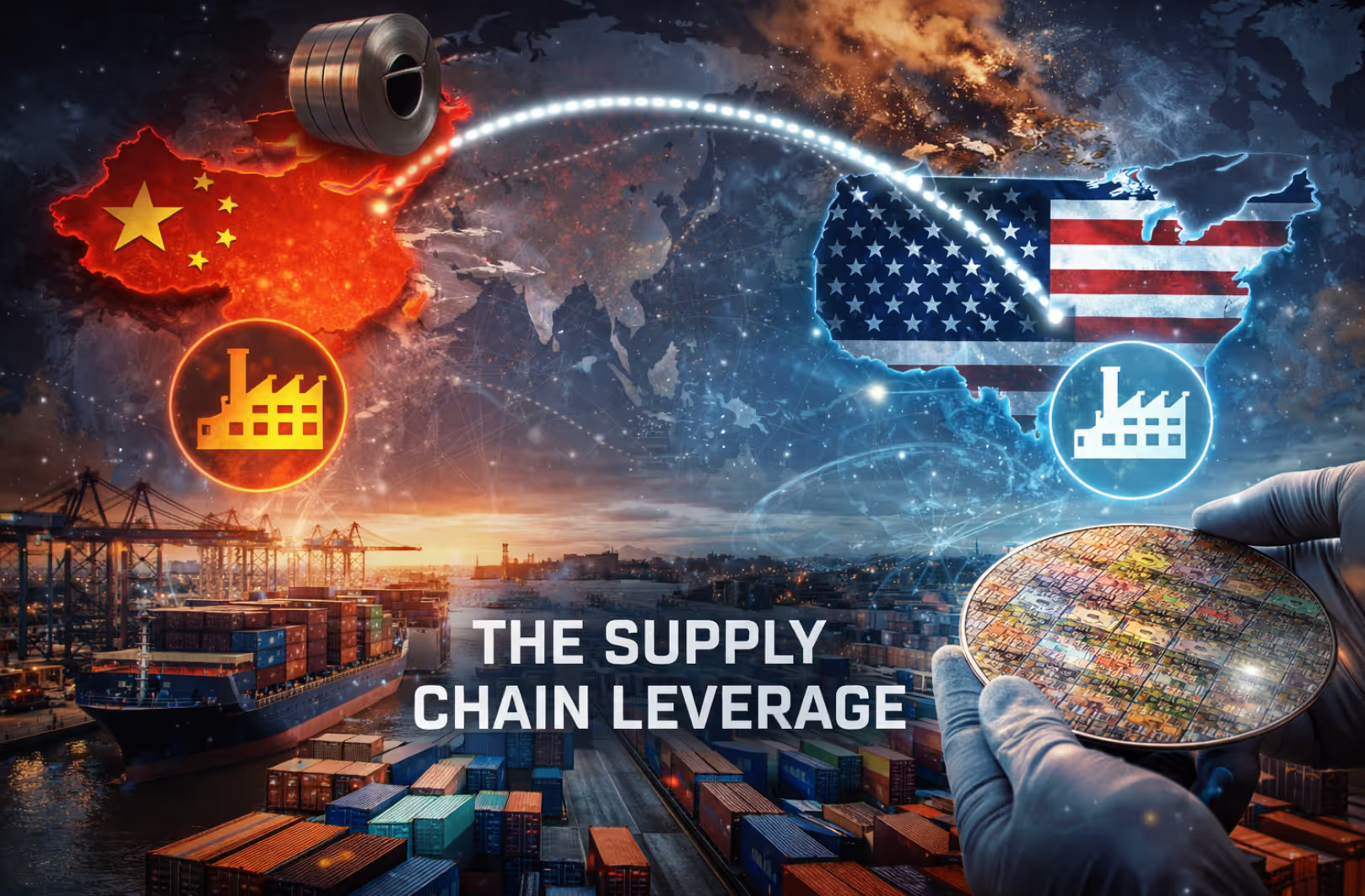
China, for instance, produces over 70% of the world’s transformer steel, a key material used in power infrastructure. It also dominates the refining of rare-earth elements essential for electronics and leads in the production of wafer-level photonics used in optical transceivers, components critical for high-speed data transmission.
This concentration of manufacturing capability creates a potential chokepoint. Any export restrictions, trade disputes, or geopolitical tensions could disrupt the global buildout of data centers. In effect, control over these supply chains provides leverage not just over commercial infrastructure, but over military and intelligence capabilities as well.
For Western nations, this has triggered a renewed focus on supply chain resilience. Initiatives aimed at reshoring semiconductor production, diversifying material sourcing, and investing in domestic manufacturing are gaining momentum. However, these efforts are costly and time-consuming, underscoring the complexity of reducing dependency in a deeply interconnected global system.
Artificial intelligence is accelerating every aspect of the data center race. Training large-scale AI models requires enormous computational resources, often concentrated in specialized facilities equipped with advanced GPUs and high-performance networking.
This has created a new layer of competition, not just for infrastructure, but for the ability to deploy and scale AI capabilities. Nations and corporations alike are racing to build “AI factories” capable of supporting next-generation applications, from autonomous systems to predictive analytics.
The strategic implications are significant. AI superiority increasingly depends on access to compute, which in turn depends on data center capacity. This creates a feedback loop: more compute enables better AI, which drives demand for even more compute.
In this context, data centers are not just infrastructure, they are enablers of technological and military advantage.
As data centers become more central to economic and national security, the challenge of protecting them grows more complex. Traditional cybersecurity measures are no longer sufficient. A comprehensive approach must address multiple layers of risk:
Governments are beginning to recognize this shift. Data centers are increasingly being classified as critical infrastructure, subject to stricter regulations and security standards. Public-private partnerships are also playing a key role, as most data infrastructure is owned and operated by private companies.
The next decade will likely see data centers move from the periphery of strategic planning to its core. As digital systems become more integral to every aspect of society, the infrastructure that supports them will become a focal point of competition and conflict.
The stakes are high. Control over data centers and the power, technology, and supply chains that sustain them, will shape not just economic outcomes, but geopolitical ones. In many ways, the data center has become the most strategically significant piece of real estate on the planet.
Protecting it will require a rethinking of security, energy policy, and industrial strategy. It will demand collaboration between governments, corporations, and technology providers. And it will define the contours of digital warfare in an era where information, not territory, is the ultimate prize.
In this new battleground, the question is no longer whether data centers matter, but who controls them, and how well they are defended.
For questions or comments write to contactus@bostonbrandmedia.com



-v3.jpg)


-v3-02.jpg)





.png)