Stay informed with our newsletter.
.webp)


EN





Artificial intelligence is moving rapidly into modern vehicles, powering driver assistance, autonomous-driving systems, digital cockpits and conversational assistants. Yet automakers and suppliers are discovering that more computing does not automatically mean a better car. The industry must balance AI performance with safety, energy use, heat, cybersecurity, reliability, semiconductor costs and real-time processing. As software-defined vehicles evolve, success will depend on deploying AI where it creates measurable value without overwhelming the vehicle’s architecture or its occupants.
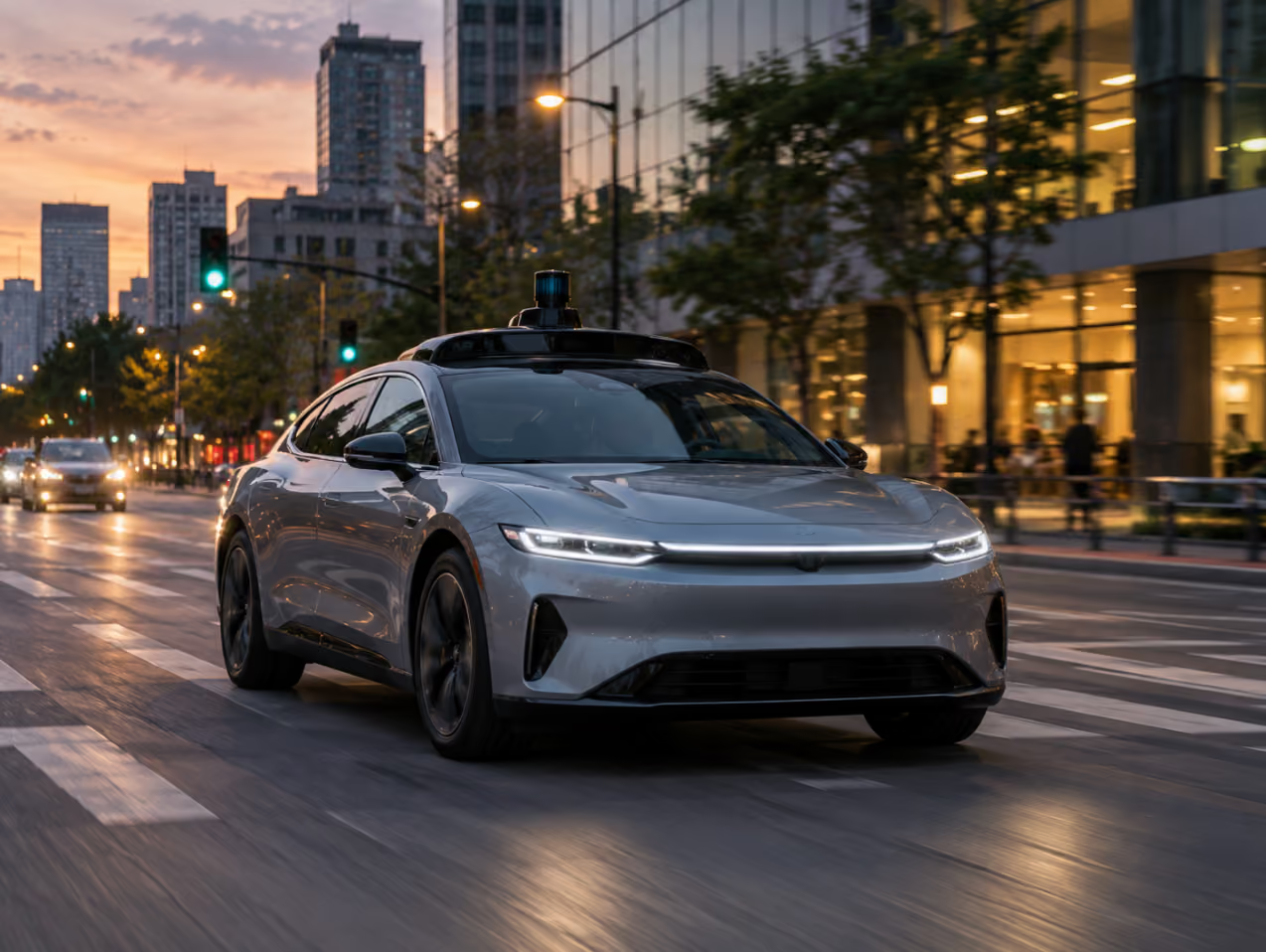
Artificial intelligence is rapidly changing what a car can do. Once associated mainly with navigation, voice commands and basic driver assistance, AI is moving toward the center of vehicle architecture, processing information from cameras, radar and lidar, managing digital cockpits, interpreting natural-language requests and increasingly helping vehicles make real-time driving decisions.
But the automotive industry is confronting a fundamental question: How much AI does a car actually need — and how much can it realistically handle?
Unlike a smartphone or cloud application, a vehicle operates in an unusually demanding environment. Its computers must function reliably through extreme temperatures, vibration and years of use. Some decisions must happen in milliseconds. Systems involved in steering, braking or obstacle detection also have to meet standards far beyond those expected of a consumer chatbot.
For automakers and suppliers, the race is therefore becoming less about installing the biggest AI system possible and more about finding the right balance between computing power, safety, energy consumption, cost and reliability.
The move toward the software-defined vehicle is accelerating.
Qualcomm reported that its automotive business generated $1.1 billion in revenue during fiscal Q1 2026, up 15% year over year, while its automotive design-win pipeline had reached approximately $45 billion. Its Snapdragon Digital Chassis increasingly combines connectivity, infotainment, advanced driver-assistance systems and cloud capabilities within a broader computing architecture.
Those numbers demonstrate just how important computing has become to the automotive supply chain.
Instead of dozens of isolated electronic control units performing separate tasks, manufacturers are increasingly developing vehicles around centralized or zonal computing architectures capable of managing multiple functions through software.
This can reduce hardware complexity while making it easier to introduce new capabilities through software updates.
The greatest demand for automotive AI comes from increasingly automated driving.
A highly automated vehicle may need to simultaneously identify pedestrians, vehicles, traffic lights, road markings, cyclists and unexpected objects while determining its own position and predicting how surrounding road users are likely to behave.
NVIDIA announced in March 2026 that BYD, Geely, Isuzu and Nissan were among companies building Level 4-ready vehicle programs around its DRIVE Hyperion platform. The architecture combines computing, cameras, radar, lidar, networking and safety systems, illustrating the enormous amount of technology required to move toward higher levels of vehicle automation.
But greater computing capacity does not automatically create autonomy.
SAE International defines six levels of driving automation, from Level 0 to Level 5. At Level 2, drivers must continue supervising the vehicle. At Level 4, the automated system can perform the driving task without requiring the person to intervene within defined operating conditions.
Moving between those levels requires far more than a faster chip.
It requires massive amounts of training data, sophisticated software, redundant systems, simulation and extensive safety validation.
Not every automotive AI workload involves autonomous driving.
Some of the fastest-growing applications are inside the cabin.
Mahindra and Google Cloud, for example, announced in August 2026 that the Mahindra BE 6 SPORTEQ would incorporate a Gemini-powered automotive agent capable of understanding conversational requests. The system can interact with more than 200 vehicle functions, covering areas such as climate settings, windows, lighting, navigation, entertainment and vehicle information.
That represents an important change.
Traditional vehicle voice systems depended on specific commands. Generative AI enables the car to understand intent rather than simply keywords.
A driver may eventually be able to tell the vehicle that they are tired, cold or looking for somewhere to eat, while the system combines information from the vehicle, navigation services and personal preferences to determine what action would be useful.
The car is moving toward becoming an AI-powered digital assistant on wheels.
There is, however, a physical limit to constantly increasing automotive computing.
High-performance processors consume electricity and generate heat. That means they need sophisticated cooling and power-management systems.
The issue becomes particularly important in electric vehicles because every system ultimately draws energy from the battery.
Automakers therefore have to evaluate whether additional computing delivers enough benefit to justify its energy requirement.
The industry is consequently focusing not only on TOPS - trillions of operations per second, but also on performance per watt.
A processor capable of delivering enormous AI performance but requiring excessive energy or cooling may be unsuitable for a mass-market vehicle.
Another limitation is connectivity.
Cloud computing is enormously useful for AI training, fleet analysis, mapping, software updates and complex non-critical requests.
But a vehicle cannot wait for a distant server before deciding whether to apply the brakes.
That is why edge AI, where computation happens inside the vehicle itself, is essential for safety-critical functions.
The future automotive architecture is therefore likely to combine both approaches: powerful onboard AI for immediate decisions and cloud AI for broader intelligence, training and updates.
Finding the correct division between them will be critical.
The increase in automotive computing is also colliding with intense global demand for advanced semiconductors.
In July 2026, General Motors and Micron announced a long-term agreement covering automotive memory and storage. Reuters reported that DRAM prices had risen roughly 70% since December, driven in part by extraordinary AI-related demand from data centers.
Automakers are therefore competing for components in a semiconductor market increasingly shaped by the wider AI boom.
This could make sophisticated automotive computing more expensive, particularly for mainstream cars where manufacturers operate under intense cost pressure.
Perhaps the biggest limit on automotive AI is neither computing power nor cost.
It is trust.
McKinsey reported in June 2026 that autonomous-driving development is increasingly moving toward AI-native, end-to-end architectures trained using massive datasets. Such systems may improve adaptability and handle more complicated driving scenarios, but they also raise significant questions around validation and predictability.
A conversational assistant misunderstanding a music request is inconvenient.
An autonomous-driving model incorrectly interpreting a pedestrian can be catastrophic.
Automotive AI therefore has to satisfy a standard that most consumer AI systems never encounter: it must demonstrate that it can perform safely under rare, unpredictable and potentially dangerous real-world circumstances.
So how much artificial intelligence can a car actually handle?
Technically, the answer will continue increasing as semiconductor performance improves.
Practically, however, the limit will be determined by safety, battery efficiency, thermal management, cost, cybersecurity, semiconductor availability, reliability and customer value.
Automakers and suppliers are discovering that the objective is not to put unlimited intelligence inside every vehicle.
It is to put the right intelligence in the right place.
The winning vehicles of the AI era may not be those with the largest processors or longest feature lists. They will be those where artificial intelligence works quietly in the background, making driving safer, easier, more personalized and more efficient without becoming an unnecessary burden on the vehicle itself.
The future of automotive AI, therefore, is not simply about asking, “How powerful can the car become?”
It is about answering a much harder question:
“How much intelligence actually makes the car better?”
For questions or comments write to contactus@bostonbrandmedia.com



-v3.jpg)


-v3-02.jpg)