Stay informed with our newsletter.
.webp)


EN





The United States is considering a policy that would require foreign travelers to submit their social media activity from the past five years as part of the entry process. The move aims to strengthen security screenings by offering deeper insights into visitors’ digital footprints. If implemented, the measure could influence millions of tourists and raise questions around privacy, data collection, and international travel norms. The proposal reflects growing global reliance on online information for security assessments.
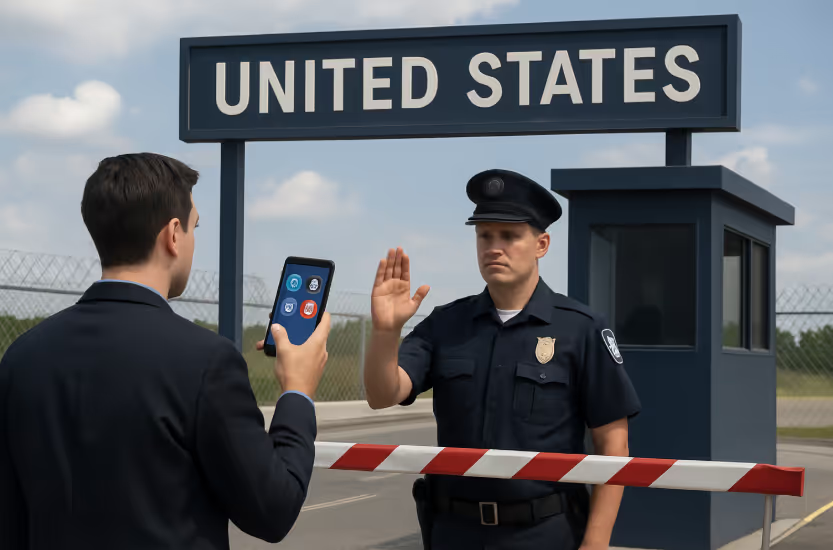
Foreign travellers from several nations, including the UK, may soon be required to hand over five years of their social media activity before they can enter the United States, according to a newly introduced proposal from US authorities.
The rule would apply to visitors from countries that currently qualify for 90-day visa-free entry, provided they complete the Electronic System for Travel Authorization (ESTA) form. Since returning to office in January, President Donald Trump has taken a harder line on border controls, defending these moves as essential for strengthening national security.
Experts warn that the latest proposal could deter many would-be visitors and potentially compromise their digital privacy. When asked whether such a rule might discourage tourism, Trump expressed no concern. “No. We’re doing incredibly well,” he replied on Wednesday.
He added that the priority was ensuring safety: “We welcome visitors, but safely. Security matters. We must prevent the wrong people from crossing into our nation.” The US expects a significant rise in incoming tourists next year with major global events on the horizon, the men’s football World Cup shared with Canada and Mexico, and the 2028 Los Angeles Olympics.
The Department of Homeland Security (DHS) and Customs and Border Protection (CBP) submitted the proposal, which was formally posted in the Federal Register, the government’s official record. The proposal explains that ESTA applicants would need to submit details of their social media use from the past five years, though it does not clarify exactly what platforms or data points will be reviewed.
Current ESTA requirements are relatively straightforward and involve basic personal details and a $40 (£30) fee. Citizens from roughly 40 nations, including the UK, Japan, Australia, France, and Ireland, can use the system to enter the US multiple times over two years.
Beyond social media handles, the updated plan calls for collecting phone numbers and email addresses used over the past five and ten years respectively, along with additional information about applicants’ family members.
The proposal refers to a Trump executive order issued in January titled “Protecting the United States From Foreign Terrorists and Other National Security and Public Safety Threats.”
The government will accept public feedback on the ESTA changes for 60 days before moving forward. A CBP spokesperson stressed that no immediate changes are taking effect, saying, “This is simply an initial step in exploring policy options to better protect the American public.”
Sophia Cope from the Electronic Frontier Foundation criticized the idea, arguing that it could worsen privacy concerns and digital rights issues. Immigration law firm Fragomen noted that travellers may also face extended waiting times for ESTA approvals if the changes are implemented.
The Trump administration has previously moved to review social media accounts of international students and skilled workers applying for H-1B visas. The State Department said applicants must make their social media profiles public during the review process.
A notice on the US Embassy and Consulate website in Mexico informs applicants that they must list all social media usernames used in the last five years. Failure to do so could jeopardize both current and future visa applications. A senior state department official defended the screening process, saying, “Americans expect their government to do everything possible to keep the country safe and that’s exactly what we are delivering.”
Officials were told to look for signs of support for terrorism, national security threats, or involvement in unlawful anti-Semitic behavior.
As part of the administration’s expanded border enforcement efforts, authorities recently signaled that the existing travel ban, which already affects 19 countries across Africa, the Middle East, and the Caribbean, might soon be widened. This announcement followed a shooting in Washington DC involving an Afghan man now facing charges.
Industry analysts say the Trump-era travel measures have already affected the tourism sector. Earlier this year, the World Travel & Tourism Council noted that out of 184 economies studied, the US was the only one expected to see reduced international visitor spending in 2025.
Other policies have also played a role. Many Canadians have opted to avoid travelling to the US in protest of Trump’s tariffs, contributing to 10 consecutive months of declining Canadian visitors.
Historically, Canadians accounted for nearly a quarter of all foreign visitors to the US, spending over $20 billion annually, according to the US Travel Association.
For questions or comments write to contactus@bostonbrandmedia.com
Source: BBC



-v3.jpg)


-v3-02.jpg)