Stay informed with our newsletter.
.webp)


EN





Bulgaria’s Euro Coins: Saints, Monks and National Symbols explores how the country’s proposed euro coin designs reflect its deep cultural roots and national identity. Featuring revered saints, influential monks, and iconic symbols, the designs highlight Bulgaria’s religious heritage, historical legacy, and sense of pride. The article explains how everyday currency becomes a cultural canvas, telling stories of faith, resilience, and tradition while connecting Bulgaria’s past with its place in modern Europe.
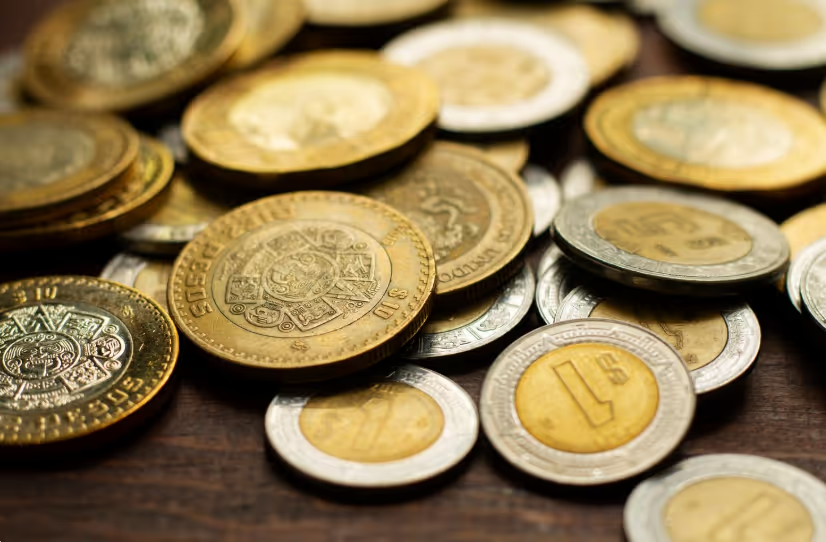
Long before Bulgaria prepared to place the euro in people’s pockets, the images chosen for its coins were already deeply familiar. They have lived for generations on the lev, the national currency introduced in 1881 and named after an old word meaning “lion.” By carrying these same symbols onto euro coins, Bulgaria signals continuity rather than change, a quiet statement that national identity does not disappear when a country joins a shared currency.
As Bulgaria steps into the eurozone, its coins tell a story carved in stone, shaped by faith, and preserved through centuries of resilience. Ancient rock art, a revered patron saint, and a monk whose words helped awaken a nation will soon circulate across Europe, turning everyday transactions into moments of cultural storytelling.
One of the most striking images is the Madara Rider, an extraordinary rock relief created in the early eighth century, during the formative years of the Bulgarian state. This powerful image appears on the one, two, five, ten, twenty, and fifty-cent euro coins, ensuring it will be the most widely seen Bulgarian symbol in the new currency set.
The Madara Rider depicts a mounted warrior triumphing over a lion, a scene that has fascinated historians and visitors for decades. Carved directly into a towering cliff near the village of Madara in northeastern Bulgaria, the relief is both monumental and mysterious. Unlike painted or portable art, it was shaped from the living rock itself, a bold declaration of permanence and authority. Scholars believe it commemorates military victory, statehood, and divine favor, themes that resonated deeply in a young medieval kingdom asserting its place in history.
Recognized globally for its cultural value, the Madara Rider has been listed as a UNESCO World Heritage site since 1979. Its presence on euro coins transforms an ancient monument into a modern emblem, bridging more than a millennium of Bulgarian history. Each coin quietly carries the message that Bulgaria’s roots run deep, even as it participates fully in a modern European framework.
While the cent coins honor strength and statehood, the one-euro coin shifts the focus to spirituality and moral legacy. It features Saint John of Rila, Bulgaria’s patron saint and one of the most revered figures in the country’s religious history. Living between the late ninth and mid-tenth centuries, John of Rila is remembered as a hermit who sought solitude in the mountains, far from power and privilege.
Legend describes him living in extreme simplicity, including a period spent sheltering inside the hollow of an ancient tree. His devotion and humility attracted followers, eventually leading to the founding of the Rila Monastery, which remains the largest and most important monastery in Bulgaria today. Over the centuries, it has served not only as a religious center but also as a refuge for Bulgarian language, culture, and identity during times of foreign rule.
By placing Saint John of Rila on the one-euro coin, Bulgaria highlights values that go beyond economics, faith, endurance, and spiritual independence. The image serves as a reminder that national character is shaped as much by moral figures as by military or political ones.
The two-euro coin continues this narrative of cultural awakening by honoring Paisius of Hilandar, a monk whose influence extended far beyond monastery walls. Living in the eighteenth century, Paisius was part of the Orthodox monastic community on Mount Athos, a spiritual center for Eastern Christianity. Yet his legacy lies not only in faith, but in words.
Paisius authored a seminal historical work that played a critical role in Bulgaria’s national revival. At a time when Bulgarian identity was under pressure and often overshadowed, his writing urged people to remember their history, language, and heroes. His work helped reignite a sense of national consciousness and pride, laying intellectual foundations for future movements toward independence and cultural renewal.
The two-euro coin bearing his likeness also carries a powerful inscription along its edge: “God protect Bulgaria.” This simple phrase blends faith and patriotism, echoing centuries of hope, struggle, and resilience. It transforms the coin into more than legal tender; it becomes a statement of collective memory and aspiration.
Together, these designs show that Bulgaria’s entry into the eurozone is not a cultural departure, but an expansion. The coins do not simply meet technical standards; they tell stories. They remind Europe that Bulgaria brings with it ancient art carved into cliffs, saints who shaped spiritual life, and thinkers who reignited national identity through words.
As these coins pass from hand to hand across borders, they carry fragments of Bulgaria’s past into everyday European life. In metal and inscription, Bulgaria asserts that while currencies may be shared, heritage remains proudly its own.
For questions or comments write to contactus@bostonbrandmedia.com
Source: NDTV



-v3.jpg)


-v3-02.jpg)