Stay informed with our newsletter.
.webp)


EN





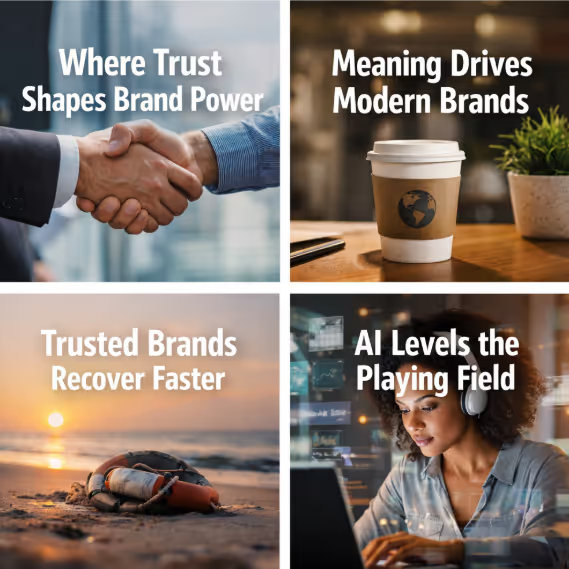
Branding in 2026 is defined by trust, meaning, and strategic differentiation as AI levels the marketing playing field. With automation standardizing execution, brands now compete on values, credibility, and consistency rather than mechanics. Consumers expect personalization, transparency in data use, and ethical behavior, while strong brands command higher price premiums and recover faster from crises. Branding has evolved into an enterprise-wide discipline shaping long-term growth, resilience, and legitimacy.
Branding has entered its most consequential era.
In 2026, the traditional advantages that once separated category leaders from emerging challengers have narrowed dramatically. Artificial intelligence has automated content creation, media buying, audience targeting, and performance optimization. Tools that were once expensive and exclusive are now widely accessible, reducing executional gaps across industries.
As a result, brand differentiation no longer depends on mechanics. It depends on meaning.
In an environment where almost any brand can sound polished, appear personalized, and reach its audience efficiently, the real question becomes: why should people trust you, choose you, and stay with you?
For decades, branding benefited from structural advantages. Larger budgets enabled superior production quality, broader media reach, and deeper consumer insights. In 2026, AI has flattened much of that terrain.
Small and mid-sized brands now deploy AI-driven personalization, predictive analytics, and automated creative at scale. Algorithms optimize messaging faster than human teams ever could. Efficiency is no longer a competitive edge, it is table stakes.
This shift has fundamentally changed what branding is responsible for. When everyone can execute well, execution alone stops being memorable. What remains is perception, belief, and emotional resonance.
Branding has moved from how you communicate to what you stand for and how consistently you act on it.
Consumer expectations in 2026 are both higher and less forgiving. Personalization is no longer impressive, it is assumed. Brands that fail to recognize individual preferences, behaviors, and contexts feel outdated or inattentive.
At the same time, audiences are far more aware of how personalization is achieved. Questions around data usage, AI ethics, surveillance, and manipulation are no longer niche concerns. Consumers increasingly scrutinize not just outcomes, but intent.
Several clear realities define the branding landscape today:
Inconsistent tone, values, or behavior across channels now signals a lack of integrity rather than a lack of coordination. In a multi-platform world, credibility is built through repetition and coherence.
In an algorithmic environment, trust has become the most valuable brand asset.
Multiple global studies consistently show that strong brands command price premiums of 10–20% compared to weaker competitors offering similar functional value. During periods of economic uncertainty or reputational risk, trusted brands recover faster and lose fewer customers.
Brand equity is also increasingly reflected in financial performance. Long-term shareholder value correlates strongly with brand strength, particularly in industries where products and services are easily substitutable.
Trust reduces friction. It shortens decision cycles, lowers acquisition costs, and increases lifetime value. In 2026, trust is not built through claims, it is built through predictable behavior over time.
One of the most important branding shifts in recent years is the decline of slogan-driven identity.
Audiences have become adept at detecting performative branding. Purpose statements unsupported by action are quickly dismissed. Values that appear only in campaigns but not in operations erode credibility rather than enhance it.
The strongest brands in 2026 communicate meaning through decisions, not declarations.
They demonstrate their values through how they treat customers, employees, partners, and communities. They make trade-offs that align with their stated principles, even when those choices are not immediately profitable.
Meaning, in this context, is not abstract. It is practical, visible, and reinforced across touchpoints.
AI has not diminished the importance of branding, it has heightened it.

As automation accelerates, branding becomes the human anchor in an increasingly synthetic environment. It is what signals judgment, empathy, and responsibility where algorithms cannot.
The most successful brands in 2026 use AI to enhance relevance, not replace human oversight. They combine data-driven precision with human context, ensuring that efficiency does not override sensitivity.
They understand that automation without judgment can amplify risk, while automation guided by values can scale trust.
Another defining tension in 2026 is the balance between innovation and continuity.
Consumers expect brands to evolve, but not to lose their identity in the process. Rapid shifts in tone, positioning, or purpose can create confusion, especially when driven by short-term trends rather than long-term strategy.
Strong brands manage change deliberately. They innovate within a clear framework, preserving recognizable elements while adapting to new behaviors and technologies.
Familiarity builds comfort. Innovation builds relevance. Sustainable branding requires both.
Perhaps the most significant shift of all is where branding now sits within organizations.
Brand strategy is no longer confined to marketing departments. It increasingly influences product design, customer experience, talent strategy, partnerships, governance, and crisis management.
In 2026, branding shapes how organizations are perceived not just by consumers, but by regulators, investors, employees, and society at large.
The brands that perform best over time treat reputation as an enterprise asset, not a campaign outcome. They invest in long-term credibility over short-term visibility. They recognize that trust, once lost, is expensive to rebuild and often impossible to fully restore.
Branding in 2026 is not about being louder, faster, or more optimized. It is about being clearer, more consistent, and more accountable.
In a world where algorithms level the playing field, meaning becomes the differentiator. Trust becomes the multiplier. And brand strategy becomes a core driver of growth, resilience, and legitimacy.
The brands that endure will not be the ones that chase attention, but the ones that earn belief.
For questions or comments write to contactus@bostonbrandmedia.com



-v3.jpg)


-v3-02.jpg)